The Foreleg of the Horse: On The Forehand
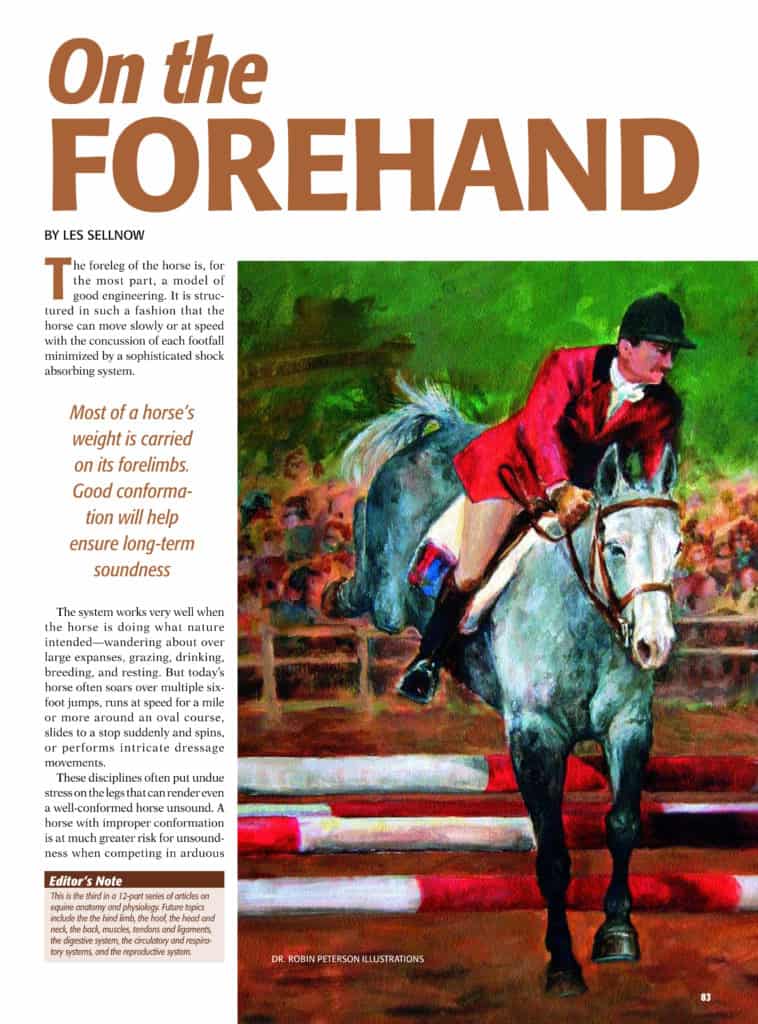
The foreleg of the horse is, for the most part, a model of good engineering. Most of a horse’s weight is carried on its forelimbs. Good conformation will help ensure long-term soundness.

The foreleg of the horse is, for the most part, a model of good engineering. Most of a horse’s weight is carried on its forelimbs. Good conformation will help ensure long-term soundness.

Learn how your horse’s anatomy works with our complete anatomy and physiology guide, including basic terminology, skin, forelimbs, hindlimbs, feet/hooves, head and neck, tendons/ligaments, muscles, digestive, cardiovascular and reproductive systems.
My 4-year-old Quarter Horse gelding does not like to bend his knees and hocks. He feels like he’s walking on stilts.
Back pain is often suspected in horses, but most treatments haven’t been researched much or at all. Results of a study designed to measure the effects of massage, chiropractic, and phenylbutazone (Bute) on back sensitivity were presented at the 200
Subluxation (partial dislocation) of the coxofemoral joint between the femur and pelvis in horses is rare; only two cases have been reported in the literature. However, six cases were seen at the University of California, Davis, in a three-year
The stifle joint is often implicated in cases of lameness, but it can be a notoriously tough joint to image. Radiography, ultrasonography, nuclear scintigraphy (bone scan), and diagnostic arthrography (joint evaluation) all can be used, but they
Measurement of osteocalcin (a marker of joint metabolism) in 2-week-old foals might be useful for identifying foals at risk for developing osteochondrosis.
Osteochondrosis (OC) is a developmental orthopedic disease that results from a
Take more than 1,000 veterinarians and veterinary students from around the globe, some armed with presentations representing thousands of hours worth of equine research, and add to it some tartan, bagpipes, and Scottish fare. Drop it all into a
Two veterinarians compiled the latest on equine orthopedic topics and presented it to their colleagues at the 46th British Equine Veterinary Association Congress, held in Edinburgh, Scotland
Each year at the British Equine Veterinary Association Congress (BEVA), the organization awards prizes to top student presentations in the clinical research portion of the program. The 2007 award winners? talks were both rooted in orthopedics,
My Thoroughbred’s stifles have been making a popping noise for quite some time.
Silicosis in horses is a respiratory condition caused by exposure to certain types of silicate dust found in some geographic regions. While silicosis is not a commonly diagnosed equine ailment in most areas of the country, Matthew Durham, DVM
My 17-year-old Half-Arabian gelding underwent colic surgery, recovered well, but his back has dropped.
I have a Trakehner/Thoroughbred cross that starts flexing his hind legs rather noticeably when trotting
Angular and flexural limb deformities in foals are concerns, to be sure, but they’re not necessarily kisses of death. At the recent Bluegrass Laminitis Symposium, Ric Redden, DVM, founder of the International Equine Podiatry Center in Versailles, Ky.
“Owners and trainers worldwide have the feeling that every veterinarian and every farrier have years of experience and vast knowledge about laminitis and podiatry (foot care). Unfortunately, this is not the case,” said Ric Redden, DVM, founder of