Latest News – The Horse
Hunter’s Bump
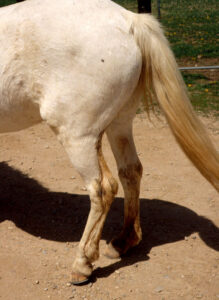
Named for the sport in which it often occurs, hunter’s (or jumper’s) bump is a sometimes painful pelvic condition that affects performance and gait.
Long-Eared Lovin’
Donkeys and mules have played, and continue to play, an important role on the equine stage. Mules in particular are used for everything from pleasure riding and packing to dressage, racing, and jumping. Donkeys are family pets in many instances and, of course, are a necessary ingredient in the production of mules. While there are some similarities between donkeys and horses, there also are
Training Young Athletes
It sounds completely backwards, the idea that you might actually increase health risks by postponing training and competition until a horse is four or older. It goes against the ages-old and widely held belief that you cause damage by initiating work before a horse’s skeleton matures. Yet research conducted from the 1980s through the present day has steadily been debunking the old theories,
Remaining Saddlebred Healing Well
Cats Don’t Dance, the remaining injured Saddlebred under treatment at Hagyard-Davidson-McGee (HDM) Associates in Lexington, Ky., is recovering well, according to his treating veterinarian. On Aug. 27 he was ready to return home shortly.
The 6-year-old gelding is one of five Saddlebreds which were maliciously injected in the back of their left front pasterns with a necrotizing substance
Third Mule Clone Born
The scientists who produced the world’s first equine clone announced that the third cloned mule foal was born about 1:30 a.m. on July 27.
The team includes Gordon Woods, DVM, MS, PhD, Dipl. ACT, and Dirk Vanderwall, DVM, PhD, Dipl. ACT, both University of Idaho professors of animal and veterinary science; and Ken White, PhD, a professor in Utah State University’s Animal, Dairy and
The World’s First Cloned Horse
The world’s first cloned horse, created by Italian scientists from a mare’s skin cell, has been born, according to a Washington Post article.
The birth of the healthy foal, announced in the Aug. 7 issue of the journal Nature, brings to nine the number of mammalian species that scientists have cloned from adult cells, along with sheep, mice, rabbits, goats, cats, pigs,
Parelli Natural Horsemanship University is Country’s First Approved Private Vocational School of Its Kind
Approval of the Parelli Natural Horsemanship University in late June as a private occupational school by the Colorado Department of Higher Education distinguished Parelli Natural Horse-Man-Ship (PNH) as the first such institution in the country to do so, according to Neil Pye, dean of instructors and of the group’s international study centers. Key to the unanimous approval given by Colorado’s
New Tufts Veterinary Conference
The inaugural “Bridge to the Future” veterinary conference, hosted by Tufts University School of Veterinary Medicine, was held in Providence, RI, on Aug. 10-11. This year’s speakers included Mary Rose Paradis, DVM, MS, Dipl. ACVIM, associate professor of large animal medicine at Tufts, who spoke about geriatric horses and ponies. Paradis discussed the results of a recent study designed to
First Case of Anthrax in 2003
Texas officials have detected the state’s first case of anthrax for 2003 in a white-tailed deer near Del Rio. “It’s not unusual to have a few cases of anthrax in livestock or deer each year in Texas,” said Bob Hillman, DVM, state veterinarian and executive director for the Texas Animal Health Commission (TAHC), the state’s livestock health regulatory agency.
Anthrax naturally occurs in
Potomac Horse Fever in Oklahoma
The death of at least one Oklahoma horse has been definitively linked to Potomac horse fever (PHF), a disease rarely found in the state. Two of her stablemates likely died of the same illness. The horse manager at the farm with the confirmed case said 11 other horses in the area have died with similar clinical signs, but blood and tissue samples from those horses were not submitted for
Death of a Derby Winner
The Blood-Horse magazine reported that 1986 Kentucky Derby winner Ferdinand died sometime in 2002. He likely met his end in a slaughterhouse in Japan, where his career at stud was unsuccessful.
Ferdinand earned nearly $4 million, retiring as what was then the fifth-leading money winner of all time. He was retired to stud in 1989 at Claiborne Farm near Paris, Ky. After a brief,
Hurricane Isabel’s Impact on Virginia
Hurricane Isabel hit the Virginia coast with fury on Sept. 18. At its peak over the Atlantic, Isabel was a Category 5 hurricane (winds greater than 155 mph), sending coastal horse owners scrambling for safe shelter for themselves and their animals. When the storm hit land, it had faded to a Category 2 hurricane (winds from 96-110 mph and storm surges of six to eight feet), then dropped to a
Gary’s Good Grub: New Orleans Edition
For those of you attending the 2003 AAEP Convention or Horseman’s Day in New Orleans, La., the end of November, we asked Gary Norwood, DVM, a local racetrack practitioner, to help us put together a list of the best eating places in the city.
Horse Beaten With Shovel
A horse in Harnett County, N.C., is recovering after allegedly being beaten with a shovel, according to news stories on the Dunn’s online edition of The Daily Record. Local horse trainer Michael Joseph Nugent, 26, of Anderson Creek, is accused of abusing the horse, and felony charges are pending.
Nugent was found guilty of misdemeanor cruelty to animals in Lillington District
Potential Police Mounts Wanted in the United Kingdom
The West Yorkshire Police in the United Kingdom have made a public appeal for new horses for the unit, according to a report in the online edition of Horse and Hound. This is the third time the force has requested “gift” horses, and this request follows budget cuts and a number of retirements of police mounts.
West Yorkshire Police horses are used for high-visibility patrols,
AAEP Publishes Vesicular Stomatitis Brochure
The American Association of Equine Practitioners (AAEP) recently released a brochure about vesicular stomatitis (VS) for the horse owner. VS is a contagious disease that afflicts horses, livestock, wildlife, and humans. Although the virus that causes VS is rarely life-threatening, it can have a significant financial impact on the horse industry because symptoms resemble those of foot-and-mout