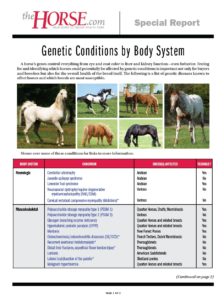
Genetic Conditions by Body System
Testing for and identifying which horses could potentially be affected by genetic conditions is important not only for buyers and breeders but also for the overall health of the breed itself.

Study: Cortisol and Noncribbing Cribbers
When cribbers did not crib, their salivary cortisol levels were up to 38% higher than those of horses that don’t crib.
EPM’s Lesser-Known Cause: N. hughesi
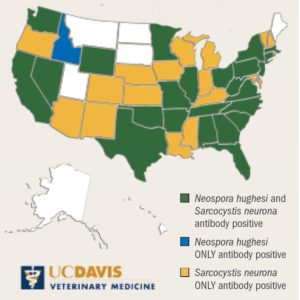
Researchers are studying the epidemiology of Neospora hughesi in horses with equine protozoal myeloencephalitis (EPM).

Poll Recap: Selling Rescue Horses
Of the 1,183 respondents, 889 (75%) said yes, it is appropriate to sell or charge a rehoming fee for a rescued horse.
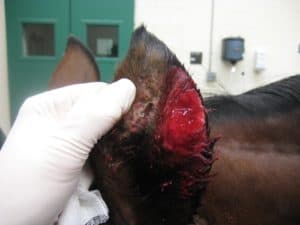
Equine Cutaneous Leishmaniasis Reviewed
In horses, leishmaniasis presents as nodules on the head, pinnae, scrotum, legs, and neck–the areas where sand flies commonly feed. These nodules can occur in groups or be solitary, and they often ulcerate.
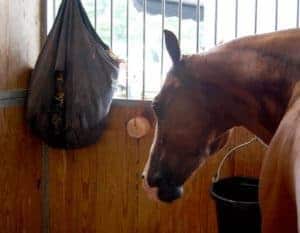
Is Himalayan Salt Better than Regular Salt for Horses?
Learn if extra money spent on a Himalayan salt block is a good investment.
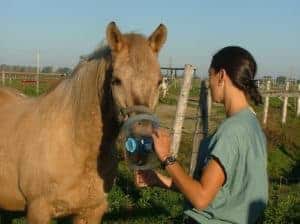
Choosing Corticosteroids for RAO: Systemic or Inhaled?
Which option is better? Study results suggest it depends on the horse and the severity of his condition.
What is Equine Pythiosis?
Learn about pythiosis, a disease characterized by ulcerative, granulomatous lesions on and beneath horses’ skin.

How Do Horses Get EPM?
Find out the most common way horses contract equine protozoal myeloencephalitis, or EPM.

Surgical Procedure Helps Horses with Nasopharyngeal Collapse
Researchers tested the technique on horses with poor performance and respiratory noise.
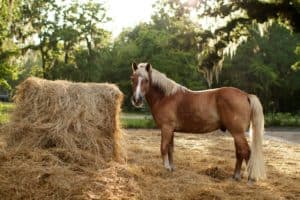
Current Thoughts on the Significance of Mycotoxins
Mycotoxins are harmful compounds that specific molds and fungi produce in soils, grains, and forages when moisture levels permit.
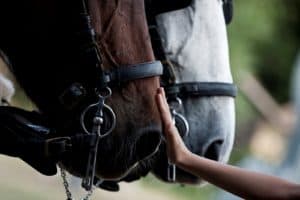
Biosecurity Tip of the Month: Horse Show and Event Visitors
Most equine events happily welcome spectators. But these individuals can pose a unique equine health threat of which horse owners should be aware. Learn how to protect your horse.

Strengths and Limitations of Equine Stress Measurements
Measuring equine stress isn’t as easy as it might sound, one researcher said. Here’s a review of the current techniques.
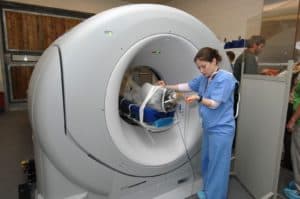
State-of-the-Art Imaging Techniques Reviewed
Learn how computed tomography (CT), MRI, and nuclear scintigraphy can help vets diagnose issues within horses’ bodies.
Montana Hunters Reminded to Have Horses Inspected
The inspection is good for a year of movement, or owners can obtain an inspection good for the life of the horse.

How Do Muzzles Impact Horses’ Grass Selection and Intake?
Researchers found the muzzles reduced horses’ grass consumption by 30% but did not impact the animals’ forage choice.