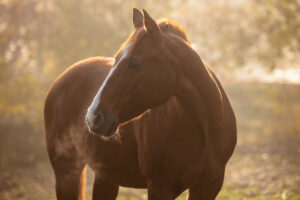
Diet: When Horses Need Less Carbs
What the research findings suggest is that young, growing foals, horses that are prone to tying-up or laminitis, those with Cushing’s disease, and some that tend to be excessively ‘hot’ mannered could possibly be managed better on low-glycemic diets.
Pest Control: The Death Squad
When it comes to pest control products, the safest choices lie with EPA-approved chemical formulations developed for horse use, such as DEET, pyrethrins/pyrethroids, and organophosphates, or the EPA GRAS (“generally regarded as safe”) products like citronella and geraniol.
Ivermectin Resistance in Foals
On many breeding farms, Parascaris equorum (roundworms) and other intestinal parasites in young foals are now controlled with one class of dewormer. This has become common because of the belief that certain drugs, like ivermectin, are highly effective and free from parasite resistance. However, a recent report from Ontario, Canada, describes foals from a breeding farm with fecal egg
Miniature Horses’ Eyes
It is tempting for veterinarians to use laboratory reference ranges collected from full-sized horses when treating miniature horses. This is not always appropriate, however, as miniature horses have some breed characteristics that are only now becoming apparent. In fact, researchers at Michigan State University (MSU) have been diagnosing ocular abnormalities in miniature horses more frequentl

Ready for Retirement?
Horses certainly are not immune to the physical problems associated with geriatric living. As the average lifespan for a horse increases, how do we make retired life as comfortable as possible for our faithful friends?

What’s Wobbler Syndrome?
Wobbler, also known as wobbles, takes its name from its primary sign–a wobbling or uncoordinated gait. In technical terms, the horse has a “proprioceptiveness deficit,” or a lack of physical awareness of his limbs and their placement.
Captive Bolt Controversy
No matter your position on equine slaughter, there is a question in the minds of horse owners of whether a penetrating captive bolt is a “humane” form of euthanasia for horses. Many individuals and groups are dismissing captive bolt as inhumane, even if they have not researched the method, have not discussed it with someone knowledgeable in equine euthanasia, or haven’t witnessed it first-han
West Nile Virus–An Evolving Epizootic
“West Nile virus (WNV) is coming to a state near you if it hasn’t already arrived,” said Eileen Ostlund, DVM, PhD, head of the equine/ovine viruses section at the Diagnostic Virology Laboratory, National Veterinary Services Laboratories in Ames, Iowa, during the Western Veterinary Conference held Feb. 15-19 in Las Vegas, Nev. In a comprehensive overview of WNV’s activity in the United States
West Nile Virus Questions and Answers
In a question and answer session at the Western Veterinary Conference, Eileen Ostlund, DVM, PhD, head of the equine and ovine viruses section at the Diagnostic Virology Laboratory, National Veterinary Services Laboratories in Ames, Iowa, offered these answers to the audience’s West Nile virus questions.
Q. Can you use Merial’s recombinant canarypox vaccine to booster horses after
Texas Horse Owners Aware of WNV Threat
Reports have surfaced that horse owners in Texas are becoming complacent and have backed off vaccinating their animals for West Nile virus (WNV), which has infected nearly 2,400 horses in the state since late 2002. Angela Pelzel, DVM, an epidemiologist with the Texas Animal Health Commission (TAHC), reported that she doesn’t believe that is the case–Texas horse owners have not grown
Research Foundation Announces 2004 Grants
The Grayson-Jockey Club Research Foundation (GJCRF) has announced $850,888 in funding for 20 projects in 2004, which will be distributed to investigating scientists at a dozen universities. This brings the GJCRF’s total funding since 1983 to $11,047,105 to underwrite 189 projects at 31 universities.
The 2004 research includes the launch of 11 new projects and the continuation of nine
Neurologic EHV-1 Case Confirmed at University of Wisconsin
The Hoofer Equestrian Center (HEC) at the University of Wisconsin, Madison (UWM), voluntarily quarantined its lower barn on Feb. 8 after two horses housed there showed neurologic signs of equine herpesvirus-1 (EHV-1). Both horses were later
Old Horse Care and Feeding
Of the 5.32 million horses and ponies in the United States, 400,000 (over 7.5%) are 20 years or older and considered geriatric, according to Frank Andrews, DVM, MS, Dipl. ACVIM. About 50 horse owners convened at the University of Tennessee’s (UT) College of Veterinary Medicine on Jan. 31, 2004, to attend a seminar highlighting techniques for managing older horses.
Loss of muscle mass,
AQHA Equine Public Service Award
The American Quarter Horse Association (AQHA) is accepting applications for its annual Equine Public Service Award until May 1. The award recognizes American Quarter Horses which are specifically used in the public service sector, including, but not limited to, police horses, park and mounted rangers, beach patrol, Royal Canadian Mounted Police, border patrol, and sheriff’s posse.
The
Shipping of In-Foal PMU Mares on Hold
The shipment of PMU (pregnant mare urine) mares from farms in the United States and Canada was put on hold in February until after the foaling season, unless the shipping distance is very short.
The reason, says Nat Messer IV, DVM, Dipl. ABVP, associate professor at the University of Missouri, and a member of an advisory board created by Wyeth Industries in Brandon, Manitoba, is because
Illinois Slaughter Legislation
New legislation to ban the slaughter of horses for human consumption in the state of Illinois was introduced Feb. 6, 2004, in the Illinois House of Representatives in the form of HB 6570. On Feb. 18, 2004, the bill was referred to the House Executive Committee. The legislation would also make it illegal to transport horses into or out of the state for slaughter.
The wording of the newly