Neurologic Filly at Laurel Park Euthanized; Additional Tests Negative
The Maryland Department of Agriculture (MDA) reported today that no horses in Laurel Park’s Barn 1, where the filly positive for neurologic equine herpesvirus-1 (EHV-1) wa
The Maryland Jockey Club today announced that no horses will be allowed to ship into Laurel Park, except those coming from the Bowie Training Center on a Maryland Jockey Club shuttle, until further notice. The limitations were instituted after a
The Maryland Department of Agriculture (MDA) has reported that blood and nasal swab samples from a 2-year old filly in Laurel Park’s Barn 1 have been confirmed positive for neurologic equine herpesvirus type-1 (EHV-1) through testing performed a
The Maryland Department of Agriculture (MDA) confirmed today that a 2-year old filly stabled in Barn 1 at Laurel Park has tested presumptive positive for equine herpesvirus type-1 (EHV-1). Results of confirmatory testing from the University of

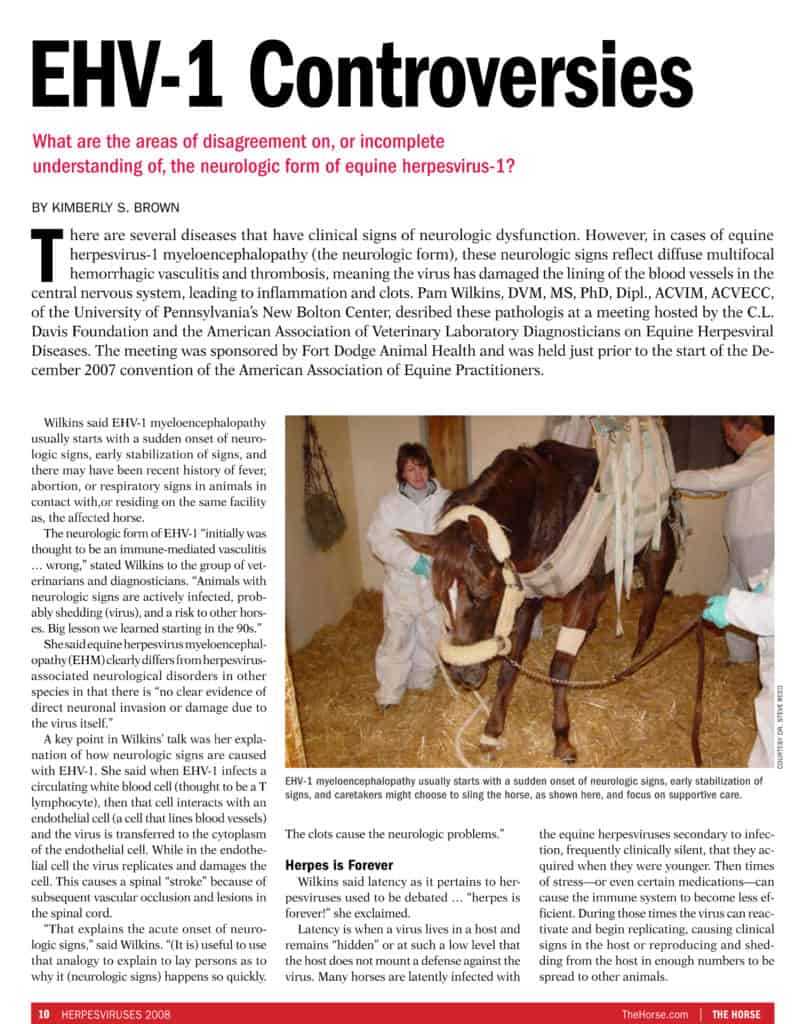
One of the biggest debates about equine herpesvirus meyloencephalopathy (the neurologic form of EHV-1) is whether there is a single mutant strain in circulation that causes EHM. We will discuss the roles of pathogenesis, prevention and protection.

A day-long seminar in 2007 on equine herpesviruses started with an overview of herpesvirus infections in horses. Equine herpesviruses are found all over the world, and there are nine equine herpesviruses identified at this time.

Pam Wilkins, DVM, MS, PhD, Dipl. ACVIM, ACVECC, of the University of Pennsylvania’s New Bolton Center, discussed several poorly understood aspects of equine herpesvirus-1 infection (such as latency, vaccination, treatment, and outbreak control) at a 2007 meeting.

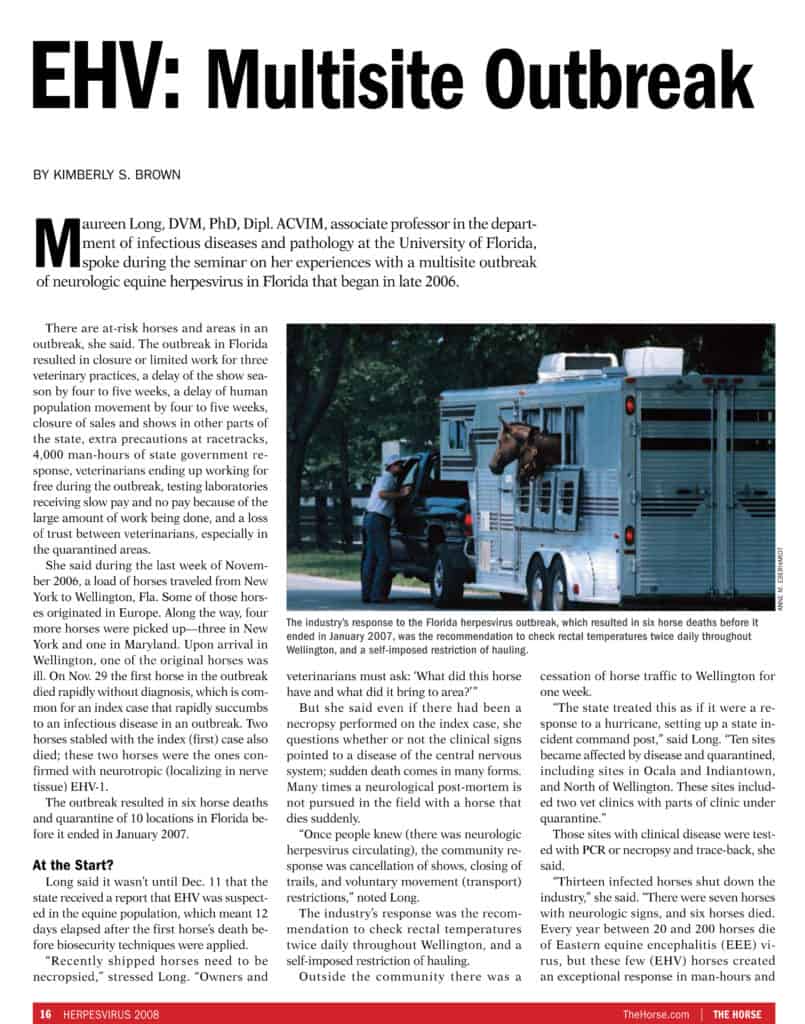
At a 2007 seminar on equine herpesvirus, Maureen Long, DVM, PhD, Dipl. ACVIM, associate professor in the department of infectious diseases and pathology at the University of Florida, discussed her experiences with a multi-site outbreak of neurologic equine herpesvirus in Florida that began in late 2006.

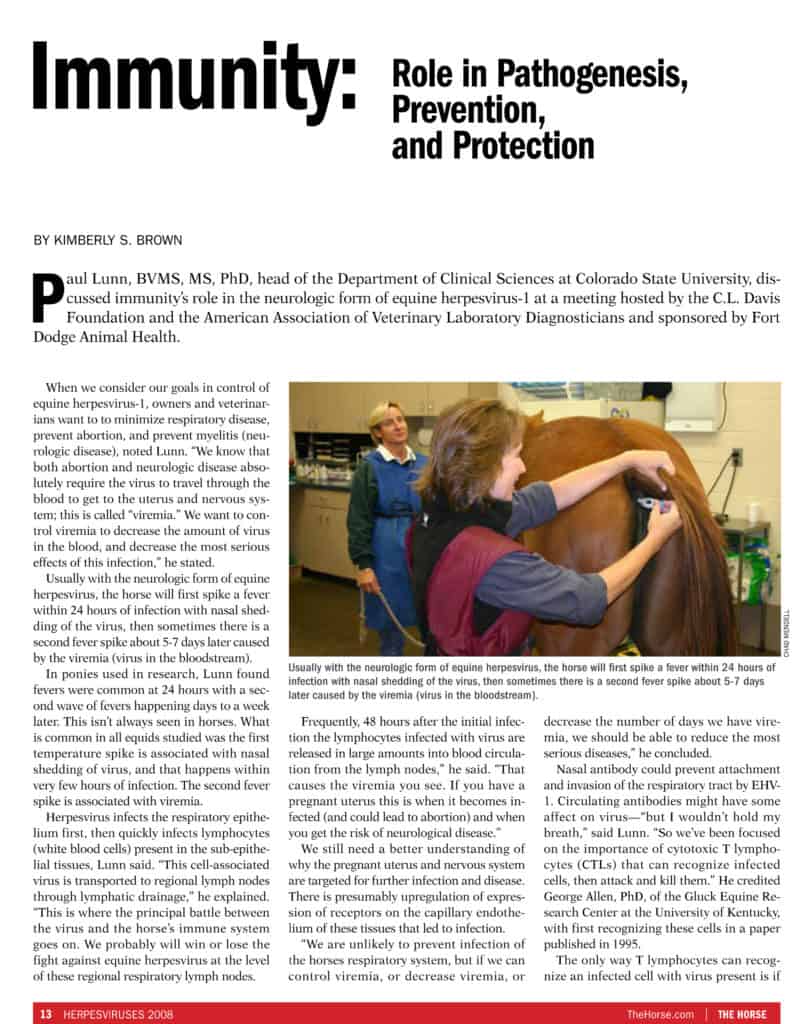
Dr. Paul Lunn discusses immunity’s role in the neurologic form of equine herpesvirus-1 at a 2007 meeting hosted by the C.L. Davis Foundation and the American Association of Veterinary Laboratory Diagnosticians.
Despite being a relatively rare disease in horses, the neurologic form of equine herpesvirus-1 (EHV-1 myeloencephalopathy, EHM) continues to cause outbreaks of disease that result in devastating losses, both emotional and economic, to the equine
What do nutritional supplements, infectious diseases, and snake bites have in common? All were considered “hot
Smell My Carrots, a 3-year-old New York-bred maiden gelding, was euthanized Saturday Sept. 6 after being found in his stall in Belmont Park?s Barn 38 with a fever and unable to stand, according to New York Racing Association?s Chief Examining
Oklahoma researchers interested in limiting equine herpesvirus (EHV) disease outbreaks have established specific dosing recommendations for the antiviral agent valacyclovir. The drug appears to be effective in preventing or minimizing clinical
The monitoring of abortions attributable to equine herpesvirus-1 (EHV-1) initiated in 1957 among the Thoroughbred mare population of Central Kentucky has continued annually for the past 51 years. The number of EHV-1 abortions per 1,000 pregnant
In 1968 the U.S. Surgeon General proclaimed that the war on infectious diseases had been won. Unfortunately, this statement was not true. Ongoing outbreaks of disease in humans and animals worldwide have established repeatedly that the war on
IDEXX Reference Laboratories has introduced two new diagnostic products to help equine veterinarians diagnose equine respiratory disease and neurologic disease. The new tests include an equine herpesvirus type-4 (EHV-4) RealPCR Test
Stay on top of the most recent Horse Health news with
"*" indicates required fields