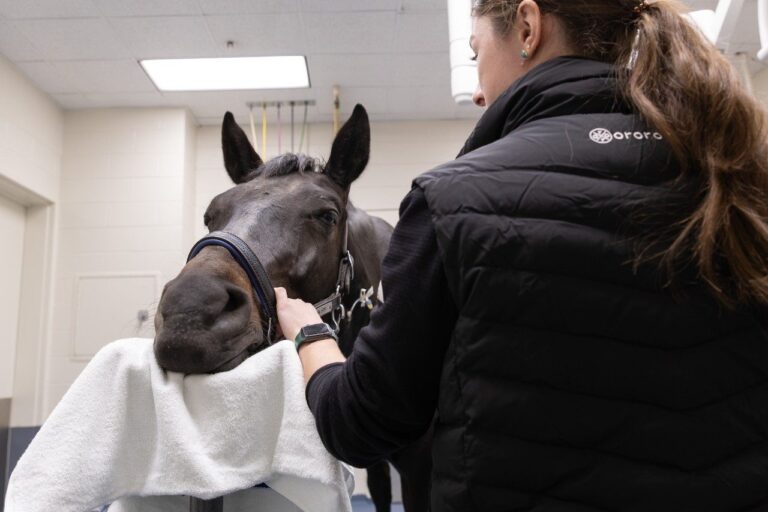
Meeting Shows Deep Divide Over Salix Use in Thoroughbreds
There is a decided split between trainers and breeders on the issue of race day furosemide in Thoroughbreds.

There is a decided split between trainers and breeders on the issue of race day furosemide in Thoroughbreds.
The meeting began with several presentations on furosemide and EIPH, the condition the medication treats.
The Race Day Medication Committee is debating whether therapeutic medications such as Salix should be banned.
The Rutgers ESC has added a virtual tour of their exercise physiology laboratory to their website.
The new regulations were prompted by increased use of the substance as a replacement for anabolic steroids.
Researchers review the characteristics and impact of epiglottic abnormalities in nonracehorses.
The recording of our Ask the Vet LIVE Q&A event on Avoiding Respiratory Problems in the Barn is now online!

A number of air quality factors in barns can make it harder for your horse to breathe, compromising his health and performance.
When a horse needs surgery, what’s his prognosis for a full recovery? What problems can occur during recovery?
Tune in on September 1 for an Ask the Vet LIVE online Q&A about Avoiding Respiratory Problems in the Barn.

Mapping airborne particles in horse barns could help minimize the risk and/or prevalence of airway disease.
Thoroughbred horsemen’s groups are drawing a line in the sand when it comes to the anti-bleeding drug Salix.
A KHRC advisory panel approved a recommendation to prohibit the race day use of adjunct bleeder medications.
The Jockey Club reiterated its calls for a ban of Salix but made it clear it wants medication-free racing.
BloodHorse.com’s Jason Shandler caught up with Mike Repole to get his opinion on the current Salix debate.
The AGSC will employ a program banning race-day medications in graded 2-year-old Thoroughbred stakes races.