New Bolton Center, TERF Announce Scholarships Awards
Two Penn Vet students received scholarships from the Thoroughbred Education and Research Foundation (TERF).

Two Penn Vet students received scholarships from the Thoroughbred Education and Research Foundation (TERF).

The simulator is designed to let veterinary students master injection skills before working with a live horse.
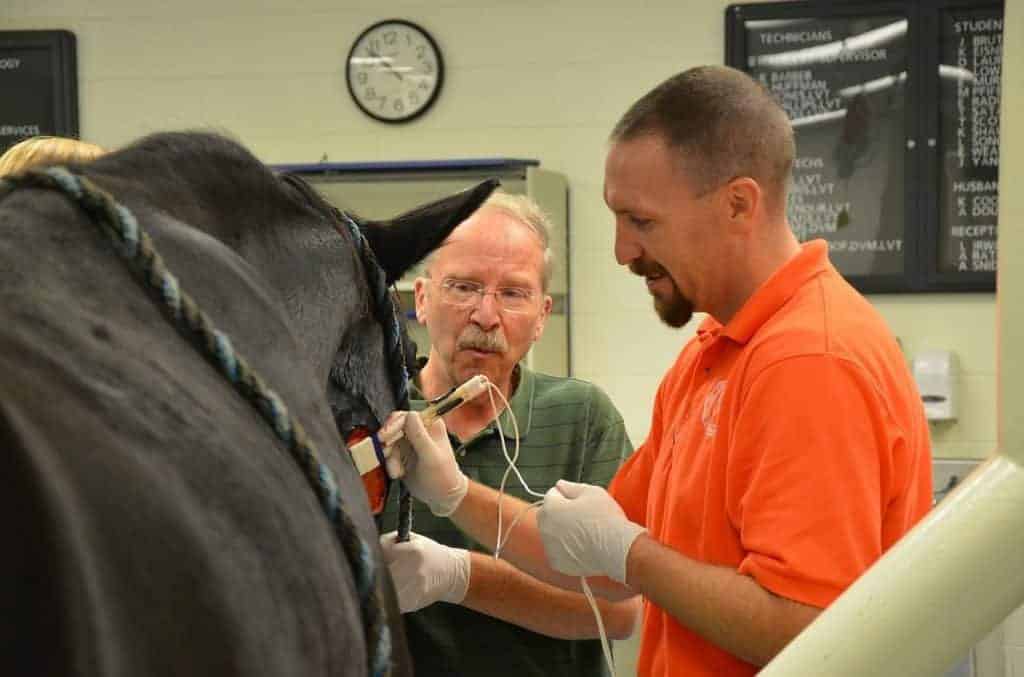
The treatment, called H-FIRE, delivers a short burst of electricity into specific places in the tumor.

One researcher says it’s unlikely that every obese horse is at risk of developing EMS and laminitis.

Dr. Amy Johnson explains the grain test she uses to test whether or not horses have botulism.

The risk factors associated with laminitis are many. But which are most important for owners to watch for?

The system is designed to allow radiation oncologists to deliver powerful treatments with pinpoint accuracy.

The National Animal Health Monitoring System (NAHMS) is planning for its third national equine industry study.

Learn about equine intra-articular joint-injections for arthritis from a leading researcher and practitioner.

Researchers identified a number of novel laminitis risk factors, including management-level factors.

For years three major parts of Phar Lap’s body have been housed in pieces at three museums in two countries.
Jackson received the award for her support of numerous equine performance-related research studies.
More than 500 attendees from 49 countries attended the 2013 WEVA Congress, held in Budapest, Oct. 3-5.
Aleman is now dual board certified in large animal internal medicine and neurology.
The $45,000 contribution from Lloyd’s supports the Equine Disease Quarterly.

The simulator allows students practice joint injections before trying their hands at injecting a live horse.