Christa Lesté-Lasserre, MA

Passionate about horses and science from the time she was riding her first Shetland Pony in Texas, Christa Lesté-Lasserre writes about scientific research that contributes to a better understanding of all equids. After undergrad studies in science, journalism, and literature, she received a master’s degree in creative writing. Now based in France, she aims to present the most fascinating aspect of equine science: the story it creates. Follow Lesté-Lasserre on Twitter @christalestelas.

Articles by: Christa Lesté-Lasserre, MA

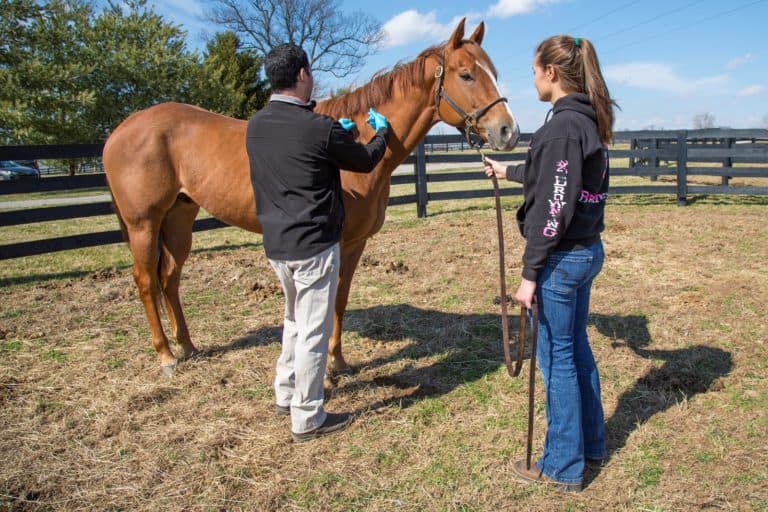
Training: Food Rewards Are More Effective Than Physical Contact

Everybody loves a good back scratch, including your horse, right? Scratching of the withers has been scientifically proven to reduce a horse’s heart rate, but a good scratch might not be enough to communicate to your horse that you’re happy with what he’s just learned and that you want him to do it again next time. According to new research by French equitation scienti
Read More

Seeking Solutions to Separation Anxiety

When teaching young horses to accept separation from their pasturemates, it might seem like a good idea to train them in pairs first for a while before training them alone. However, new equitation science research suggests that pairing them up might just delay the anxiety of separation and, in the end, the results of this method don’t differ much from those of immediate individual separation.

Read More

NSAIDs Congress Exposes Benefits and Risks, Focuses on Horse Welfare

Scientific, legal, and ethical points of view on non-steroidal anti-inflammatory drug (NSAID) use in competition horses continued to stream Switzerland’s air even at the close of the two-day NSAIDs congress, hosted by the Fédération Equestre Internationale (FEI) in Lausanne. Although no consensus was reached,

Read More

Bilateral Training Improves Performance, Welfare, Researchers Say

Congratulations, your horse has learned a new trick! Now, start all over again–this time on the other side. That’s right; it turns out if you want your horse to learn a trick or skill correctly, you’re probably going to have to teach with cues that are visible to the horse from both sides of his head. According to new equitation science research, what a horse learns on hi

Read More

FEI NSAID Congress Convenes in Switzerland

The future of non-steroidal anti-inflammatory (NSAID) use in international equestrian competitions is currently under open debate in an unprecedented two-day congress hosted by the Fédération Equestre Internationale (FEI) in Lausanne, Switzerland. This “long-awaited” event on Aug. 16 and 17 provides a forum for an organized and scientifically informed debat

Read More

Smaller Endoscopes Lead to Less Invasive Navicular Treatment

A novel twist to an existing surgical procedure is creating new opportunities for healing a long-recognized form of lameness, according to Italian researchers. Palmar foot pain (a modern term for navicular syndrome) cases are now being treated with e

Read More

Study: Rein Tension Varies Between Riders, Affects Horses’ Gaits

You know what it means to apply light contact with the bit, but have you ever wondered if your interpretation is the same as other riders’? And how strong is “strong contact,” exactly? What kinds of effects do these different hand movements have on your horse–particularly his stride? These questions are what a couple of England-based equitation science researchers

Read More

Spatial Reasoning and Laterality Affect Riding Horses’ Behavior

“Can’t go over it, can’t go under it, have to go around it.” No, your horse isn’t on a bear hunt; he’s on a bucket hunt, trying to reach his food around an experimental barrier. Italian equitation science researchers set up this obstacle game to see how horses respond to the next question: “Around it, yeah, but which way?” Whether horses go right

Read More

New Foal Immunity Research Brings Hope for Improved Prevention Methods

A foal’s immune system is known to be weak and immature, but new cell-based research suggests that “immunodeficiency” might be too broad a term to define the disease-fighting capacity of the youngest horses. The research is overturning old theories about foal immunity, which could soon lead to improved disease prevention methods and more effective treatments for sick

Read More

Once-Paralyzed Foal Now Walking Freely

Vitelle, the once-paralyzed filly, is finally walking, trotting, and cantering without a walker at the farm in Belgium she left more than a year ago. In June 2009, at 3 weeks old, the Boulonnais Draft horse foal developed sudden paralysis and urinary incontinence. Three days later she underwent a groundbreaking surgical laminectomy at a Belgian veterinary school to remove a cyst from her spinal co

Read More

Equitation Science Symposium Emphasizes Horse Welfare and Human Safety

Rein tension, saddle and seat pressure, training rewards and reinforcement, and the evaluation of stress and emotions in riding horses were some of the main topics at this year’s International Equitation Science Symposium held July 31–Aug. 2 in Uppsala and Strömsholm, Sweden. With the theme “Horse welfare and human safety: importance of learning, training, and

Read More

FEI Athletes Receive Anti-Doping Regulation Training

With the adoption of the new Equine Anti-Doping and Controlled Medication Regulations (EADCMR), effective since April 2010, the Fédération Equestre Internationale (FEI) has reinforced the concept of the Person Responsible in doping cases. The recent doping case of German rider Marco Kutscher, who was tri

Read More

Morrissey Disqualified, Ground Jury Reprimanded in Excessive Whipping Incident

Alltech FEI World Equestrian Games (WEG) show jumping horse candidate Crelido, ridden by Michael Morrissey (USA), was abused during a WEG-qualifying event when he was “excessively whipped,” and Morrissey has hence been disqualified, according to the statement of the final decision of the Fédération Equestre Internationale (FEI) Tribunal.

Read More

FEI Hypersensitivity Protocol Refined Following Sapphire Decisions

Less than a week after the resolution of the legal dispute concerning World Cup mount Sapphire, ridden by McLain Ward (USA), new international guidelines for the evaluation of hypersensitivity have been issued, according to the Fédération Equestre Internationale (FEI). “Following the Sapphire disqualification and the legal challenge, the FEI examined carefully t

Read More

Equitarianism Brings Veterinary and Farrier Care to Dominican Republic Equids

Through literally hundreds of vaccinations and dewormings, 60 surgeries, nutrition training, and a nationwide farrier clinic, all from June 6-13, the Dominican Republic’s horses, donkeys, and mules are once again benefiting from a new concept known as “equitarianism.”

The equitarian effort, headed by Jay Merriam, DVM, MS, of the Massachusetts Equine Clinic in conjunc

Read More

FEI: Kutscher ‘Person Responsible’ for Doping at 2008 Olympics

Two-time Olympian Marco Kutscher might not have known his horse Cornet Obolensky received injections of a prohibited substance during the 2008 Olympic Games in Beijing, but the German equestrian was still named the “primary person responsible” and, thus, negligent, according to the decision of the Tribunal of the Fédération Equestre Internationale (FEI).

Read More

More From The Horse

bay horse lying down in sandy paddock
How Veterinarians Evaluate Horses With Laminitis
North Carolina Owners: Vaccinate Horses Against Rabies
Horse with lots of fly in face

Stay on top of the most recent Horse Health news with

FREE weekly newsletters from TheHorse.com

Sponsored Content

Weekly Poll

sponsored by:

Readers’ Most Popular

The Horse
Privacy Overview

This website uses cookies so that we can provide you with the best user experience possible. Cookie information is stored in your browser and performs functions such as recognising you when you return to our website and helping our team to understand which sections of the website you find most interesting and useful.