Stephanie L. Church, Editorial Director

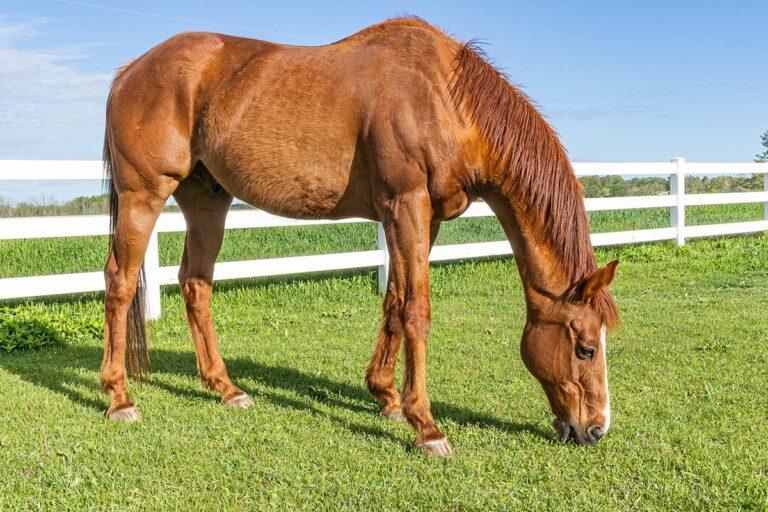
Stephanie L. Church, editorial director for The Horse and Stable Management, grew up riding and caring for her family’s horses in Central Virginia and received a B.A. in journalism and equestrian studies from Averett University. She joined The Horse in 1999 and has led the editorial team since 2010. A 4-H and Pony Club graduate, she enjoys dressage, eventing, and trail riding. Her heart horse, It Happened Again (“Happy,” pictured), a former graded-stakes-winning Thoroughbred gelding, was her longtime mount and remains a lasting inspiration. She now has an 8-year-old off-track Thoroughbred, Dune of Pilat (“Dune”), and is enjoying building a partnership with him. Stephanie is based in Lexington, Kentucky.

Articles by: Stephanie L. Church, Editorial Director

Rhodococcus Equi Pneumonia Linked to Large Farms, Lots of Horses

Farms with large acreage and many mares and foals are more likely to have cases of Rhodococcus equi foal pneumonia than smaller farms with fewer horses, according to a recently published Texas A&M University (TAMU) study. Additionally, farms that are intensively managed and use what are considered desirable practices to prevent disease are more likely to have R. equi cases.

Read More

American Horse Cloning Project Successful

America’s first cloned horse turned six weeks old today, according to Texas A&M University (TAMU) researchers who partnered on the successful cloning venture with French scientist Dr. Eric Palmer of Cryozootech.

Read More

Assess Heel Lacerations Early for Best Recovery

“A simple heel bulb laceration may look like a regular ‘nothing’ cut, but it could be life-threatening if it’s in the coffin joint, so you need to get it evaluated right away,” said Robin M. Dabareiner, DVM, PhD, Dipl. ACVS, while describing a

Read More

Twelve Years of EPM Research: Are We Any Smarter?

“I think every time we find out something about EPM (equine protozoal myeloencephalitis), it turns up more questions,” said Bill Saville, DVM, PhD, Dipl. ACVIM, an associate professor in the Department of Veterinary Preventive Medicine at The

Read More

African Horse Sickness Cases in South Africa

At least six African horse sickness (AHS) cases have been logged recently in the Eastern and Western Capes of South Africa, according to ProMED web site posts in early April. Last week, South African media outlets reported an outbreak of the

Read More

Joint Cartilage Adaptation in Young Horses

It is widely believed that exercise and limb-loading in foals help joint cartilage functionally adapt to the rigors of athletic activity. In 2005, Dutch researchers set out to find out if they could verify the concept of functional adaptation of

Read More

Additional Horse at Maryland Farm Shows Signs of EHV-1

(edited from press release)


Facility managers who are handling a neurologic equine herpesvirus type-1 (EHV-1) incident at a Columbia, Md. horse stable (Columbia Horse Center, CHC; read archived stories) reported April 7 that an

Read More

Neurologic Herpesvirus in Canada and Pennsylvania

The neurologic form of equine herpesvirus type-1 (EHV-1) has been detected in horses in two additional areas of North America–Nova Scotia, Canada, and Meadowlands, Pa. At least four affected horses were put down (three in Canada and one in

Read More

Strangles Guidelines Released to the Public

In 2005, the American College of Veterinary Internal Medicine (ACVIM) released its consensus statement on guidelines for treatment, control, and prevention of strangles, which is caused by Streptococcus equi. The 12-page paper took a year

Read More

Saddlebred to be Reburied at Kentucky Horse Park

The body of champion Saddlebred Wild Eyed and Wicked will be re-interred at the Kentucky Horse Park in Lexington after forensic study.

Wicked, a two-time winner of the Saddlebred Triple Crown, was one of five Saddlebreds that were injected

Read More

Pneumonia Linked to Large Farms, Lots of Horses

Farms with large acreage and many mares and foals are more likely to have cases of R. equi foal pneumonia than smaller farms with fewer horses, according to a recently published Texas A&M University (TAMU) study. Additionally, farms

Read More

Filly Helped by “Equine Walker” Recovering Nicely

An “equine walker” that was designed and built in 24 hours by a caring veterinarian and a skilled blacksmith has successfully assisted a severely malnourished filly to recovery. The filly is walking on her own and recovering remarkably, says Roger Murphy, DVM, of Lexington Ky.

Read More

More From The Horse

electrolytes for horses; Why Do Electrolytes Encourage Horses to Drink?
spring pasture, turnout tips, horse turn out, horse in pasture, grazing, spring, spring turnout
Horses in their stable
What's New With Weaning?

Stay on top of the most recent Horse Health news with

FREE weekly newsletters from TheHorse.com

Sponsored Content

Weekly Poll

sponsored by:

How often do you apply fly spray to your horse during peak fly season?
176 votes · 176 answers

Readers’ Most Popular

The Horse
Privacy Overview

This website uses cookies so that we can provide you with the best user experience possible. Cookie information is stored in your browser and performs functions such as recognising you when you return to our website and helping our team to understand which sections of the website you find most interesting and useful.