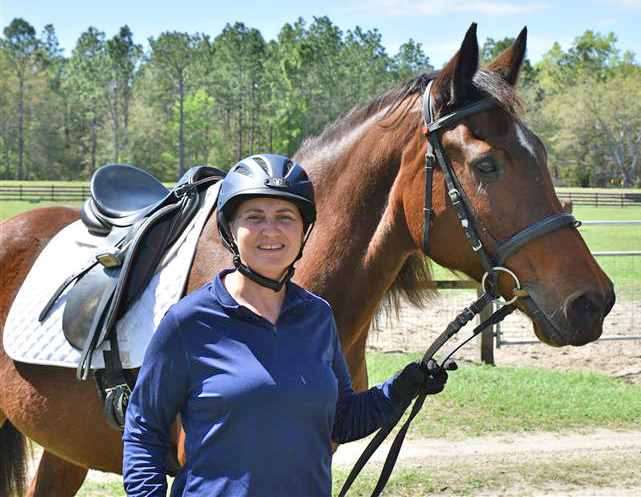
Stephanie Ruff

Stephanie Ruff has spent her entire career in various facets of the equine industry. She was a freelance writer for many years, was the owner/editor of Arabian Finish Line, managing editor of Arabian Horse Life and content manager of Practical Horseman and Dressage Today before moving to The Horse. She has ridden many different disciplines, but for the last 20 years has focused on dressage. Stephanie has both a B.S. and M.S. in Animal Science from the University of Kentucky and has always had a keen interest in equine health, science, and research. A native of Pennsylvania, Stephanie enjoys hanging out with her Arabian and Half-Arabian mares, two German Shorthair Pointers, traveling and embracing the Florida lifestyle where she currently lives.

Articles by: Stephanie Ruff

Gentling Abused Colts

I run a rescue ranch in Tucson for abused horses and dogs. I recently got in two young horses about six to eight months old, weighing in at about 500 pounds each. They have been badly branded, and they appear to be beaten up pretty badly. Their cuts are healing, and they seem to have that “baby resilience.” One of them has a bad limp in the right front leg; I suspect from being hobbled or

Read More

Keeping Disease at Bay

Preventing communicable diseases from striking horses should be the goal of every horse owner. Despite our best efforts, however, there are going to be occasions when a communicable malady afflicts one or more horses at a private farm or public stable. When that occurs, efforts must be made to treat the afflicted animals and to prevent the disease from spreading to others on the premises or i

Read More

The Magnificent Seven

Ever wonder why some minerals (such as copper, zinc, iron, and selenium) are referred to as “trace minerals” while other minerals (such as calcium and phosphorus) are not?

Read More

What Boys Are Made Of

An appreciation of normal reproductive anatomy is essential to the competent physical examination of the stallion’s reproductive tract. If you are involved in breeding, then you should be familiar with what is considered normal so you know when something is wrong. This information will also help mare owners make informed decisions about a particular stallion which might have physical problems

Read More

Stop Problems Before They Start

Thought you knew the latest in keeping your horse healthy from head to toe? Think again! Richard Mansmann, VMD, PhD, from Central Carolina Equine Practice in Chapel Hill, N.C., is using a preventive foot care program that’s designed to detect early and/or prevent foot problems that could limit performance in horses. This program involves at least an annual visit by the veterinarian and

Read More

Arthritis Under Control

Although not usually life-threatening, arthritis causes your horse pain and can be career-ending. In fact, a research report from Michigan State University’s McPhail Equine Performance Center calls degenerative joint disease the single most common cause of early retirement for sport horses.

Scientists are working hard on several studies that might eventually present realistic solutions

Read More

Advice and Advisors

Who among us hasn’t had a problem that frustrated us because we didn’t know where to turn for answers? Maybe it’s something complicated or technical and there isn’t anyone in our area who is an expert. Perhaps the question deals with something controversial, and we’re afraid of hurting someone’s feelings or making that person feel that we are looking beyond him or her for answers. Or maybe we

Read More

44 Florida EEE Cases

The number of confirmed Eastern equine encephalitis cases (EEE) in horses has risen to 44 as of May 6 in north central Florida, according to Bill Jeter, DVM, diagnostic veterinary manager for Florida’s Division of Animal Industry. This confirmed earlier speculations that 2003 will have higher-than-normal numbers of EEE cases this year. The virus has been confirmed in 18 counties, and 24 of th

Read More

First WNV Case of 2003 Detected In Florida

One equine case of West Nile virus (WNV) in Florida had been confirmed by serological testing as of May 1, according to Leroy Coffman, DVM, Florida’s state veterinarian and director of the Division of Animal Industry. This was the first reported equine case of WNV in the state this year, and possibly the first in the United States this year.

The WNV case was confirmed in an unvaccinated

Read More

Uterine Lavage Before Insemination Not Harmful to Fertility

Uterine lavage can be performed immediately prior to artificial insemination in mares without adversely affecting fertility, according to a recent study completed at the University of Idaho (UI) in Moscow, Idaho. The uterine lavage process is used to clear the uterus of inflammatory fluids that could decrease the viability of semen in mares.

Researchers already knew that uterine lavage

Read More

Uniform Drug Policy Years Away

A standardized medication and testing policy for Thoroughbred racing in the United States is three to five years away, said Rick Arthur, DVM, vice president and director of the Oak Tree Racing Association and a member of the Racing Medication and Testing Consortium. He said this during an April 1 California Horse Racing Board (CHRB) Medication Committee meeting. Arthur said he is encouraged b

Read More

FDA Approves New Equine Dewormer

The Food and Drug Administration (FDA) recently approved a new, broad-spectrum parasite control product from Merial that will treat and control 61 species and stages of equine parasites, including tapeworms.

Zimecterin Gold combines two active ingredients, ivermectin and praziquantel, to provide a broad spectrum of parasite control. Praziquantel is proven to have a wide margin of safety

Read More

Equine Influenza Spreads in the U.K.

Equine influenza has spread to nearly 20 premises–mostly Thoroughbred training stables–in the eastern, central, and southern parts of the United Kingdom. “The reason (it’s unusual) is because despite the fact that horses have been very well vaccinated and have very high antibody levels, they are still becoming infected,” according to James Wood, BSc, BVetMed, MSc, PhD, MRCVS, DLSHTM, Dipl.

Read More

African Horse Sickness Outbreak Kills 300 Horses in South Africa

An outbreak of African horse sickness (AHS) detected in late March in South Africa has killed 300 horses, according to a Pro-MED report. African horse sickness is a lethal virus spread by the Culicoides bolitinos midge, a species of small fly. Although AHS is endemic to all parts of Africa (except the Western Cape), rain has increased the midge population.

The outbreak began in th

Read More

EHV Outbreak in England Unusual; Some Cases Could be EHV-4

“It’s very unusual to get EHV-1 outbreaks all at the same time on different premises,” said James Wood, BSc, BVetMed, MSc, PhD, MRCVS, DLSHTM, Dipl. ECVPH, head of epidemiology at the Animal Health Trust (AHT) in the United Kingdom, about the recent flare-up of neurologic equine herpesvirus-1 cases in his country. At least 12 U.K. horses have been euthanized after infection with the

Read More

New Advisory Board Members Appointed

A new board will serve in an advisory capacity to The Horse magazine. Each of these American Association of Equine Practitioners (AAEP) members is volunteering to mentor the publication by answering questions and helping us understand topics of importance to horse owners. Each person brings a wealth of knowledge and years of service to the industry. We will maintain our previous group

Read More

More From The Horse

horse nose
horse in stable
Insektenplage. Schönes Pferd frei zwischen gelben Blumen auf einer Wiese wird von Insekten attackiert
Beautiful horses, animals, pasture, stables, horseback riding

Stay on top of the most recent Horse Health news with

FREE weekly newsletters from TheHorse.com

Sponsored Content

Weekly Poll

sponsored by:

How do you plan to keep your horse safe during fireworks and Fourth of July festivities? Please select all that apply.
125 votes · 156 answers

Readers’ Most Popular

The Horse
Privacy Overview

This website uses cookies so that we can provide you with the best user experience possible. Cookie information is stored in your browser and performs functions such as recognising you when you return to our website and helping our team to understand which sections of the website you find most interesting and useful.