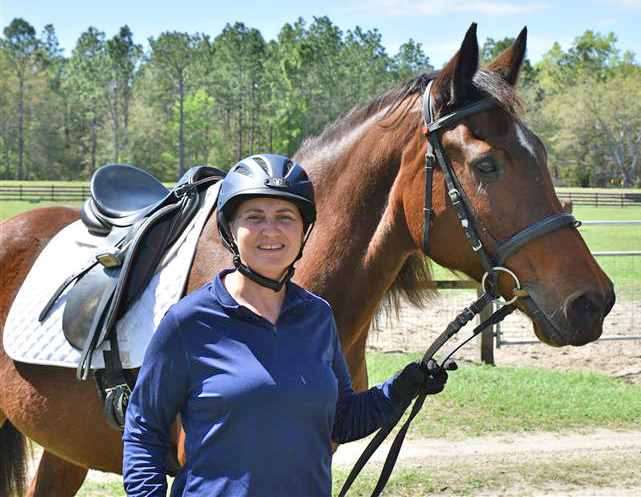
Stephanie Ruff has spent her entire career in various facets of the equine industry. She was a freelance writer for many years, was the owner/editor of Arabian Finish Line, managing editor of Arabian Horse Life and content manager of Practical Horseman and Dressage Today before moving to The Horse. She has ridden many different disciplines, but for the last 20 years has focused on dressage.
Stephanie has both a B.S. and M.S. in Animal Science from the University of Kentucky and has always had a keen interest in equine health, science, and research.
A native of Pennsylvania, Stephanie enjoys hanging out with her Arabian and Half-Arabian mares, two German Shorthair Pointers, traveling and embracing the Florida lifestyle where she currently lives.
Kentucky Disease Diagnostic Center Fetal/Foal Loss Update: 5/23/01As of noon May 23, the Kentucky Livestock Disease Diagnostic Center had received three additional aborted/stillborn equine fetuses/foals (one early-term and two late-term) for
A good mystery has many clues, some more obvious than others, and some more misleading. Researchers are scientific detectives, trying to piece together observations and facts that lead to a conclusion. But, while some cases are concluded with all
At Monday’s daily briefing from the University of Kentucky, it was announced that the scientific investigating team, with the Kentucky Association of Equine Practitioners and the Kentucky Thoroughbred Farm Managers Club, will hold an information
As of noon May 21, the Kentucky Livestock Disease Diagnostic Center had received 12 additional aborted/stillborn equine fetuses/foals (one early-term and 11 late-term) for diagnostic testing/evaluation. The total received since April 28, 2001, is
An informal survey of Central Kentucky farms on May 21 suggests the worst may be over as far as mare reproductive loss syndrome is concerned. While heavy losses already have been incurred, particularly involving maiden and barren mares bred in
Discussions of results obtained to date by several scientists and consultants working on the investigation into the cause of Mare Reproductive Loss Syndrome (MRLS) have caused the investigation to shift to a more thorough examination of the
Kentucky lawmakers will ask their colleagues to help horse farmers in the wake of a mysterious illness that has killed foals and caused fetuses to abort, according to an Associated Press report.
The third week of May in Central Kentucky was marked by cautious optimism, with the slowing of early fetal and late-term gestation loss, growing frustration among industry professionals, and much-needed rain.
Southern States has included the patented mycotoxin binder MTB100 in its line of Triple Crown horse feeds since February of 2000, according to Bill Vandergrift, PhD, owner of Equivision nutrition company and a consulting nutritionist
Veterinarians in Ohio are continuing to try to make sense of why an increased number of abortions, stillbirths, and red bag deliveries are occurring in the Ohio River Valley. Ohio counties that are seeing problems similar to the Kentucky syndromes
Lexington, Ky., feed companies are busy filling orders for bags and buckets of mycotoxin binder from horse owners in 15 states throughout the East Coast.
Feeding the binder, which is an additive derived from yeast, has been recommended by
Charles Frank, the veterinary advisor to the United Kingdom Thoroughbred Breeders Association, said that in a meeting earlier this week of the European Federation of Thoroughbred Breeders that a statement was made to advise members not to re-import
On Wednesday, May 16, the Kentucky Department of Agriculture was assured by the Florida State Veterinarian that there was no ban on the entry of Kentucky-grown hay into the state of Florida. Today, May 18, Allen Johnson, Administrative Branch
Dr. Doug Byars, head of the medicine unit at Hagyard-Davidson-McGee in Lexington, Ky., said his clinic alone has seen about 40 cases of pericarditis (fluid in the sac around the heart) in the past two weeks.
The scientific investigation into Mare Reproductive Loss Syndrome continued through the weekend as all teams work in their specific areas of expertise. The investigative analysis team, headed by Dr. Thomas Tobin, is requesting samples of mare