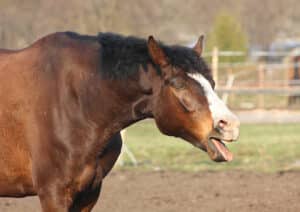
Colic remains the leading cause of illness and death in horses, affecting an estimated four out of 100 horses each year. Researchers have also identified colic as the most common equine emergency. In one recent study Sarah Freeman, BVetMed, PhD, Cert.VA, Cert.VR, Cert.ES, Dipl. ECVS, FHEA, FRCVS, professor at the University of Nottingham’s College of Veterinary Medicine and Science, in the U.K., analyzed 2,600 emergency veterinary calls and found that colic accounted for 35% of after-hours emergency visits.
Freeman says horse owners typically notice the first signs of colic and must decide when to call a veterinarian. This can be challenging, but it is an essential skill because early treatment improves outcomes. Researchers on a 2022 study said common reasons for delayed response to clinical issues in horses include lack of understanding or knowledge of the subject and difficulty recognizing subtle signs of abdominal pain.
Know Your Horse’s Normal Vital Signs
Those findings echo a 2020 study in which Freeman and her colleagues surveyed 1,331 horse owners about their understanding of a “normal” versus a colicky horse and their general understanding of colic. One key finding was only 45% of owners correctly reported a horse’s normal resting heart rate. “An increased heart rate is a key measure of pain in horses,” says Freeman.
This means many owners are unfamiliar with their horse’s normal heart rate and, therefore, might not recognize an elevated heart rate in a colicky horse or call their veterinarian in a timely fashion. A normal resting heart rate in an adult horse ranges from 28 to 44 beats per minute.
In addition, owners need to familiarize themselves with other vital signs, including respiratory rate, rectal temperature, mucous membranes (the gums), capillary refill time, and gut sounds. “The respiratory rate is typically 10 to 24 breaths per minute,” says Sally DeNotta, DVM, PhD, Dipl. ACVIM, clinical associate professor of large animal medicine at the University of Florida’s College of Veterinary Medicine, in Gainesville. “The gums should be pink and moist with a capillary refill time of less than two seconds, and most horses will pass six to 10 piles of well-formed manure in 24 hours.”
The normal temperature for a horse is considered to be 99°F to 101°F, but it’s important to know your individual horse’s normal within that. Normal gut sounds should be gurgling, gaslike growls, “tinkling” sounds (fluid), and occasionally “roars”.
“Horse owners and managers are encouraged to routinely evaluate their horse’s normal physical exam parameters so they can quickly appreciate when something is abnormal and call their veterinarians with as many details as possible,” DeNotta adds.
Subtle Signs of Colic in Horses
Even in serious cases, colicky horses might not have very high heart rates, show intense pain, roll, or thrash. More subtle signs of colic owners should familiarize themselves with include:
- Frequently looking at their sides
- Little or no manure production, passing smaller than normal fecal balls, or passing dry or mucus-coated manure
- Changes in eating behavior, such as not finishing all their grain or hay
- Changes in drinking behavior, such as “sham” drinking (appearing to drink but not actually consuming water)
If you notice any of these signs in your horse, assess his vital signs and record them for your veterinarian.
Barriers to Approaching Colic and Calling the Veterinarian
In a follow-up study published earlier this year, Freeman and colleagues (Burrell et al., 2026) explored horse owners’ knowledge of colic in greater depth. The researchers provided owners with evidence-based data about misconceptions horse owners had when it came to making decisions in a colic emergency, and found some owners would not change their behaviors in ways that could benefit horses during an emergency.
Specifically, of the 984 respondents who reported they already knew how to take their horse’s vital signs, 435 said they would continue to monitor their horses’ heart rate as before, and 29% said they weren’t sure whether they would change their approach to routine health monitoring. “Sharing evidence-based information had limited impact on decision-making,” wrote the researchers.
“I also think it’s useful to look into some of the barriers to change,” says Freeman. “These barriers may include owners not being able to measure heart rate, being worried if the heart rate is high, and feeling anxious, preferring to make decisions on other advice or previous experience rather than evidence or having had a bad previous experience and thinking the next one will be similar.”
“As soon as your horse begins exhibiting signs of colic, call your veterinarian,” says DeNotta.
Again, in the 2020 survey Freeman and colleagues showed that while owners reported being confident in their ability to recognize colic, only 20% of survey respondents correctly defined colic (i.e., abdominal pain). “Further, when given three different colic scenarios, few survey respondents were confident in recognizing the cases with milder signs,” says Freeman. “This finding suggests that owners may be less able to recognize colic than they believe.”
Henrique da Silveira Costa et al. (2022) echo these results: “Common reasons for delayed response are the lack of knowledge of colic and difficulty in recognizing subtle signs of abdominal pain.”
Delays in Equine Colic Treatment
“The best thing a horse owner can do to prepare themselves to successfully handle a colic episode is to know their horse’s individual vital parameters and behavior patterns so they can recognize a subtle deviation from the (normal),” says DeNotta.
If the colic episode proves to be more severe than can be handled at the farm, quickly transporting the horse to the local emergency hospital might be the next step, says DeNotta. “Some of the most substantial, and most preventable, delays we observe are related to arranging trailering and getting horses loaded,” she says. “My advice to all horse owners is to have a transport plan in place, keep trucks and trailers in good running condition, and use them regularly
“Maybe most importantly, teach your horses to load,” she adds. “You don’t want to be troubleshooting any of these tasks in a time of medical emergency, and we can’t treat your horse if you can’t get to the hospital.”
Future Colic Research
“An owner’s ability to recognize colic and seek assistance is a critical first step in determining case outcome,” says Freeman, adding, “We know this is hard!”
Freeman says she is working with an AI company to develop an algorithm that would detect behaviors associated with colic and alert owners, prompting them to check the horse and review video footage. “I am super excited for how this will help by continuously watching when an owner can’t be, and also picking up early changes in behavior,” she says.
Take-Home Message
Successful colic outcomes depend on preparation and prompt action. Know your horse’s normal vital signs and behavior, recognize even subtle signs of abdominal pain, call your veterinarian early, and have a reliable transport plan ready before an emergency occurs.