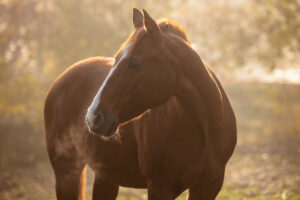
In the Wings Relieved of Stallion Duty Because of Laminitis
Darley stallion In the Wings, who won the 1990 Breeders’ Cup Turf (gr. I) and was a champion in France, was diagnosed with laminitis the past weekend and has been relieved temporarily from stallion duty. The 18-year-old son of Sadler’s Wells covered 15 mares at Kildangan Stud in County Kildare, Ireland, prior to the diagnosis.
“In the Wings is a terrific patient and appears to be
Equine Grass Sickness Linked to Clostridium Botulinum
A new study completed at the University of Liverpool in the United Kingdom and funded by The Home of Rest For Horses has revealed that grass sickness is strongly associated with low antibody levels to the bacterium Clostridium botulinum. The findings might lead to routine vaccination against the bacterium in U.K. horses.
Grass sickness was first identified around 100 years
Merial’s Jack Chellew Receives SRF’s Burke Humanity Award
Jack Chellew of Merial Pharmaceuticals is the recipient of the second annual Standardbred Retirement Foundation’s Burke Humanity Award. Chellew is Senior Sales Representative in the Equine Group for Merial Pharmaceuticals and has been with Meria
Deadly African Horse Sickness Outbreak in Africa
Six horses in the Western Cape, Africa, succumbed to an outbreak of African horse sickness (AHS) during the week of Feb. 23, according to several news reports. The affected horses were from the Stellenbosch area, reported www.sabcnews.com.
The first cases occurred at the Elsenburg Agricultural College, and another case was discovered 16 km from
Neurologic Conditions, In-Depth
Assessing neurologic conditions might seem difficult, but with practice and attention to the subtle differences between different conditions’ deficits, the process can become easier. Additionally, practitioners discussed vaccination and treatment options for the different diseases.
Spaying Mares With Newer, Safer Methods
Spaying a mare (ovariectomy) means removing her ovaries so she no longer comes into heat and has a more mellow attitude, like a gelding. An ovariectomy can be done standing (under sedation and local anesthesia) through a flank approach or a vaginal approach.
An infrequent complication associated with the old method of spaying (using a very old surgical instrument, a chain escraseur) is
Owner-Performed Fecal Exams
Can you direct me to a chart or a book containing information and illustrations of eggs of various parasites?
A Prosthetic Eye for the Horse
Using ocular ultrasonography, he was able to diagnose complete retinal detachment with a large retinal tear. Because of the grave prognosis for recovery of vision, enucleation (removal of the eye) was recommended.
Riding in Southern Spain
The following is an excerpt from my travel log as three members of Equine Affairs Association–Carol Collins, Bonnie Moretto, and I–went to Barbate, Spain, in March of 2003 for a riding holiday through The following is an excer
Eye Protection from the Sun
I have a 14-year-old Paint/Quarter Horse with one blue eye that has been diagnosed with a detached iris. ” have a 14-year-
Continuing Education for Veterinarians and Horse Owners
Continuing education is a euphemism for most of life. We learn as we live. But if life is continuing education, then medical science is the fast track. For equine veterinarians, much of our professional continuing education takes place at the American Association of Equine Practitioners (AAEP) annual convention, which is highlighted in a supplement that accompanies this issue of The Horse.

Open Mares
An experienced veterinarian can help to determine why a seemingly healthy mare can’t become pregnant.
Preventing Supporting Limb Laminitis (AAEP 2003)
Laminitis in the contralateral (same end–fore or hind–opposite leg) limb is a well-recognized and potentially devastating sequela (result) in horses with complete fractures, sepsis involving a synovial structure, catastrophic breakdown injuries, and other conditions that cause unilateral non-weight-bearing lameness.
Mad Cows and Horses
We know horses don’t get the deadly neurologic problem commonly termed mad cow disease or BSE (bovine spongiform encephalopathy). However, we’ve faced our own plethora of neurologic crises in the past few years, including West Nile virus (WNV),
Oranges for Treats?
Can horses eat oranges? I just bought a 4-year-old gelding who apparently loves oranges.
Ascarids: A Growing Problem
Editor’s Note: This is part 3 in a 12-part series on internal parasites of horses.
In the world of internal parasites, ascarids get no respect. Unlike strongyles, they aren’t a high-drama threat to your horse’s health, and they