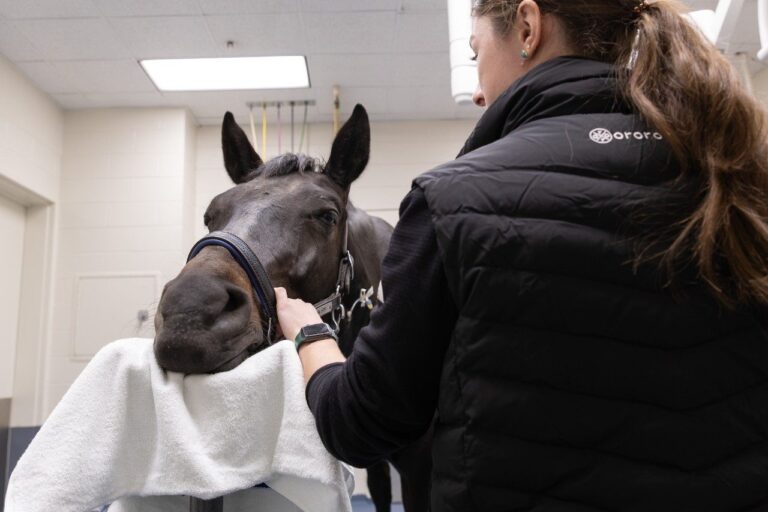
Fetal Heart Rate Measurements Aid Health Monitoring
Fetal heart rate monitoring can help veterinarians easily and reliably assess the health of the unborn foal.

Fetal heart rate monitoring can help veterinarians easily and reliably assess the health of the unborn foal.

Dr. Stephen O’Grady addresses a reader’s question about a foal with a recently developed club foot.
Newborn foals can be susceptible to many viral and bacterial infections. One example is the unique susceptibility of young foals to Rhodococcus equi, a common cause of bronchopneumonia.
Knowing how a normal foal should behave and when to call the veterinarian can go a long way toward avoiding a trip to an equine neonatal intensive care unit.
Lactation is a very important function in a mare. So important, in fact, that two lives depend on it. A mare’s body will sacrifice her foal’s health to save her own life … both during gestation and after foaling. In other words, you must feed her
Vaccinating 5-month-old foals with a single dose of West Nile virus chimeric vaccine in the presence of maternal antibodies to West Nile virus does induce a cell-mediated response (in the foal).
During a three-year study on articular (joint) cartilage maturation, researchers at the Gluck Equine Research Center used new genetic techniques to investigate how joint cartilage changes between newborn foals and young adult horses.
It is
Rhodococcus equi bronchopneumonia is a prevalent cause of disease in foals, said M. Keith Chaffin, DVM, MS, Dipl. ACVIM, a professor of medicine at Texas A&M University’s vet school, at the 2008 American Association of Equine Practitioners convention, which was held Dec. 6-10 in San Diego, Calif.
One of the most common deformities that equine veterinarians deal with in newborns is contracted digital flexor tendons. This might cause foals to walk on the toes of their front hooves instead of being flat footed.

Start your foal out right to help avoid bone and tendon problems later in life.
Horses can be born with cataracts due to developmental or heritable causes–known as congenital cataracts. Foals with cataracts often present very early in life, usually at 1 to 2 months of age. Typically, the owners will notice the whiteness in
The foal’s immune system is almost a blank slate at birth; researchers are figuring out how to best protect horses as they grow.
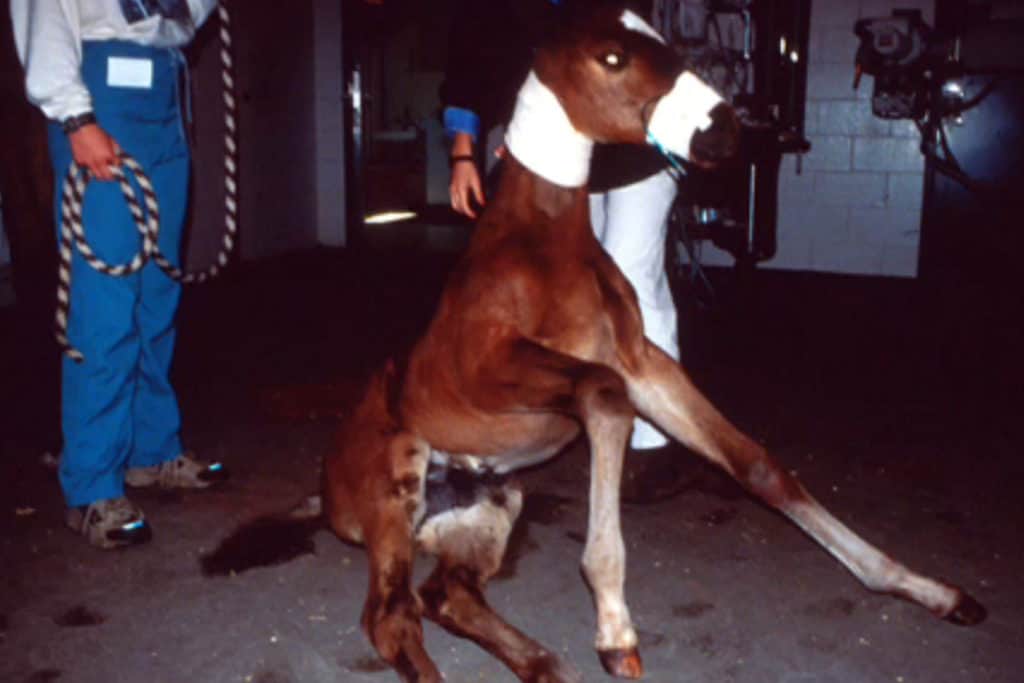
A problem in eastern Canada, the United States, and internationally, R. equi is a soil bacterium that causes severe pneumonia in foals.
Welcoming a healthy foal can be a challenge when the mare or the foal has health problems. At Virginia Tech’s Marion DuPont Scott Equine Medical Center, expert faculty and staff have experience in helping achieve a good birthing outcome as well
A product that could stimulate the immune systems of newborn foals to better fight infection of Rhodococcus equi would be very beneficial, said Steeve Giguère, DVM, PhD, of the University of Florida, at the 2008 American Association of Equine
Researchers at Cornell University announced plans to conduct a new study focused on Lavender Foal Syndrome/Coat Color Dilution Lethal (LFS/CCDL). The project, led by Samantha Brooks, PhD, and in collaboration with Doug Antczak, VMD, PhD, and Don