Did you know chiropractic care can help more than just your horse’s sore back? Researchers have proven that chiropractic care improves brain and urinary function, digestive issues, anxiety, and headaches in humans. Nobel prize winner Roger Sperry found that 90% of the brain’s nutrition and stimulation come from movement of the spine.
Chiropractic is health care that focuses on the spine and nervous system. It helps the body heal by restoring movement in the spine and other joints, allowing the body to function more efficiently. Chiropractic has the potential to improve not only equine musculoskeletal health but also digestive, brain, and immune system function due to the relationship between the spine and internal organs.
What to Expect at Your Equine Chiropractic Appointment
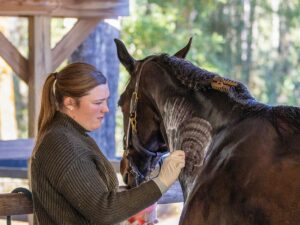
An equine chiropractic appointment first involves collecting pertinent history on the horse. What made you seek out chiropractic care? Is your horse girthy? Head shy? Does he have trouble balancing one direction?
Next, the chiropractor will watch the horse walk away from and toward her in a straight line. This gives information about how the pelvis swings and where your horse could be restricted. The normal-functioning pelvis should swing evenly left and right and in a figure-eight pattern as the horse walks.
A visual exam of muscle symmetry, posture, and areas of muscle hypertrophy or atrophy/weakness provides more clues about where your horse might be restricted. Then a hands-on exam helps the chiropractor evaluate muscle tone, sites of pain, evidence of poor saddle fit, and spinal mobility.
Finally, motion palpation of individual joints and necessary adjustments restore mobility and normal proprioceptive feedback to your horse’s brain.
How Can You Best Prepare for Your Appointment?
- Be ready to share pertinent history and any questions you have so your concerns get addressed. Does your horse buck at the canter? Sink down when you sit on his back? Are both leads symmetrical? Does he have a difficult time bending one way or the other? Has your horse had any falls, injuries, or lamenesses?
- Have your horse clean and dry, preferably with no hoof oil or slippery coat product. The chiropractor needs a certain amount of grip to be able to make adjustments safely and effectively.
- Have your saddle and typical pad ready in case there is a concern about saddle fit.
- Select a flat, safe area to work where your horse will be comfortable and relaxed.
- Be ready to learn about your horse and how you can help him going forward.
What to Expect After Equine Chiropractic Adjustment
Expect at least one day of rest with turnout or hand walking. It is best for the horse to move around after an adjustment, so his muscles and nervous system take in the changes made and to allow the body to loosen up. If the horse has significant soreness or stiffness, your chiropractor might recommend two or more days of rest.
You might also want to have an anti-inflammatory such as Bute on hand. Chiropractors occasionally prescribe this for a few days post-adjustment.
Depending on your chiropractor’s findings, she might recommend stretches or exercises for strengthening and mobility. Often you can see significant improvement in just one adjustment, but chiropractic is not typically a one-and-done treatment. Usually, horses need at least one recheck after three to four weeks to see how they have held the adjustments that were made.
Now it’s time to unlock your horse’s full potential through chiropractic care.