Equine veterinarians commonly diagnose sepsis—a systemic inflammatory response to infection—in horses with pleuropneumonia, endotoxemia, post-foaling uterine infection (which can lead to laminitis), and other conditions. They also see it in neonatal foals. “Despite substantial advances in medical management, sepsis continues to be a leading cause of illness and death in these patients,” said Kallie Hobbs, DVM, MBA, PhD, Dipl. ACVIM-LAIM, an assistant professor at Texas A&M University’s College of Veterinary Medicine, in College Station.
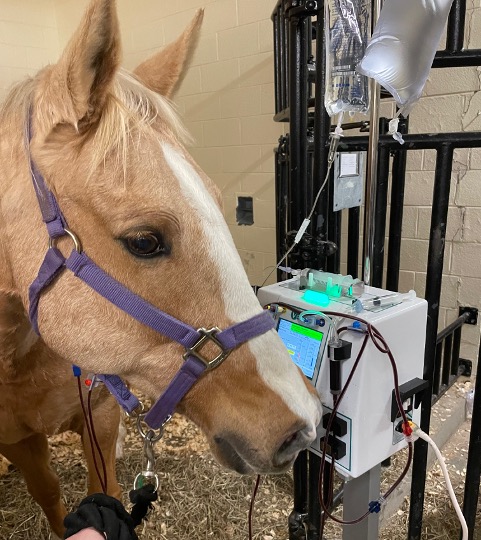
As part of her PhD at North Carolina State University, Hobbs examined the use of a novel hemoperfusion device (VetResQ and PuriFi pump by Cytosorbents), a polymer column that has shown promise as an adjunctive therapy in cases of human sepsis, in horses. She presented her results at the American College of Veterinary Internal Medicine (ACVIM) Forum, held June 19-21, in Louisville, Kentucky.
“So, (this is) something that pulls blood out of the horse, runs it back through a column that absorbs toxins, and then puts them back into the horse,” she explained, describing the VetResQ and PuriFi devices.
Testing the Hemoperfusion Device in Horses With Induced Sepsis
For the study, Hobbs administered lipopolysaccharide (LPS), a molecule found in the outer membrane of Gram-negative bacteria, to create sepsis in six university-owned horses. Next, she filtered each horse’s blood through either a sham or polymer column.
She collected blood at five time points over 72 hours to analyze neutrophils (using flow cytometry), and at 10 timepoints for cytokine (chemical messenger protein important in infection response) multiplex analysis.
Hemoperfusion Shows Potential to Reduce Inflammation and Cell Damage
“We found that horses that were filtered with this (hemoperfusion) column actually have reduced signs of sepsis,” Hobbs said. “All of their white blood cell counts returned back to normal much faster, and then they also had decreased damage markers as part of that.”
In column- versus sham-treated horses, Hobbs also saw stabilization of reactive oxygen species, which are molecules produced during strong immune responses that can lead to oxidative stress, tissue damage, and organ dysfunction. Additionally, she noticed increased early neutrophil apoptosis, which is the body’s natural process of removing neutrophils after they’ve done their job. She did not find statistical difference between systemic cytokines in the column and sham treatment.
Next Steps: Using Hemoperfusion in Clinical Equine Cases
In summary, Hobbs said treating with hemoperfusion using this polymer column might improve neutrophil health to reduce overall cytokine concentration in horses with LPS-derived endotoxemia.
The device has proven useful in several cases. “We’re starting to use this clinically in horses that have sepsis, severe liver injury, anything that causes massive inflammation and organ damage … as a novel extra treatment that you can do for the next steps,” she said.
Take-Home Message
Hobbs said these results provide proof of concept for hemoperfusion as a potential treatment to mitigate deleterious LPS-induced immune responses in adult horses. She acknowledged the need for future research in horses with clinical sepsis to define the anti-inflammatory mechanism of hemoperfusion therapy.