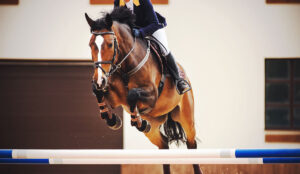
Researchers confirmed younger and less experienced show jumping riders were more likely than seasoned competitors to yank on the reins or whip their horses after being disqualified or choosing to withdraw. The findings suggest better training and awareness could reduce harmful behavior toward horses and improve both welfare and performance, said Gabor Tatai, of the Department of Ethology at the Loránd Eötvös University’s Institute of Biology, in Budapest, Hungary.
Tatai presented his study results at the 2025 International Society for Equitation Science (ISES) Conference, held July 23–26, in Fort Collins, Colorado.
In show jumping, like most other equestrian disciplines, success depends on a strong horse-rider partnership. When that connection breaks down and errors occur, riders might get eliminated or need to withdraw, which can lead to frustration and conflict, Tatai said.
He and his colleagues analyzed 440 videos from the 2023–2024 Hungarian show jumping season in which riders failed to complete their round. “We wanted to see how riders react to frustration when they’re disqualified or withdraw from a show jumping course,” Tatai said. After something happened that made it impossible to complete the round, about two-thirds of riders responded with punishment (pulling sharply on the reins, kicking with spurs, or using a whip), he added.
Rider Experience Level and Response to Frustration
The researchers suspected experience might affect how riders handle frustration. Using machine learning—specifically, a method called latent class clustering—they grouped riders into four categories based on their average jumping height over the past 10 years:
- Amateur: average rider age 16, average jump height 94 cm (3 feet 1 inch)
- Intermediate: average rider age 26, average jump height 109 cm (3 feet 7 inches)
- Young advanced: average rider age 17, average jump height 111 cm (3 feet 8 inches)
- Professional: average rider age 31, average jump height 117 cm (3 feet 10 inches)
Amateurs showed the highest rate of punishment—68.4%—compared to 43.1% for intermediates and 41.9% for young advanced riders. Professionals punished least often at 29.8%, and Tatai noted they displayed more calming responses such as patting the horse.
Education for Better Horse and Rider Connection
Overall, the findings show that the younger and less experienced riders were, the more likely they were to punish their horses after disqualification or withdrawal. “Amateur riders—typically those who are younger—may lack the emotional regulation and training to respond constructively under stress,” Tatai said.
Better education about horse behavior and positive reinforcement could make a meaningful difference, Tatai said. “This is the largest countrywide investigation of this kind approved by the Hungarian National Sport Horse Federation in order to make riders aware of the problem, and (in the future) introduce horse welfare education into the mandatory exam packages riders need to pass before becoming a competitor,” he noted.