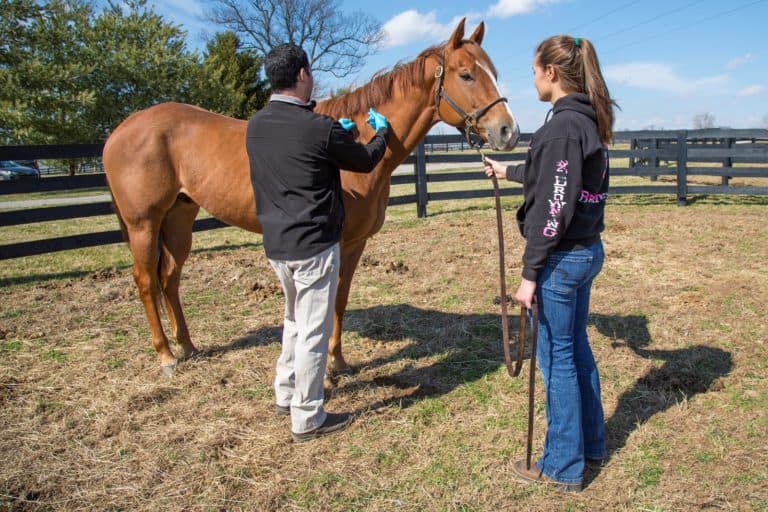
Getting a Handle on Glanders
Glanders, caused by Burkholderia mallei, is a highly contagious bacterial disease in equids and is widely


Glanders, caused by Burkholderia mallei, is a highly contagious bacterial disease in equids and is widely
With sick animals, people often think negative diagnostic results are “bad” results since the cause of disease is still unknown. However, we would do well to remember Thomas Edison’s mindset: “I have not failed. I have just found 10,000 ways that
Ticks are not only unsightly, they also can transmit infectious diseases such as ehrlichiosis, Lyme disease, and piroplasmosis to horses. Severe infestations can cause skin irritations and even anemia (a decrease of healthy red blood cells).
During the 2010 calendar year, 95,384 serum samples were tested for equine infectious anemia (EIA) in Kentucky with no positive animals being discovered. Of these, 84,111 samples were collected and tested to comply with state regulations governing
International reports of contagious equine metritis, equine herpesvirus, equine influenza, strangles, equine piroplasmosis, equine arteritis virus, Eastern equine encephalomyelitis, West Nile virus, salmonella, and more.

Mosquito-borne virus infections of horses pose a continuous and expanding threat to equine health in the United States.
Equine atypical myopathy (EAM), a seasonal, pasture-associated muscle disorder of unknown etiology (cause), presents a particular challenge to veterinarians. The disease is characterized by a generalized complete degeneration of muscle fibers, which
Infection of the pregnant mare by pathogenic leptospires can result in abortion, stillbirth, or birth of a weak foal. Yearly assessments of leptospiral abortions is important, as disease incidence can vary based on fluctuating environmental factors
Colonization of the foal’s GI tract by pathogenic organisms can lead to diarrhea. Research has focused on identifying organisms responsible for the diarrhea, but less research has looked at what allows the pathogenic organisms to become established.
Determining the cause of early fetal loss is very difficult, and in many instances the aborted fetus is reabsorbed or lost.
An outbreak of abortion associated with equine arteritis virus (EAV) infection occurred on a Thoroughbred breeding farm in San Antonio de Areco, Buenos Aires Province, in March 2010. On March 31, EAV was detected by reverse-transcription polymerase chain reaction (RT-PCR) and virus isolation from an aborted equine fetus and placenta, which was the third abortion to have occurred on the premi
The International Collating Center, Newmarket, United Kingdom, and other sources reported the following disease outbreaks. Contagious equine metritis (CEM) was reported from Germany, Italy, and the USA. A single mare case was reported out of 1,183 animals tested in Germany. Italy recorded T. equigenitalis infection in one non-Thoroughbred mare and two non
Providing horses a continuous supply of clean water is part of the foundation of good husbandry. Several different water sources might be found on a horse farm: ponds, streams, lakes, and automatic waterers or troughs supplied by well water or city w
Equine heart disease is multifaceted and can be induced by multiple mechanisms. Although horses do not routinely suffer from traditional “heart attacks,” they can develop heart abnormalities that can negatively impact their health and longevity.
Foals, like other young animals, are especially susceptible to diseases. A review of necropsy cases over a one-year period at the University of Kentucky Livestock Disease Diagnostic Center was conducted to determine common pathologic diagnoses in the foals submitted for necropsy. For this study, all foals 1 day to 6 months of age were included. A total of 272 foals within this age range were
An adverse event can be broadly defined as an undesirable occurrence after the use of a vaccine, drug, animal device, insecticide, medicated feed, etc. Multiple federal agencies are involved in taking reports of adverse events in animals, which can make it difficult for owners and veterinarians to easily notify the appropriate agencies. Adverse reactions can range from a minor swe