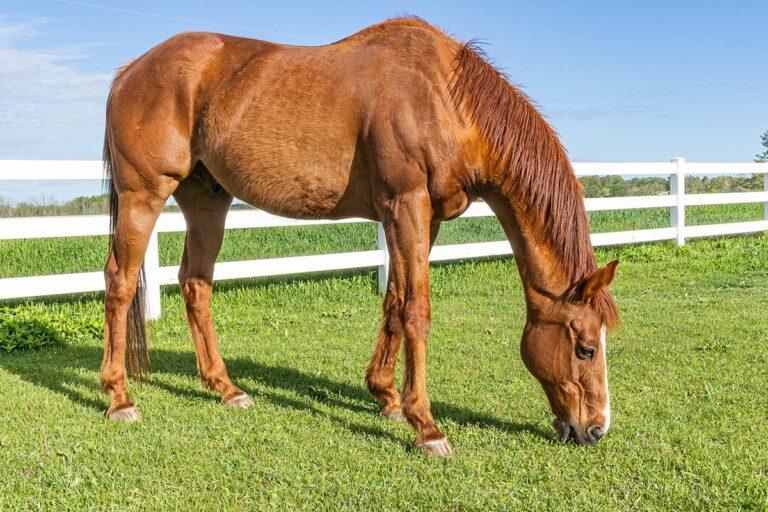
Stephanie L. Church, editorial director for The Horse and Stable Management, grew up riding and caring for her family’s horses in Central Virginia and received a B.A. in journalism and equestrian studies from Averett University. She joined The Horse in 1999 and has led the editorial team since 2010. A 4-H and Pony Club graduate, she enjoys dressage, eventing, and trail riding. Her heart horse, It Happened Again (“Happy,” pictured), a former graded-stakes-winning Thoroughbred gelding, was her longtime mount and remains a lasting inspiration. She now has an 8-year-old off-track Thoroughbred, Dune of Pilat (“Dune”), and is enjoying building a partnership with him. Stephanie is based in Lexington, Kentucky.
Articles by: Stephanie L. Church, Editorial Director
Stephanie L. Church, Editorial Director
September 1, 2003
On July 18, Pfizer Animal Health announced the U.S. release of Equimax, a dewormer designed to kill all major equine parasites in one dose–including tapeworms.
The apple-flavored paste dewormer combines praziquantel with ivermectin to treat horses four weeks of age and older.
According to the company, Equimax has been proven safe and effective in over 25 countries with more than 2
Stephanie L. Church, Editorial Director
September 1, 2003
Why does my stallion not perform as eagerly in the breeding shed as in the past? Why does my mare’s ground behavior become nearly unbearable during estrus? Is there a reason that my gelding isn’t moving along as easily in his training as other horses I’ve worked with in the past? What can be done about each situation? These are all questions that a unique group of equine veterinarians,
Stephanie L. Church, Editorial Director
August 25, 2003
The death of at least one Oklahoma horse has been definitively linked to Potomac horse fever (PHF), a disease rarely found in the state, and two of her stablemates likely died of the same illness. The horse manager at the farm with the confirmed
Stephanie L. Church, Editorial Director
August 20, 2003
West Nile Virus Antibody is a prescription product, administered intravenously by a licensed veterinarian. It is an antiserum product that increases the antibody level in the circulatory system. This enhances an animal’s ability to neutralize virus present in the blood.
Stephanie L. Church, Editorial Director
August 20, 2003
So you want to have your own horse farm. Should you build or buy? Hire a real estate agent or go out looking on your own? What about once you’ve acquired a facility–how do you manage the soil, fencing, employees, security, and manure? Four individuals versed in purchase, design, and management of horse farms shared their knowledge about establishing and getting the most out of your equine
Stephanie L. Church, Editorial Director
August 19, 2003
A recent Austrian study has shown that melanomas in gray horses are less malignant than those found in solid-colored horses characterized by early metastases (cancer that started from cancer cells from another part of the body). Researchers believe this might be because gray horses have specific genetic factors that inhibit the metastatic processes. Additionally, the researchers found that th
Stephanie L. Church, Editorial Director
August 19, 2003
The USDA’s Animal Plant Health Inspection Service has issued a conditional license to Novartis Animal Vaccines, Inc., for the manufacture and distribution of West Nile Virus Antibody, Equine Origin, for treatment of disease caused by West Nile virus (WNV).
Typically, antibody products are very specific and mimic the activity of naturally occurring molecules used by the body’s immune
Stephanie L. Church, Editorial Director
August 15, 2003
The West Nile virus (WNV) 2003 season is well underway. Reports of equine cases are steadily rolling in from states where the virus has been detected before, and veterinary and public health officials in those states that haven’t experienced cases in the past four years are likely readying for their first detection of WNV. The USDA reported Aug. 11 that 309 equine cases of West Nile virus
Stephanie L. Church, Editorial Director
August 12, 2003
Texas officials have detected the state’s first case of anthrax for 2003 in a white-tailed deer near Del Rio. “It’s not unusual to have a few cases of anthrax in livestock or deer each year in Texas,” said Bob Hillman, DVM, state veterinarian and executive director for the Texas Animal Health Commission (TAHC), the state’s livestock health regulatory agency.
Stephanie L. Church, Editorial Director
August 12, 2003
Cats Don’t Dance, the remaining injured Saddlebred under veterinary treatment at Hagyard-Davidson-McGee (HDM) Associates in Lexington, Ky., is recovering well and might be returning home sometime next week, according to his treating veterinarian.
Stephanie L. Church, Editorial Director
August 8, 2003
A “horse ripper” suspected of killing more than 40 horses in Germany struck again on Aug. 5, according to The Guardian, an online newspaper in London.
The two horses killed were mares kept in Helmstedt, near Hanover, and another two horses were badly injured. All victims’ stomachs had been slit open with a knife.
Police suspect the cases are the work of an equine
Stephanie L. Church, Editorial Director
August 5, 2003
Three horses recently died of blister beetle poisoning in Clay County, Fla., and two have returned after treatment at the University of Florida following ingestion of alfalfa hay contaminated with blister beetles. The hay was delivered from a supplier in Oklahoma.
Blister beetles, any of six species of the genus Epicauta, can inhabit alfalfa and clover fields from the central
Stephanie L. Church, Editorial Director
August 1, 2003
Top veterinarians and the USDA dispute allegations made in a May 30 article in The Denver Post that the West Nile virus (WNV) vaccine might have caused widespread abortions and deformed foals. Mare owners calling themselves the “Lost Foals Group” claimed the vaccine caused up to 1,200 abortions and nearly 300 deformed or dummy foals.
Stephanie L. Church, Editorial Director
August 1, 2003
The research team that made headlines in May after producing the world’s first equine clone–a mule named Idaho Gem–on June 9 has repeated its success with the birth of another mule–Utah Pioneer.
Researchers Gordon Woods, DVM, MS, PhD, Dipl. ACT, and Dirk Vanderwall, DVM, PhD, Dipl. ACT, from the University of Idaho (UI); and Ken White, PhD, from Utah State University, said the male
Stephanie L. Church, Editorial Director
August 1, 2003
Veterinarians are scrambling to keep up with the Eastern equine encephalitis (EEE) cases emerging in the southeastern United States. Since the beginning of June, South Carolina has had 17 confirmed equine cases, with about 25 pending confirmation. Florida’s EEE case count is up to 113 this year, and Georgia has 30.
In 2002, South Carolina had five equine cases of EEE, Florida had 25, and
Stephanie L. Church, Editorial Director
July 30, 2003
The one sabotaged Saddlebred still under treatment is recovering well, according to two veterinarians who have been treating the horse at Hagyard-Davidson-McGee (HDM) Associates in Lexington, Ky. However, they cannot say the gelding is completely out of the woods yet. Six-year-old Cats Don’t Dance is currently sound and slowly responding to a combination of cutting-edge treatments