Universal Ultrasound (AAEP 2009 Tradeshow)
Peter Brunelli, president, talks about new and current products in 2010.


Peter Brunelli, president, talks about new and current products in 2010.
Whether transporting a horse across an ocean or across state lines, there are legal requirements that you need to meet. Your paperwork must be complete or you face the possibility of fines, quarantine, or even your horse being rejected and refused entry into a state or country.

Dr. Stephen O’Grady addresses a reader’s question about a foal with a recently developed club foot.
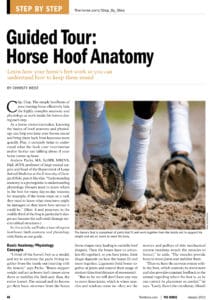
The simple hoofbeats of your moving horse effectively hide the highly complex anatomy and physiology at work inside his hooves during each step.
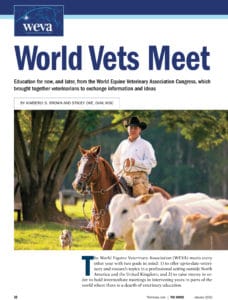
The 2009 WEVA Congress was held in Guarujá, São Paulo, Brazil, which ranks among the top 10 countries with the highest population of equids. It boasted one of the largest gatherings in WEVA’s 24-year history with attendance of 1,175. Topics included Rhodococcus equi pneumonia, sleep disorders, seizures, guttural pouch problems, abortion, and lameness from tendon sheath issues.

As you admire a horse, you take in his physique, his muscle tone, and the sheen of his coat. But underlying these essential outer parts is the structure that forms the scaffold to which all soft tissues attach: the equine skeleton.
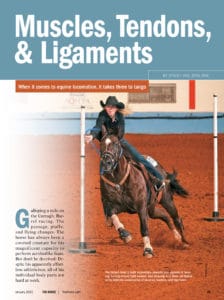
The horse’s body is both exceedingly powerful and capable of bending, turning around tight corners, and stopping on a dime, all thanks to his intricate combination of muscles, tendons, and ligaments.
New imaging technologies, such as MRI, CT, digital ultrasound, and nuclear scintigraphy, have helped us understand anatomy better and improved our ability to visualize joint injury. As a result, we’re now able to utilize nonsurgical joint therapies.
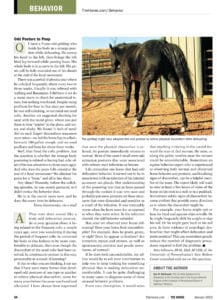
I have a 9-year-old gelding who holds his body in a strange position while defecating. He curves his head to the left, then brings the left hind leg forward while passing feces. His whole body is in a curve to the left… any ideas why?
International dressage rider Lisa Wilcox is co-host of the Dressage Radio Show and does a tip of the week when she is on that show

Norm Luba, executive director of NAERIC, talks about the organization winning the 2009 Lavin Cup welfare award. (4:11)

Dr. Rodney Belgrave of the Mid-Atlantic Equine Medical Center discusses equine multinodular pulmonary fibrosis. (3:20)
The typical veterinarian’s arsenal against equine herpesvirus includes vaccination to prevent the disease and supportive care/antiviral medication when the disease strikes. However, small interfering RNA, or siRNA for short, is a Nobel Prize-winning technology that Cornell University researchers have been studying for equine use.
Lloyd Brown deployed to Haiti as part of the Humane Society International (HSI) field assessment team. He reports on horse and companion animal health concerns following the earthquake. He was able to work with contacts in Dominican Republic to stage equipment, supplies, and a small team in preparation for going into Haiti. His mission: to do an “on the ground” assessment of the needs and issues i
Kip Deville, who has been battling life-threatening laminitis for several months, continues to show significant improvement at Rood and Riddle Equine Hospital in Lexington, Ky., and his connections remain cautiously optimistic.
“He is doing great,” said Mike Iavarone, president of IEAH Stables. “Every day has been better and better for him. He is walking around well
Legislators in the United Kingdom have proposed major changes in animal health, including a new governmental body. The bill was introduced by Environment Secretary Hilary Benn.
Other measures in the draft Animal Health Bill, which was drawn up following extensive public consultation, include:
Making statutory the role of Chief Veterinary Officer (UK), base