Haylie Pfeffer, Digital Editor, holds a degree in equine studies with a concentration in communications and a minor in social media marketing. She is a Pennsylvania native and, as a horse owner herself, has a passion for helping owners provide the best care for their horses. When she is not writing or in the barn, she is spending time with her dog, Clementine.
When was the last time you stepped into a feed room that didn’t contain a wide array of buckets, bottles, and tubs of supplements? Supplements have become more the rule than the exception.
Horses in some management conditions are susceptible to sand ingestion; here’s how to avoid sand buildup and resulting complications such as colic. Rarely do we see our horses lapping up sand like it’s some rare commodity. But inevitably horses end up with burdens of sand in their intestinal tracts from grazing sandy pastures or eating off the ground. In areas with sandy soil
Managing internal parasites in the face of dewormer resistance.
Anthelmintic resistance is a growing problem the world over. While we might not see “super worms” ravaging our equine companions, there is a pressing need to update deworming strategies and horse owners’ perceptions regarding available deworming tools.
Preparation includes understanding the nature of racing emergencies along with an assessment on how to maximize available resources. Venue-specific concerns should be identified, as every situation is unique, and Scollay-Ward urged on-track veterinarians to develop team proficiency by collaborating on duties and establishing relationships prior to the need for implementing emergency procedures.
In an effort to reduce the number of unwanted horses in Minnesota, several equine organization are banding together to offer free equine castration for horses and owners that meet program criteria.
Organizers of the project include the Minnesota Horse Welfare Coalition, the Minnesota Horse Council, the Animal Humane Society, and the University of Minnesota, in cooperation with the
The song says the sun shines bright on my old Kentucky home, but there is no sun shining Kentucky Oaks morning, and the weather is the big topic of conversation.
Owners, trainers, and racing fans have been watching the skies over Louisville, Ky., all week. It was not raining as the abbreviated training hours ended May 1, necessitated by an early first post of 10:30 a.m. (EDT) both Oaks
The ongoing investigation into contagious equine metritis (CEM) now includes more than 820 exposed or positive horses, according to the USDA.
The investigation began in mid-December 2008, when a Quarter Horse stallion on a Kentucky farm tested positive during routine testing for international semen shipment.
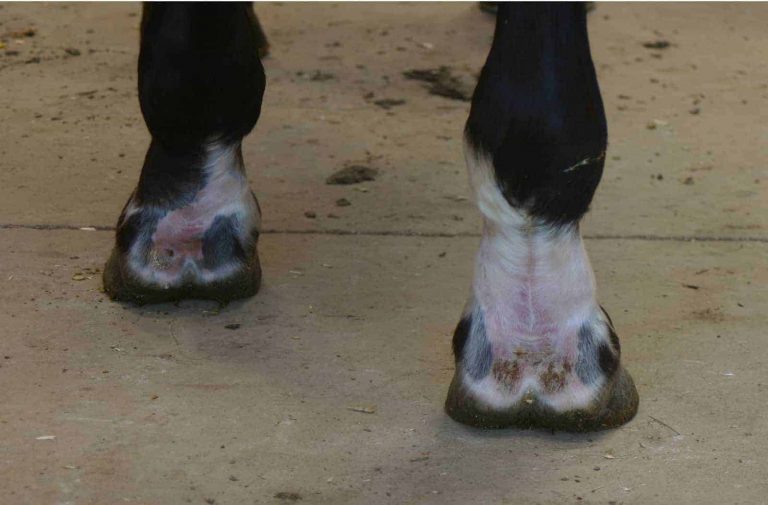
In the spring and summer my Paint mare has a rash-type skin problem around her nose and moving to her shoulders. It starts out looking like what we were told was dew poisoning, but it has spread to the point of bumps, scabs, raw sores, and bleeding.
Preston Madden, who bred Alysheba, called the 1988 Horse of Year and racing Hall of Fame member “a gift from heaven” during a memorial service for the pensioned stallion at the Kentucky Horse Park near Lexington April 29.
The bay son of Alydar was euthanized March 27 after he fell in his stall at the Horse Park, injured his right hind femur, and was unable to get up. A chronic
In a recent survey, 96% of respondents said they used nonsteroidal anti-inflammatory drugs (NSAIDs) to control the joint pain and inflammation in horses, and 82% administer them without always consulting their veterinarian. More than 1,400 horse owners and trainers were surveyed to better understand attitudes toward NSAIDs, in a project sponsored by Merial, the maker of Equioxx (firocoxib).
During its semi-annual Board of Governors meeting April 25, the United States Polo Association (USPA) voted to establish a committee to examine existing and additional safeguards for polo horses, including developing a prohibited substance policy.
The USPA’s Board of Governors approved the following motion:
“In light of the tragedy that occurred this past week, the USPA Equine
As you handicap this year’s Kentucky Derby, you better ask yourself not only who can get a mile and a quarter, but who can do so on an off track. Some of this year’s contenders have been running on synthetic surfaces and never touched a track listed as sloppy or muddy. That might change May 2 because Churchill Downs has a traditional dirt surface, and the forecast is for rain.
The co-owner of a Nebraska training ranch from which 211 BLM mustangs and burros were recently removed faces federal charges for the alleged maltreatment of a mustang adopted in her name.
On April 16, the BLM cited Anissa Meduna, co owner of the 3-Strikes Ranch in Alliance, Neb., with one count of inhumane treatment of a wild horse or burro, said BLM spokesperson Cindy Wertz.
The Bureau of Land Management (BLM) is hoping cash incentives will boost adoptions of wild horses and burros that would otherwise spend their lives in long-term holding facilities.
Under a pilot program slated to debut at an adoption event in Kellyville, Okla., next month, the agency will pay $500 to qualified individuals who adopt BLM mustangs or burros that are four years