Protecting the Elbow From the Shoe
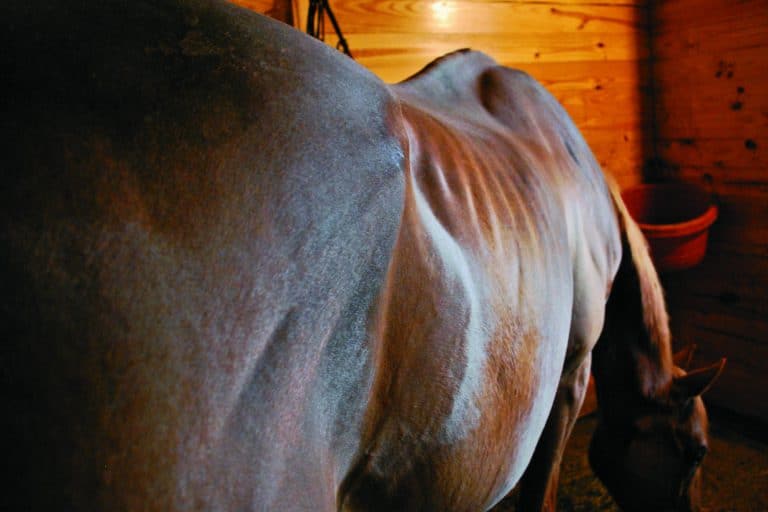
I’m desperate to find some way to prevent my 20-year-old Thoroughbred mare from cutting her elbow on her egg-bar shoe when lying down.

I’m desperate to find some way to prevent my 20-year-old Thoroughbred mare from cutting her elbow on her egg-bar shoe when lying down.
Can poison oak and poison ivy cause allergic reactions in horses? There is quite a bit of poison oak and poison ivy on the acreage where I keep my horses.
In any of the equine behavior literature that I have read, I am unable to find any description of the sleeping behavior we see in our retired broodmare (17 years old). She has functioned as the watch horse in the small herd she was from, and she now is retired at our two-horse farm and continues to maintain that role. She is rarely seen lying down, nor shows evidence of that–no surface dirt
Buying that first horse can be exciting and scary. Getting that dreamed-about horse is the exciting part, and being concerned that you don’t make mistakes in choosing the right one is the disconcerting and worrisome part. In this article, we’ll first look at the situation through the eyes of horse owners, then we’ll turn to a panel of veterinary experts who will discuss what to watch for
Rutgers Cooperative Extension and the Rutgers Equine Science Center recently published “Agricultural Management Practices for Commercial Equine Operations.” Considered to be the first comprehensive set of U.S. guidelines for horse operations, the document is available for download at www.rce.rutgers.edu and
Illinois HR649 amendment 4, which would ban equine slaughter for human consumption in the state and make it illegal to transport horses into or out of the state for slaughter, passed the Illinois Senate (as SB1921) in late May. However, it was defeated in the House by nine votes and has been referred to a rules committee as a result of objections from some representatives. No further action
Legislation designed to prevent horse slaughter at the national level could be indefinitely stuck in committee.
In January 2003, U.S. Rep. John Sweeney, a Republican from New York, proposed HR 857, the American Horse Slaughter Prevention Act. HR 857 seeks to prohibit the slaughter of horses for human consumption; the sale, possession, and trade of horseflesh for human consumption; and th
Clinically normal horses can shed Salmonella bacteria, especially when stressed. Reports on the percentage of horses shedding Salmonella have ranged from 1.5% to 64.5%, depending on whether the horse was hospitalized (higher numbers). Since stress can cause shedding, transport to the hospital–on top of the ailment requiring hospitalization–often means a high Salmonella
On May 8, Rood & Riddle Equine Hospital in Lexington, Ky, sent out letters to area clients, farm managers, and veterinarians notifying them that an increased number of salmonella cases had been detected at the clinic this year, and explaining the methods staff were using to eliminate the Salmonella organisms and safeguard the health of patients. According to several area
“A prize in every box.” While that phrase refers to the little toy one finds in a box of Cracker Jacks, adopting a former racehorse is not so different: You’re not quite sure what you’ll get, but often the experience is fun and the horse can be a treasure for years to come. For the most part, ex-racehorses are well-trained, intelligent horses which, in the right hands, successfully move on to
Endotoxemia in horses is usually associated with severe infections, inflammation, and colic. Endotoxin from intestinal bacteria activates release of inflammatory mediators such as thromboxane B2 (TxB2), tumor necrosis factor-alpha (TNF-alpha),
Healthy bone undergoes constant metabolic change to prevent bone loss or abnormal remodeling (cell turnover) that can occur with loading. Horses with navicular disease can have abnormal remodeling and formation of osteolytic lesions (areas of
EDITOR’S NOTE: This is part seven of a 12-part series on internal parasites of horses.
Back in January, in our first installment of this series, we described what makes a parasite different from other kinds of infectiou
As horse owners, we care deeply about our animals. When one of our beloved horses dies, we lose a trusted friend. For many of us, the experience is emotionally devastating. Yet, just when we are at our most pronounced stage of grief, we are
Equine encephalitis has been around for a long time. Old-time horsemen simply referred to it as sleeping sickness. They knew that if a horse contracted it, the animal’s prognosis was not great, and that if he did recover, his ability to perform
In a society that is trying to slow the aging process, free radicals and antioxidants are terms that are regularly tossed around.
Stay on top of the most recent Horse Health news with