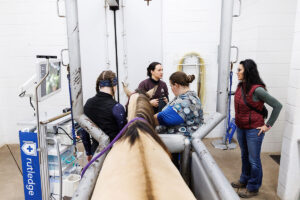
checking horse for ulcers

Veterinarians rely on a thorough history, physical examination, and gastroscopy to guide gastric ulcer diagnosis. Gastroscopy, which allows the veterinarian to visualize the horse’s stomach with an endoscope, remains the gold standard for confirming the presence, location, and severity of gastric ulcers. In this Ask TheHorse Live excerpt Laramie Winfield, DVM, Dipl. ACVIM, cVA, cVMMP, of Steinbeck Peninsula Equine Clinic, in Salinas, California, explains how veterinarians use gastroscopy to diagnose equine gastric ulcer syndrome.

This podcast is an excerpt from our Ask TheHorse Live Q&A, “What You Need to Know About Equine Gastric Ulcers.” Listen to the full recording here.

 

About the Expert:

Picture of Laramie Winfield, DVM, Dipl. ACVIM, cVA, cVMMP

Laramie Winfield, DVM, Dipl. ACVIM, cVA, cVMMP

Laramie Winfield, DVM, Dipl. ACVIM, cVA, cVMMP, grew up in the Salinas Valley, riding horses with her mom and sisters. Winfield’s professional interests are equine internal medicine, emergency and critical care, neonatology, acupuncture, sports medicine, and ophthalmology. Winfield is certified in veterinary acupuncture and is also a veterinary medical manipulation practitioner, having completed her training at the Integrative Veterinary Medical Institute in Reddick, Florida. In integrating her riding background with her training in internal medicine, acupuncture, and spinal manipulation Winfield strives to offer a comprehensive view of horse health and performance. Winfield is an equity partner at Steinbeck Peninsula Equine Clinics, in Salinas, California. She enjoys spending time with her husband, Nick Carlson, DVM, Dipl. ACVS, and their children. She loves horseback riding and three-day eventing with her horse Franky.