Managing chronic laminitis in horses calls for a proactive approach
Orion went straight from the sale barn to the hospital. FarmHouse Fresh Sanctuary, in McKinney, Texas, agreed to pick up, foster, and stabilize the horse on behalf of another rescue organization, says Elise Khan, sanctuary manager. Orion, she says, was a mess.
His soles were thin, and he appeared to have laminitis, a condition when lamellae, or the tissues that anchor the coffin bone within the hoof, become inflamed and painful. His lamellae were compromised, and the coffin bone had sunk. Orion had a body condition score of less than 1, and he also had pneumonia.
While hospitalized for his other issues, Orion wore boots with an orthotic gel insert to support his feet. He continued wearing them after he went home to the sanctuary.
But then Orion ended up with fluid around his heart and lungs, and his feet started abscessing.
Kendell Metcalf, DVM, CED, AVCA, an equine podiatrist at Three Oaks Equine Clinic, in Whitesboro, Texas, who treats Orion, opted to switch out the gel orthotics for custom sole support made with dental impression putty. For a time Orion wore wooden shoes and improved but then became uncomfortable again.
Orion’s saga could be termed chronic laminitis; his coffin bone and laminae were compromised from previous episodes. Getting him comfortable was a long process.
“The way we think about laminitis changed a bit over the past 20 years,” explains Benjamin Flakoll, DVM, a podiatry and ambulatory associate at Rood & Riddle Equine Hospital in Saratoga, New York. “We thought of laminitis as a discrete disease with a common pathophysiology, regardless of what caused laminitis.”
Now, laminitis is thought of more as a syndrome, he explains. Historically, veterinarians described the pathophysiology of laminitis in terms of four phases: developmental, acute, subacute, and chronic.
While your veterinarian might use those terms to describe what’s going on inside the hoof, the definition of chronic has pivoted. Essentially, chronic laminitis is a symptom; laminitis can be acute or chronic no matter the cause.
Veterinarians often see acute or chronic laminitis in horses with hyperinsulinemia, termed hyperinsulinemia-associated laminitis (HAL), formerly known as endocrinopathic laminitis. In general terms HAL refers to laminitis linked to insulin dysregulation (ID)—defined as hyperinsulinemia, or elevated insulin levels in the bloodstream—and tissue insulin resistance. (In tissue insulin resistance, fat, muscle, and liver cells don’t respond effectively to insulin, limiting their ability to clear glucose from the bloodstream and store it as glycogen.)
You might hear the term equine metabolic syndrome alongside hyperinsulinemia-associated laminitis. Any equid can develop EMS, which is marked by insulin dysregulation, abnormal fat deposits, and an increased risk of developing laminitis—and not just once.
What Is Laminitis?
Laminitis begins when lamellae (also called laminae)—the fingerlike spongy tissues attaching the coffin bone to the inside of the hoof capsule (the wall or hard part of the hoof)—get inflamed.
Metcalf likens the lamellae to Velcro because of how the lamellae reaching out from the hoof wall and the coffin bone interdigitate with one another, anchoring the hoof wall to the coffin bone, and vice versa. As laminitis progresses, the inflamed lamellae can stretch and start separating from one another. The coffin bone can rotate (what horse owners often refer to as founder) or sink and in some cases poke through the horse’s sole.
Clinical signs of laminitis in horses include lameness, stiffness, or a reluctance to move or pick up feet; sensitivity and heat in the hoof; and bounding digital pulses. If the front feet are involved, the most common sign is a sawhorse stance, in which the horse appears to lean back, shifting weight onto the hind feet. Horses can develop three types of laminitis:
Laminitis secondary to systemic inflammatory response syndrome can happen when there’s inflammation in the horse’s body (such as colitis, which affects the colon, or large intestine). In Orion’s case the pleural pneumonia he experienced likely contributed to the recurrent pain in his feet.
When you start treating pleural pneumonia, “you start killing off a bunch of Gram-negative bacteria,” Metcalf explains. “They spit this stuff up called endotoxin, and then endotoxin affects their feet negatively.”
Supporting-limb laminitis, the second type of laminitis, occurs when the horse bears weight unevenly across his limbs. For example, if your horse sustains a severe injury in his left front, he might put more weight on the right front. Eventually, laminitis could develop in the right front foot. Experts suggest this likely results from altered blood flow in the chronically weightbearing limb.
Metabolic-associated laminitis—the most common form—now accounts for most chronic laminitis cases. Affected horses develop lamellar inflammation due to ID caused by an endocrinopathy, says Flakoll, such as pituitary pars intermedia dysfunction, or PPID, formerly equine Cushing’s disease.
“This form of laminitis is slowly progressive, and horses typically have recurrent bouts, which is why when people commonly talk about chronic laminitis, they usually mean endocrinopathic laminitis,” he adds.
Managing a Laminitic Episode
Expect to keep an actively laminitic horse on stall rest for an extended period of time unless the case is mild, Flakoll says. You’ll need to support the hoof mechanically, likely with therapeutic shoes for “at least a few cycles,” he adds.
“A horse like Orion, you’re really just building the biggest, toughest, robust foot around that bone,” Metcalf says. The aim is to give the coffin bone the structural support needed and build reserve capacity in the hoof so that if there’s another acute-on-chronic event, the hoof has the structure in place to keep the coffin bone in normal orientation.
“I think the biggest thing on that is, if you can get him to grow sole, you’ve got a shot,” he says.
If the horse experiences laminitis due to ID, your veterinarian will start the horse on medication to address the condition. Long-term, the horse might need a different maintenance medication than the one used to stabilize his insulin regulation. Meanwhile, diet and management changes, such as restricted turnout and access to grass, also prove critical.
To manage the horse’s pain Flakoll suggests a non-steroidal anti-inflammatory drug (NSAID) such as phenylbutazone (Bute). Ideally, the horse will need to be on an anti-inflammatory medication only briefly, but Metcalf says some must stay on a low dose indefinitely.
The need to ice the horse depends on what caused the laminitis. “Icing is really important for horses that have systemic inflammatory response syndrome,” Flakoll says, noting it’s not critical for other types.
Laminitis & Endocrinopathies
Veterinarians believe elevated insulin levels damage laminae over time, says Flakoll.
Affected horses “have this slowly progressive stretching of the laminae, and eventually they have what’s called an acute-on-chronic episode,” he explains. Something—maybe an insulin spike—“will push them over the edge, and they will have acute damage to the laminae superimposed on all that chronic damage that had been going on slowly.”
Flakoll adds that in many cases the incident marks the first time the owner notices or reports the horse being lame. Radiographs (X rays) might show significant coffin bone rotation, but that doesn’t mean it happened suddenly.
Two endocrinopathic diseases–equine metabolic syndrome (EMS) and, again, PPID—commonly contribute to chronic laminitis, Flakoll says.
Typically, veterinarians associate PPID with older horses. Nerve cells that synthesize dopamine, which typically inhibits production of some hormones, can start losing function and allow for unchecked production of those hormones, leading to disease.
With EMS practitioners consider insulin dysregulation the most important risk factor. Affected horses are typically overweight with regional adiposity (crested necks; fat deposits over withers, backs, and rumps).
Preventing Hyperinsulinemia-Associated Laminitis

The good news about HAL is that horse owners can manage it. “There’s a slow onset,” Flakoll says. “So there’s a lot you can do before they actually get laminitic.”
He suggests screening teenage horses yearly for endocrine disease by testing insulin and adrenocorticotropic hormone (ACTH) and keeping an eye on the horse’s body condition score. Yearly hoof radiographs can also help cut through confusion.
“If you have these yearly rads done, you might be able to catch a little bit of their rotation before they actually have a laminitic event,” Flakoll says.
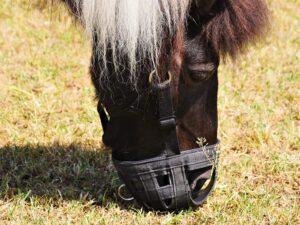
A horse with hyperinsulinemia needs restricted turnout. Management possibilities include dry lots, grazing muzzles, and avoiding turnout during seasons or times of day when pasture sugar content is high.
Body Condition and Exercise
Your horse might be fatter than you think. “Most horse owners think their horse is an ideal body weight, and it’s technically like a 6 or a 7 (on the Henneke body condition scoring system),” Flakoll says. Veterinarians recommend a body condition score of 5.
Even if your horse doesn’t need to lose weight, exercise is important for insulin-dysregulated horses. It helps them have a more normal insulin response, Flakoll says.
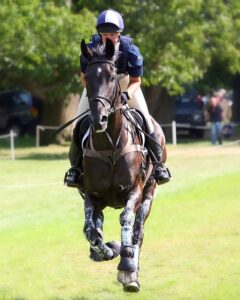
Turnout alone does not provide enough exercise. Walk-trot-canter on the longe line for 15 to 20 minutes or getting ridden every other day “is probably a good way to keep them fit and have them be less likely to get insulin dysregulated,” he adds.
Pasture and Hay
Skip the fragrant bales of green hay and forgo grain, says Flakoll. “I tell people, ‘If you have a really insulin-dysregulated horse, you want to get the worst-quality hay you can and soak it,’ ” he says. First-cutting hay—the greener, leafier kind—often contains too much sugar and starch (nonstructural carbohydrates, or NSC) for horses with insulin dysregulation.
Aim for smaller, slowly consumed meals. Haynets help accomplish this goal. You’ll also have to be aggressive about reducing the NSC content of the laminitic horse’s diet.
“The main NSCs in temperate grasses are water-soluble carbohydrates,” says Flakoll. “We want to get the total NSC level of the hay we are feeding these horses to be less than 10%. Since a large component of the NSC content of hay is water-soluble, soaking gets rid of a lot of it but not all of it.
“Most people aren’t testing their hay, and it changes with the time of year,” he adds. “The easiest way to make sure your hay doesn’t have too much NSC in it is to soak it before you give it to your horse. I wouldn’t recommend this for just your average horse, but if your horse is having a laminitic episode, then this makes a huge difference.”
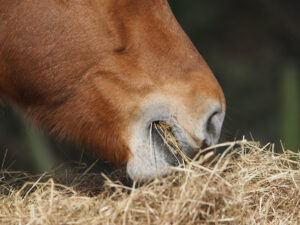
Horses should get about 1.5 to 2% of their body weight in hay daily. Think of your haynet like a strainer in a pasta pot. Fill the haynet with hay and soak it in a tub of water overnight. When you’re ready to feed your horse, discard the water and hang the net.
You might need to make big changes to your horse’s turnout arrangements.
“Some horses with endocrinopathic laminitis may never be able to be safely turned out and will require a dry lot,” says Flakoll. “If this isn’t an option, then you can try limiting turnout to when it is safest.”
Lush, green, spring pastures high in NSC are unsafe. So are pastures in the fall, when temperatures turn colder. Generally, the NSC in grass is lowest from about 3 a.m. to 10 a.m. However, if there’s been a hard frost overnight, the NSC will be higher. “Do not let the horse out under those conditions,” Flakoll says.
As for supplements, he says no product reliably prevents a laminitic episode in a horse with ID. Instead, he recommends reducing the NSC content of diet, limiting meal size and rate of ingestion, and restricting calories until the horse reaches an ideal body weight.
Coffin Bone Rotation & Therapeutic Shoeing
Therapeutic shoeing addresses coffin bone rotation with the main goal being to reduce the pull of the deep digital flexor tendon—which attaches to the underside of the coffin bone and runs up the back of the hoof, allowing the horse to flex his foot. “This tendon actively pulls the coffin bone and is what causes the rotation of the bone, Flakoll says. Your vet might decide to use a wedge shoe.
“The goal is to achieve a palmar/plantar angle of 20 degrees, which theoretically reduces the pull of the tendon by up to 60%,” he explains.
Once the horse has built up enough sole, your podiatry team might choose a different therapeutic shoe. “The goal will be to slowly decrease the palmar/plantar angle over time, provide good breakover, and protect the sole in order to maximize growth,” Flakoll says.
The horse might be able to return to being barefoot (or to a regular shoe with a pad) relatively quickly. Some horses need shoes or foot protection only intermittently, such as when being ridden on uneven terrain.
“Most of those horses that have had a laminitic episode or had founder at one point in time, they don’t have the sole clearance that they used to have,” Metcalf explains. “They do need or benefit from some degree of protection.”
Take-Home Message
Chronic laminitis causes significant pain in horses and can result from systemic illness, injury, or insulin-related hormonal imbalances. Managing laminitis involves rest, hoof support, dietary changes, and ongoing care, depending on the cause of the laminitis. With early detection and proper management many cases can be prevented or controlled.