Feeding HYPP Horses
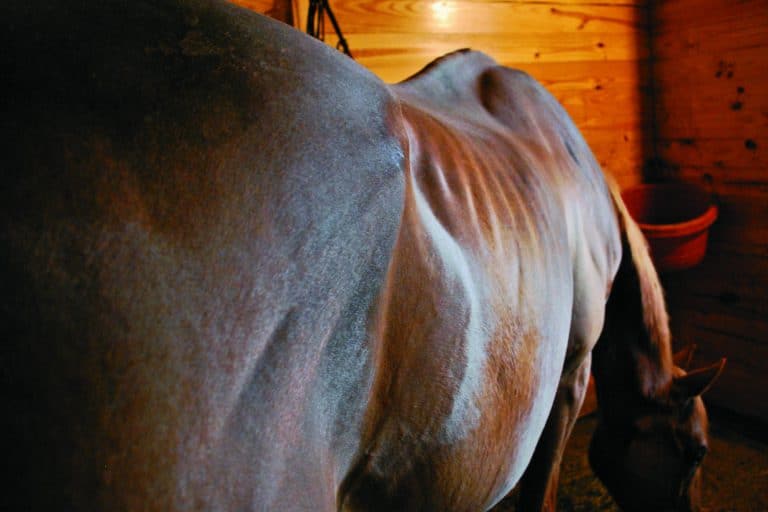
Horses with hyperkalemic periodic paralysis (HYPP) need careful dietary management to reduce or eliminate its characteristic muscle dysfunction attacks.

Horses with hyperkalemic periodic paralysis (HYPP) need careful dietary management to reduce or eliminate its characteristic muscle dysfunction attacks.
More than a half-century ago, noted science fiction author Isaac Asimov began his acclaimed series of Robot novels, examining increasingly complex interactions between humans and robots in a future world. Asimov’s underlying premise for the books was that robots had advanced sufficiently to become sentient beings. Questions raised by this development include whether robots should be
Horses often get banged and bruised by running into things, being kicked by another horse, falling down when running and bucking, etc. It’s not unusual to suddenly discover your horse has a large, soft lump on some part of his body. The most common areas are the hindquarters, chest, or along the ribs. The skin might not be damaged, but the injured tissues underneath can bleed or ooze serum,
They come in various colors and sizes. Some weigh 50 pounds, others a pound or less. But how do we know which salt and/or mineral block to place before our animals? Should we offer all of them and let the horses choose? Can a horse actually get enough salt and minerals from a rock-hard block to meet his needs? Shouldn’t we simply buy feed that already contains the necessary ingredients for a
Is there an uglier word in medicine than “cancer?” This is true in human and veterinary medicine. Many of us view cancer as invasive, debilitating, and fatal. But those who know horses know that while cancer occurs in equids, most of these cancers are sarcoids and melanomas–cancers that are generally benign, but should receive attention from a veterinarian to ensure they aren’t a danger to
When a weanling on a North Carolina breeding farm was diagnosed with larval cyathostominosis, Dianne Little, BVSc, MRCVS, equine surgery resident and PhD candidate in the Department of Clinical Sciences in North Carolina State University’s (NCSU) College of Veterinary Medicine, was suspicious of anthelmintic resistance. Parasites resistant to dewormers and associated diseases, such as larval
A diagnosis of sacroiliac joint (SI) pain tends to be one of exclusion, after other causes of hind limb lameness have been ruled out. To simplify the diagnostic process, researchers in the United Kingdom conducted a study involving 74 horses suspected of having SI pain. The objective was to use both nuclear bone scan (scintigraphy) and a local anesthetic block to positively identify abnormal
If you’ve been around horses, particularly performance horses, for even a short while, you’ve probably met someone who’s had a horse’s joints injected. The procedure–which involves injecting medication directly into the joint to combat such problems
I’m amazed at some of the angry reactions that followed our publication of a news item last month on a hereditary disease called hyperelosis cutis (HC) or hereditary equine regional dermal asthenia (HERDA). Some of the researchers involved–Ann Rashmir, DVM, MS, Dipl. ACVS, associate professor of surgery and head of the Hyperelastosis Cutis Research Program at Mississippi State University, an
All in all, vaccine reactions are very rare, and the process of vaccination against a disease process is one of the best ways you can safeguard your horse’s health. Vaccination is one of the most impressive discoveries of modern medicine; the ability to protect a horse against the ill effects of several severe and often fatal diseases is a huge benefit. However, you should understand the
“West Nile virus (WNV) is the number one diagnosed neurologic disease in horses, or close to it,” said William Saville, DVM, PhD, Dipl. ACVIM, of The Ohio State University, at a March 10 Fort Dodge Animal Health educational seminar for veterinarians held in Lexington, Ky. “Because of the decreased number of cases in 2003 compared to 2002, people are starting to think we’ve got WNV under
Horse owners and veterinarians alike have wondered if they can use Merial Limited’s Recombitek equine West Nile virus (WNV) vaccine in horses previously vaccinated with Fort Dodge’s West Nile-Innovator. Recently, Merial released the results of a study investigating this issue.
In the study, 27 horses were vaccinated in spring of 2003 with a two-dose initial series of Innovator per label
Thirteen horses in the Western Cape, South Africa, are believed to have succumbed to an outbreak of African horse sickness (AHS) by March 22, according to several news reports. The affected horses were from the Stellenbosch magesterial district and surrounding areas, reported www.sabcnews.com.
The first cases occurred at the Elsenburg
The American Association of Equine Practitioners (AAEP) issued a call in March for proposals to research the efficacy of aminocaproic acid and/or conjugated estrogens related to use as race day medications for the prevention of exercise-induced pulmonary hemorrhage (EIPH).
The use of aminocaproic acid and conjugated estrogens, commonly known as adjunct bleeder medications, was cited as a
Anvils on wheels, horses on loading docks, and a fleet of oversized pickup trucks from nearly every state in the union were evidence that the farriers had come to town. Close to 1,000 farriers, friends, and trade show exhibitors jammed the Rochester Convention Center in Rochester, N.Y., Feb. 24-28, for the world’s largest single gathering of the hard-hammering professionals–the annual
Patricia N. Olson, DVM, PhD, joined Morris Animal Foundation (MAF) as executive director on April 19. Olson brings more than 30 years of experience in the veterinary profession, education, non-profit, corporate, and public policy fields to the 56-year-old animal health-focused organization. She replaces Robert Hilsenroth, DVM, who is retiring as the executive director after 12 years of
Stay on top of the most recent Horse Health news with