Consider the reasons your horse needs to gain weight and learn how to help safely and effectively
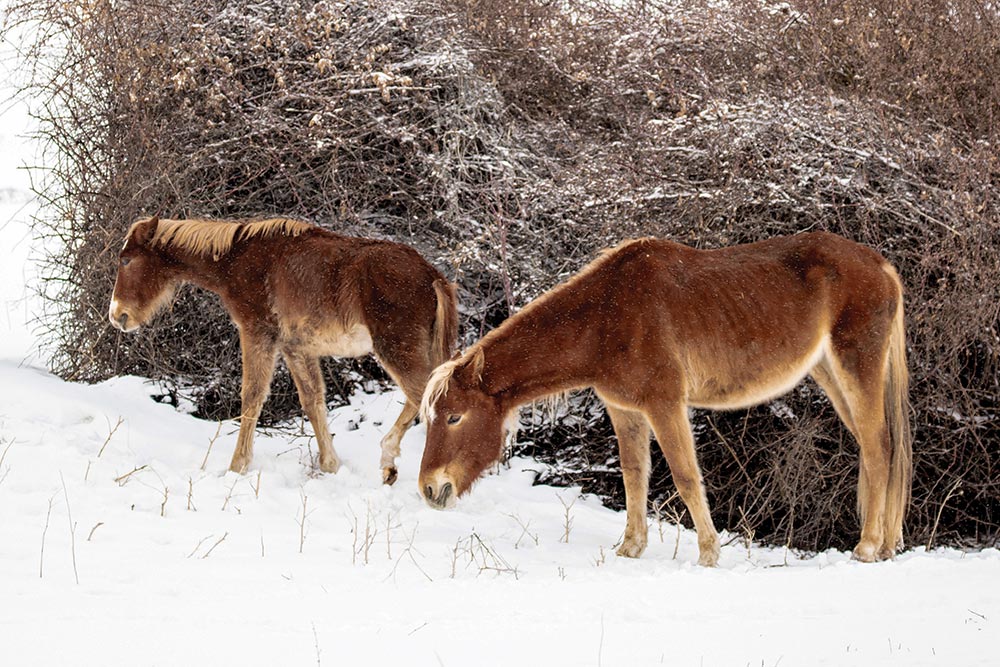
Horses are individuals and, therefore, how you manage and feed one might not work for the next. For example, in a barn of 20 horses doing the same work, diets almost certainly vary, even when weight and workload match.
Nutritionists often call this difference keeper status. They classify horses as easy, average, or hard keepers based on how readily they gain and maintain weight.
Defining A Hard Keeper
“The terms ‘easy’ and ‘hard keeper’ are relative,” says Devan Catalano, PhD, assistant professor of equine science and equine extension specialist at Colorado State University, in Fort Collins. “When we say a horse is an easy keeper, what we mean is that relative to the average horse they’re metabolically thrifty and need less calories to maintain their weight. On the flip side, a hard keeper requires more calories than the average horse to maintain that same weight, despite other variables such as breed or workload being the same.”
Authors of the Nutrient Requirements of Horses (NRC, tinyurl.com/58suhcd2) take these differences into account. When planning your horse’s diet, you can refer to the recommended digestible energy supplementation levels for your horse based on weight, workload, and keeper status. “The NRC recommends 10% more energy be fed to horses that are classified as hard keepers,” says Christine Skelly, PhD, associate professor and equine extension specialist in the Department of Animal Science at Michigan State University, in East Lansing.
“Hard keepers might have either reduced efficiency of extracting nutrients from the diet; sometimes this comes with age or underlying medical conditions, or it could be due to environmental or physical factors,” says Carissa Wickens, PhD, associate professor and equine extension specialist at the University of Florida, in Gainesville.
Further, “if you look at a breeding farm for example, there might be some horses that are running around all the time and very active in the paddocks, whereas others might not be,” says Skelly. “The horses with more voluntary movement will require more calories.”
“Additionally, I think that it’s important to make the distinction between a hard keeper and a horse that is simply in heavy work and burning a lot of calories,” says Catalano.
Breed Differences
Some breeds have a reputation for being harder keepers (think Thoroughbreds), while others get labeled as easy keepers (Quarter Horses).
“Within any breed you could have the whole spectrum of easy to hard keepers,” says Catalano. “You can have a mellow Thoroughbred that’s an easy keeper, or you could have a Quarter Horse that is a nervous nelly and burns off their calories faster than a typical Quarter Horse can take them in. So, instead of relating it to breed, I would say that it is related to disposition. If you have a more anxious, higher-strung horse that is naturally exerting more energy, they’ll tend to be a harder keeper than a relaxed, mellow horse that just stands in the field.”
Changes in Health Status
For horses that have lost weight or struggle to maintain and gain weight, your veterinarian must be involved to rule out or treat health issues. Horses dealing with pain, certain health conditions, or high parasite loads might struggle to maintain weight. These horses need medical attention, not just more calories.
“Certain diseases (such as pituitary pars intermedia dysfunction, kidney or liver diseases, and cancer) can make a horse look like they are a hard keeper, so without proper veterinary care and treatment, you may be missing the boat,” says Skelly. “Beyond specific diseases, general annual maintenance is critical to ensure that their dental hygiene is top notch and that they’re free from parasites as much as they need to be.”
Senior horses experience health changes as they age, and regular veterinary care supports them into their senior years. Keep in mind a horse might become a hard keeper when he never used to be one. “As horses get up into their teens, they are traditionally going to start losing weight,” she notes. “Some of that is a dental issue, and some of that is that they’re not able to process their feed the way they used to.
“I had my first horse, Blue Bonnet, and she lived to be in her 30s,” Skelly adds. “She was always an easy keeper. I look back at photos of her at the Houston livestock show and think, ‘Oh my gosh, she is so fat!’
“But then I remember going off to college and coming home to her being very thin,” she continues. “At this point she was in her 20s, and she was being fed the same as she always had been; however, it just wasn’t enough anymore. As soon as we switched her over to a senior feed, began feeding her four to five times per day, she was back exactly where she needed to be within four months.”
When weight loss occurs in these horses, call your veterinarian first to rule out any health conditions. Then, after health care has been addressed, adjust their nutrition.
Forage Considerations
Forage should form the foundation of every equine diet, so evaluate both the quality and amount you provide. “When we ask horse owners, ‘How much forage are you feeding?’ they might say they offer two flakes in the morning and three flakes in the afternoon,” says Wickens. “But how much does each flake weigh? So, before we start looking at concentrates or fat supplements, it’s important to make sure horses are being provided with enough forage each day.
“Depending on the type of forage you’re feeding, if it’s a legume hay, or a grass hay, they will differ in terms of weight,” she adds. “So, owners should be weighing their feed.” You don’t need to weigh hay every day—just know what flakes from your current hay supply weigh—but quantifying your hay ensures you’re meeting forage requirements of at least 1.5-2% of your horse’s body weight.
Forage quality matters as much as quantity. The nutritional content of hay and pasture varies significantly depending on factors such as plant species and maturity.
Skelly says that for horses struggling to maintain weight during grazing season, she recommends turnout on grass that’s about 4 to 8 inches tall. “Sometimes that’s prohibitive, so you need to regroup and maximize your hay program” she says. “That might include bumping up from a grass hay to one that has greater legume content.” (Alfalfa is a legume, for example.)
“Grass hay that is leafier and has fewer seed heads—which indicates a lower maturity—will have more calories per pound,” notes Catalano. “Despite that, you can’t determine energy density visually, so a more straightforward route is to look for hay that has alfalfa mixed in with the grass. I try not to go above 50% alfalfa (from a calorie and nutritional standpoint), but you can either buy hay that is already mixed, or you can buy grass hay and alfalfa hay and feed some of both each day.”

Considering Concentrates
Supplemental concentrates increase the amount of calories the horse consumes to promote healthy weight gain and improve his body condition.
“There are several commercial feed products available for horses that are higher fat and fiber,” says Wickens. “These feeds include highly digestible fiber sources—ingredients such as beet pulp. We still want to be careful to avoid feeding large amounts of high-starch and -sugar concentrate so that we’re not creating an environment … that might be conducive of gastric ulcers, so inclusion of fat and fiber in the horse’s diet in consultation with an equine nutritionist is recommended.”
“Before I look at adding fat supplements, the amount of concentrate being fed can often be increased,” says Catalano. She says she works with a lot of horse owners who want to add a fat supplement when their horses struggle to gain weight, but often it’s more practical—both in terms of labor and cost—to increase the horse’s concentrate ration first and then reevaluate his condition after 30 days.
Adding Fat Supplements
Beyond choosing a quality concentrate and feeding it at an adequate amount, calorically dense fats can be a useful addition for a horse needing to gain weight.
“Top dressing your feed with some oil is a great way to increase calorie intake,” says Skelly. “You can get really expensive oil that has a lot of bells and whistles to it with the omega-3s and everything, which is great, or you can get vegetable oil.”
“My go-to vegetable oil is canola,” Catalano continues. “Of what I call economy oils it has the most favorable omega-3 to -6 ratio relative to soy or corn oil. If you’re concerned about the omega-3 content (needing to add more omega-3s to properly balance the omega-3 to -6 ratio in your horse’s diet and reduce inflammation), add flax oil or opt for a commercial oil that has a listed omega-3 content.”

You can also feed powdered fat supplements. “Some have flavor added, which might be necessary for picky horses; however, the serving sizes tend to be small—so the math just doesn’t work out,” Catalano says. “Even one ounce of 100% fat is still not much to elicit significant weight gain.”
Other Hard Keeper Management Considerations
When managing a hard keeper, consider how and where you feed the horse. “Most of the time horses are fed in a group setting, so they have competition for the feed resources provided,” explains Wickens. She notes that even a well-balanced diet won’t help if a horse gets pushed off his feed and starts losing weight. In group settings farm managers must provide enough space and resources so that every horse can eat without conflict.
When housing a harder keeper, managing stress plays a key role, too. Horses handle housing situations differently. “Reducing outside stressors is important,” says Catalano. “Some horses are content in a stall at night; some horses hate it. So, if they are nervously pacing all night, that will burn a lot of calories. Adjusting your housing and turnout style to reduce stress can be an additional management change to support harder keepers in maintaining a healthy body condition.”
Take-Home Message
Harder-keepers generally need more calories than the average horse to maintain a healthy body condition. Horses of any breed, type, or age can be hard keepers, so avoid generalizations and treat every horse as an individual.