Q: What management changes can owners make for horses with asthma?
A: This is such an important question. Management changes are really the most critical part of dealing with these horses with asthma. The crux of the issue is trying to reduce exposure to the allergens that trigger the horse’s asthmatic episodes, which can be hard to do.
I don’t know any barn that doesn’t have some degree of dust in it. If any horse on the property eats hay, there’s going to be some hay dust. Then there are horses allergic to things in the environment, such as different kinds of tree or grass pollen, and that’s just impossible to avoid. A part of managing this involves getting to know your horse and understanding what triggers his asthma.
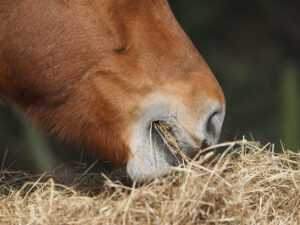
A lot of horses are triggered by hay and hay dust. So, for those animals, it can mean eliminating hay from their diet. You might feed a pelleted feed, soaked alfalfa cubes, or even some low-dust chopped hay products. Some horses do well staying on hay as long as the hay is steamed or soaked so that there’s no dust in it. Other horses are not bothered by hay, but they struggle more in the summer with pasture-associated asthma. Those horses need to be removed from whatever pasture triggers it.
Sometimes management means changing to a different pasture, coming into an arena turnout instead of a grass pasture. Other times, when the horses are triggered by everything outside, it’s getting them in the barn more. Although turnout can help some horses with asthma, there’s the subset of horses more triggered by the pasture, so the first management change is understanding when your horse’s signs are the worst. Is it in the spring when there are certain kinds of pollen out? Is it the middle of the summer when there are certain kinds of grass out? Or is it in the winter when you’re feeding various kinds of hay? Then avoid the triggers once you understand them.
In other horses, finding specific triggers such as certain types of feed can sometimes be done by allergy testing ideally through skin testing. In rarer cases, it’s not so much just managing dust exposure, grass, and hay exposure, but rather managing exposure to certain types of feed that might trigger a horse.
When researchers compared horses that had management changes to reduce the dust and triggers in their environment, horses treated with just steroids, or those treated with management changes and drugs, they found horses treated with medication alone exhibited the worst clinical signs. This highlights the importance of management changes.
Related Content | Ask TheHorse Podcast: Managing Asthma in Horses