When horses crib, weave, or repeatedly stall-walk, it can be tempting to blame boredom. But these repetitive, unvarying, seemingly functionless behaviors, known as stereotypies, often reflect deeper unmet needs.
“As horse owners and facility managers, we often refer to boredom being at the root of undesirable behaviors,” says Carissa Wickens, PhD, associate professor and extension equine specialist at the University of Florida, in Gainesville. “But if we think about how the horse evolved and what they’re meant to do in terms of their behavioral routines and biology, boredom simplifies it a bit too much.”
How and whether boredom contributes to stereotypic behaviors remains a bit of a question mark, says Camie Heleski, PhD, a senior lecturer in Ag Equine Programs at the University of Kentucky, in Lexington. One challenge involves the lack of clear cause-and-effect relationships. Horses can respond very differently to similar environments.
“Stereotypic behaviors tend to develop in response to some level of poor welfare, and so it becomes a coping mechanism,” Heleski says. “You can have a horse that has all sorts of inappropriate housing and never becomes stereotypic. On the other hand, you can have another horse that only has a two-week stall rest period recovering from an injury or illness, and they develop stereotypic behavior.”
Horse Boredom vs. Stereotypic Behaviors
“We have a solid body of research that consistently shows some of the risk factors for development and continued performance of stereotypies, which include social isolation, limited forage availability, limited turnout, or limited natural grazing time,” Wickens says.
Heleski also cites researchers who found higher rates of stereotypies later in life among horses weaned early and abruptly.
Some researchers have linked cribbing to equine ulcers. “There’s been some thought that these youngsters figure out when they crib, they emit more saliva,” says Heleski. “That saliva goes down to the stomach and helps buffer the pH. But this is not straightforward, and we need more research.”
Boredom, on the other hand, might simply result from inactivity or a lack of variety in a horse’s daily routine. Bored horses might appear restless, disengage during work, or exhibit unwanted behaviors. However, these behaviors can also indicate pain or other problems, so owners shouldn’t automatically attribute them to boredom.
Managing Stereotypic Behaviors in Horses
Providing the three Fs (friends, forage, and freedom to move) can help reduce the risk of developing stereotypies.
“For some of the locomotor stereotypies, like weaving or stall walking, providing access to social companions can help reduce the behavior,” Wickens says. “Oftentimes, when we turn those horses out into a bigger paddock, or where they have social contact, those locomotor stereotypies almost completely stop or at least get much better.”
Of all the stereotypies, cribbing tends to be the most common and challenging to manage. Unfortunately, by the time a horse becomes a cribber, the behavior is typically resistant to change, Heleski says.
“This is why it’s so important to try to prevent it,” she adds. She describes a cribber that gradually cribbed less after being turned out in large pastures with other horses and fed free-choice forage. When he returned to the stall, however, the behavior resurfaced.
Cribbing collars are often the go-to tool for reducing cribbing but carry their own risks during turnout, similar to halters, especially if fitted improperly.
“I have mixed feelings on crib collars,” Heleski says. “If we think about cribbing as a coping mechanism, maybe I shouldn’t try to stop him. That can be a really hard thing for people to be okay with.”
3 Boredom-Busting Tips
Rather than trying to stop unwanted behavior, focus on meeting a horse’s physical and mental needs. Small changes in environment, feeding, and routine can significantly improve social engagement and overall well-being.
1. Offer a variety of forages.
“We’ve seen research that shows that a variety of forage types and forage spread out in different locations can promote horses’ natural patch foraging behavior,” Wickens says. “If you give them variety or spread it out, they will spend time smelling, investigating, taking bites, and visiting the various forage sources.”
2. Encourage curiosity.
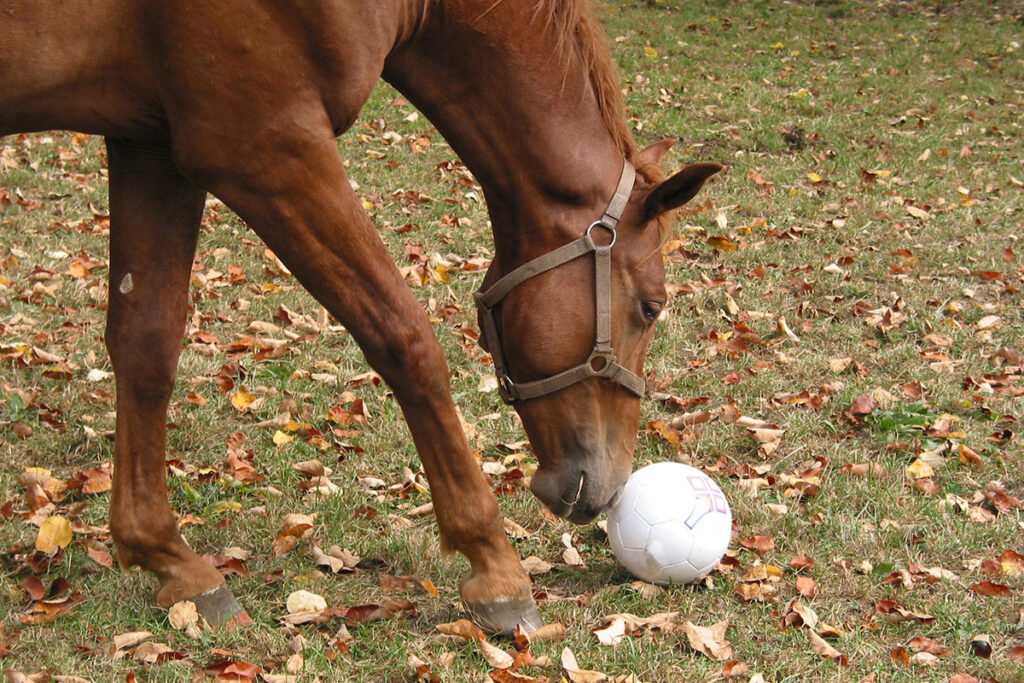
Toys, food-dispensing devices, and pasture enrichment designs, including track systems, can encourage movementand satisfy natural curiosity. Facebook groups exist where horse owners share a variety of enrichment ideas to engage their horses while in the barn or on turnout.
“Food balls and other toys they have to manipulate for little bits of feed and things like that can be helpful because it stimulates more natural feeding and gives them some enrichment in the stall or paddock,” Heleski says.
3. Introduce variety.
Even horses in regular work can become bored with the routine. To add variety, consider trail riding or hauling to a different place to ride, introducing new exercises, or incorporating new maneuvers or obstacles into riding sessions.
Take-Home Message
Whether your horse seems bored or has developed stereotypic behaviors, providing opportunities to socialize, forage, and move freely can help meet his behavioral needs.