
Listen to this article:
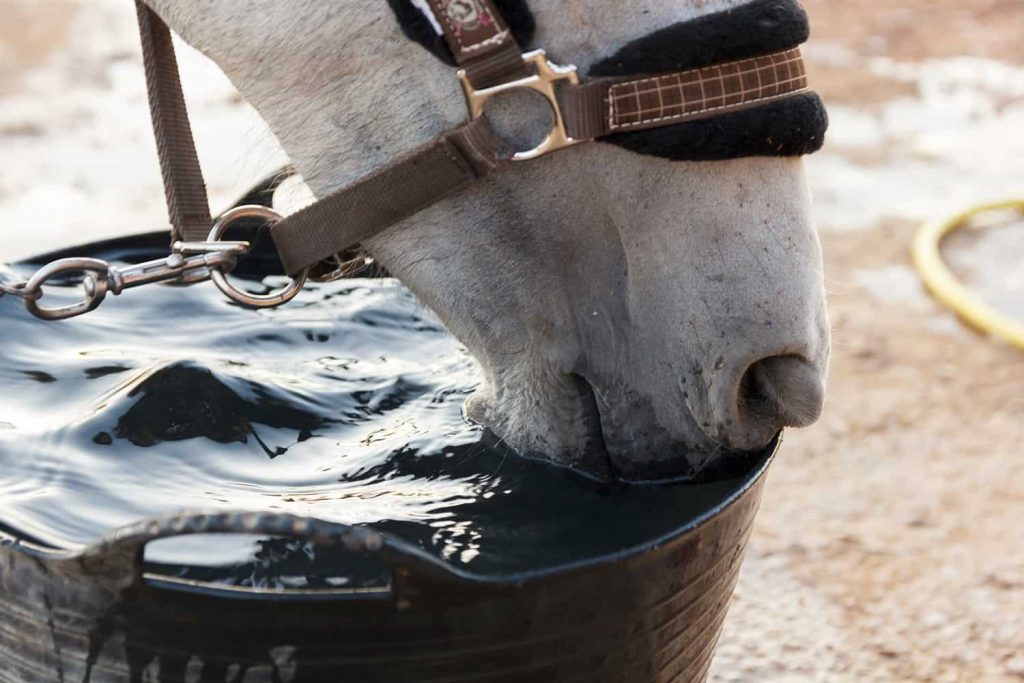
Q. Recently my horse tied-up while running cross-country. This has happened before but not for well over a year. He’s not a good drinker while traveling and barely drank 15 gallons over three days, which actually is more than normal when away from home. My vet thinks the tying-up is most likely related to hydration. What can I do to get him drinking more?
A. Having a horse that won’t drink while traveling and staying away from home is both frustrating and concerning. It can be near impossible to make a horse drink, but the good news is there are some things you can try.
My first recommendation is to increase the horse’s daily sodium intake. Sodium helps stimulate thirst, so maintaining adequate amounts in your horse’s blood is very important. Horse sweat contains a lot of chloride and sodium, so it’s possible that if your horse is sweating heavily, his sodium levels can drop, resulting in a reduced desire to drink.
A 1,100-pound horse needs about 1 ounce of salt per day for maintenance. The purpose of daily sodium intake is purely to meet maintenance needs, not to replace those electrolytes lost in sweat. Many people rely on salt blocks for their horse’s sodium, but few horses really use a salt block, at least not adequately enough to meet their maintenance sodium levels. I generally recommend giving 1 tablespoon of salt or concentrated electrolyte per 500 pounds of body weight. While a salt block should always be available, my preference is to add a source of sodium to the horse’s feed every day. This could be as simple as adding salt, or if your horse is picky, he might find a quality electrolyte more palatable.
From this base starting point, you will need to administer additional electrolytes any time the horse sweats, which includes long trailer rides to events. Feed a well-formulated and concentrated electrolyte as directed by the manufacturer. When buying an electrolyte, make sure the first ingredient is not sugar. If it is, actual electrolyte levels will not be high enough to have any meaningful effect.
Typically, I find that increasing the horse’s sodium intake does the trick for horses that don’t drink when away from home. However, there are those for whom this alone will not suffice. So other ways you can encourage drinking and get water into your horse include making sure the water is warm enough, soaking hay, putting apple juice in the water, turning grain meals into gruel, and putting a handful of grain in the water bucket. Note that if you put a handful of grain in the water, you might need to empty and clean that bucket more regularly. Anytime you put something in a water bucket, such as a handful of grain or dissolvable electrolytes, always provide a second water source with nothing added to it, so the particularly picky horse has an option to drink plain water if he refuses to drink water with additives.
Hopefully your horse’s tying-up issues are just related to hydration, and the bloodwork your veterinarian will have pulled should indicate whether hydration is the main suspect. However, you and your vet will want to rule out a couple of other causes. Take, for instance, a vitamin E deficiency. Horses with inadequate vitamin E tend not to recover from exercise as well or as quickly, and over time they generate the risk of developing conditions such as equine motor neuron disease, so having their levels checked by your vet is a very good idea.
Finally, if these things do not help, you will need to talk to your veterinarian about completing a thorough workup. It’s possible your horse could suffer from a neuromuscular condition such as polysaccharide storage myopathy (PSSM), which would cause repeat tying-up episodes. Once properly diagnosed, you can often manage such conditions successfully.
Hopefully, you can identify the cause of this issue, your horse will start drinking well, and he won’t experience any additional tying-up episodes.





2 Responses
All of these recommendations are great but here is one trick that we used.. We always prepared to make sure our livestock would stay hydrated when traveling to a show where we knew the water had a particular odor… We would add a little molasses to the water at home for a week or so before travelling.. just enough to flavor the water a bit.. then we would do the same at the show venue after we arrived.. Never had a problem.. of course we always made sure that they had adequate salt in the diet..
I have found it extremely useful to teach my horses to drink on cue. It is actually easy to do if your horse tends to like to take a drink after exercise. All you do is lead your horse to his water when you know he is likely to be thirsty (hence why post-exercise works well), point to the water, and give him whatever verbal cue you want to use (I just say “Drink!” in a certain tone of voice). At the moment he takes a drink, you say “Good!” and offer him a treat. It helps if your horse already knows that “Good!” marks a correct behavior and gets him a reward, but not absolutely necessary. Do this a few times over a few days, and then try taking the horse to the water at a different time (not post-exercise). The horses I have taught this to figure it out usually in one or two sessions. Sometimes, if they are not thirsty, they will just put their lips in the water and play with it, but I simply say no, then repeat my request. They learn very quickly that they don’t get a reward unless they actually swallow some water. I can use this to get them to drink before they go in the trailer or whatever. See, you CAN lead a horse to water and make him drink!