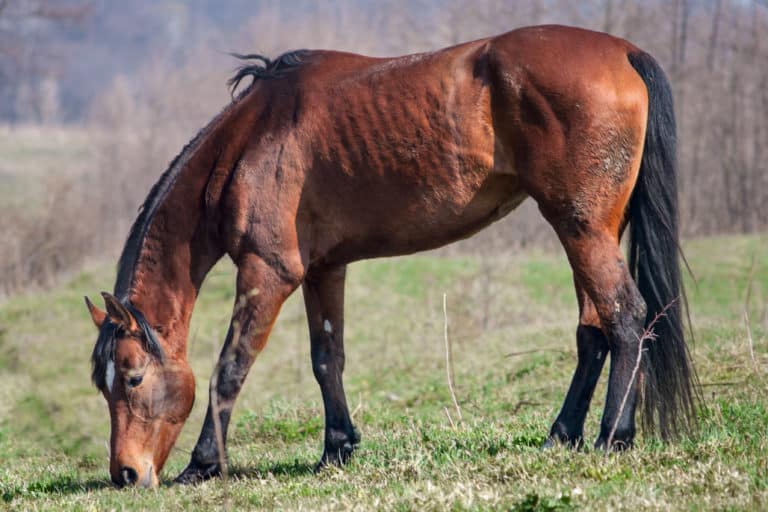
Keegan said most equine practitioners use head movement to determine forelimb lameness and pelvis movement to clarify hind limb lameness. He added that multiple lamenesses can certainly complicate the issue.
Twenty-four, seven–that’s what caring for horses entails. Twenty-four hours a day, seven days a week, horses are the responsibility of someone. And that’s if they are young and healthy, turned out, and don’t need special care. If they have physical or psychological problems, or if there are special needs that must be seen to, care can become time-consuming and expensive. Then multiply that b
We’ve all heard of people and animals that are “sensitive” to anesthesia. Monica Aleman, MVZ, PhD, Dipl. ACVIM, head of the neuromuscular disease lab at the University of California, Davis, reported on a genetic problem called equine malignant hyperthermia (EMH) that can make simple anesthesia deadly for some horses. Malignant hyperthermia-like
Ten years after a deadly virus was first discovered in Australia, it has reared its ugly head once again. A horse near the Townsville area of Australia was diagnosed with Hendra virus, a deadly equine morbillivirus, on Dec. 14, 2004, and it was later euthanatized. A short time earlier, a veterinarian in the Cairns area was diagnosed with a mild case of the Hendra virus, but that individual
The Frank J. Milne Lecture was presented by Peter Rossdale, OBE, MA, PhD, Dr. (h.c.) Berne, Dr. (h.c.) Edinburgh, DESM, FACVSc, FRCVS. The title of his talk was “The Maladjusted Foal: Influences of Intrauterine Growth Retardation and Birth Trauma.”
Rossdale’s primary area of research is equine reproduction, and he has won many awards and honors for his work in this field. He is a past
Stephanie L. Church, Editorial Director
March 3, 2005
Illinois agriculture and health officials reported in early January that a LaSalle County horse tested positive for rabies at the Illinois Department of Agriculture laboratory in Galesburg on Dec. 10, 2004. Eleven people received preventive rabies treatment following exposure to the horse. Another domestic animal rabies case–a cow–was confirmed in eastern Bureau County on Jan. 13.
Once a mare is diagnosed with placentitis, he said, it is incumbent upon the veterinarian to inform the owner about potential outcomes. The underlying message was that treatment of a premature foal in an intensive care facility can be expensive, with no guarantee of a positive outcome.
New Mexico and Colorado have been removed from the Kentucky list of vesicular stomatitis (VS)-embargoed states. Neither state is experiencing active cases of VS and there are no premises currently under quarantine as a result of past infection.
Bans were imposed beginning in May 2004 after a VS outbreak was reported in Texas. Embargoes were placed on animals from New Mexico in June 2004
“You think breeding mares on foal heat is tough, try dead mares!” said Elaine Carnevale, DVM, PhD, professor in equine reproduction in the department of biomedical sciences at Colorado State University (CSU), with a laugh as she began her talk following a presentation on foal heat breeding success. Her presentation covered CSU’s work with
The USDA’s National Animal Health Monitoring System (NAHMS) will be conducting an Equine 2005 study, which will examine equine events and on-farm health management factors as they relate to the control of equine infectious diseases.
NAHMS conducts national studies on the health and management of America’s domestic livestock populations. In 1998, it took its first in-depth look at the U.S
Several studies have been conducted on extracorporeal shock wave therapy (ESWT) at various institutions this past year. One presented by C. Wayne McIlwraith, BVSc, PhD, DSc, FRCVS, DrMedVet (hc), Dipl. ACVS, director of Colorado State University’s Gail Holmes Equine Orthopaedic Research Center, involved ESWT’s effects on osteoarthritis. In a model of induced
It is well documented that the equine fatality rate for hurdling and steeplechase racing is significantly higher than that of flat racing. The disparity in fatality rates is likely due to the fact that the types of injuries sustained in jump racing differ from those sustained in flat racing. Some catastrophic injuries, such as vertebral fractures, occur more frequently in horses racing over
Many unethical and/or unlicensed products cause frustrations for manufacturers who spend millions of dollars researching new drugs, just to have illegal products claiming equivalency and taking product sales from licensed products. To add to the problem, many of the illegal products are not efficacious, or might not even contain the active ingredient.
Controversy over medication and drug testing has been around since organized equine competitions came into being. There has always been more disagreement than agreement among the various factions involved, and more contention than harmony. Drug testing is a legal part of nearly all breed and discipline competitions these days, and much of what is done in regard to drug testing in other
Vaccinating large populations of wild mice against the bacterium that causes Lyme disease could one day help reduce the risk of transmission of the infection to horses.
A recent study, supported by the National Institute of Allergy and Infectious Diseases, demonstrated that the vaccination of wildlife hosts might be a promising, ecologically based strategy to help prevent the spread of
The American Association of Equine Practitioners (AAEP) made the welfare of unwanted horses in the United States a priority for the foreseeable future, according to AAEP leaders during the annual convention.
While the AAEP’s stand against the national bill that bans slaughter of horses has been seen as a negative by many horse owners, the AAEP is not pro-slaughter, but pro-horse, said