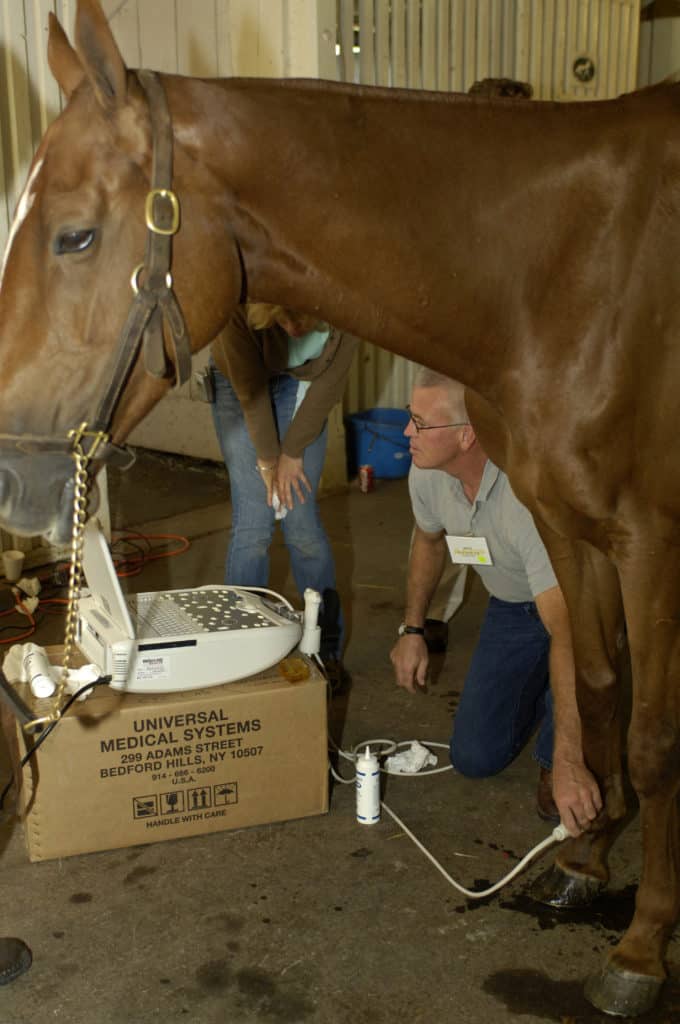
Ultrasound Beats X Rays for Identifying Articular Lesions
Researchers reviewed records of 432 lesions in 254 joints on 137 horses and identified 83% of the lesions via ultrasonography and identified only 62.2% of the lesions using radiography.

Researchers reviewed records of 432 lesions in 254 joints on 137 horses and identified 83% of the lesions via ultrasonography and identified only 62.2% of the lesions using radiography.
The ASPCA announced a $100,000 grant to the Science and Conservation Center in Billings, Mont., to construct the Henry Bergh Training Annex to train professionals in administering fertility control to wild horses.
The District Attorney in Wallowa County, Ore., has dismissed charges against a breeder of Portuguese Lusitano and Andalusian horses accused last year of maltreating more than 100 horses at her farm.
An effort to make Kentucky the first jurisdiction to ban the anti-bleeder medication furosemide for racing purposes failed when the KHRC voted 7-7 not to approve a recommendation that would have phased out the medication over a three-year period.
Alice Stack, MVB, Dipl. ACVIM, of Michigan State University is researching exercise-induced pulmonary hemorrhage (EIPH) with Fred Derksen, DVM, and Ed Robinson, BVetMed, PhD, MRCVS.
The BLM is offering a $1,000 reward for information leading to the arrest and conviction of whoever is responsible for the fatal shooting of two wild horses discovered dead in the Newland Reservoir area in northeastern Lassen County, Calif.
Revised regulations adopted by the West Virginia Racing Commission (WVRC) would allow the agency to take action against permit holders found to have knowingly sold a horse for slaughter. The regulations also allow for action in cases of horse abuse.
Two horses competing in Great Britain’s famed Grand National steeplechase were euthanized after sustaining serious injuries during the race, which was held April 14 at Aintree Racecourse near Liverpool, England.
Forty horses were contained in the barn at the time of the blaze. Of those, 18 were killed in fire. The McHenry County Animal Control personnel and volunteers rescued the remaining 22.

A French research team sequenced the genome of Taylorella equigenitalis, the causative agent of contagious equine metritis (CEM), as well as T. asinigenitalis, a closely related species generally isolated in donkeys.
Five hours of television broadcast and a live webcast of the entire competition highlight this year’s coverage of the Rolex Kentucky Three-Day Event presented by Bridgestone.
Equine practitioners are involved in evaluating populations of patients and making judgments on the appropriate course of action based on their own experiences or those of others, all of which culminates in a population-based approach.
North Carolina State University (NC State) College of Veterinary Medicine (CVM) will be hosting a large animal emergency rescue training presented by Technical Large Animal Emergency Rescue (TLAER), April 20-22.
Much of modern epidemiology is concerned with identifying and accounting for bias. Thus, understanding principles of epidemiology is a useful investment of time to make us better interpreters of clinical evidence and thereby better practitioners.
Veterinarians and horse owners worldwide are now realizing the problems resulting from following the traditional calendar-based deworming protocols for controlling strongyles and ascarids, one researcher says.
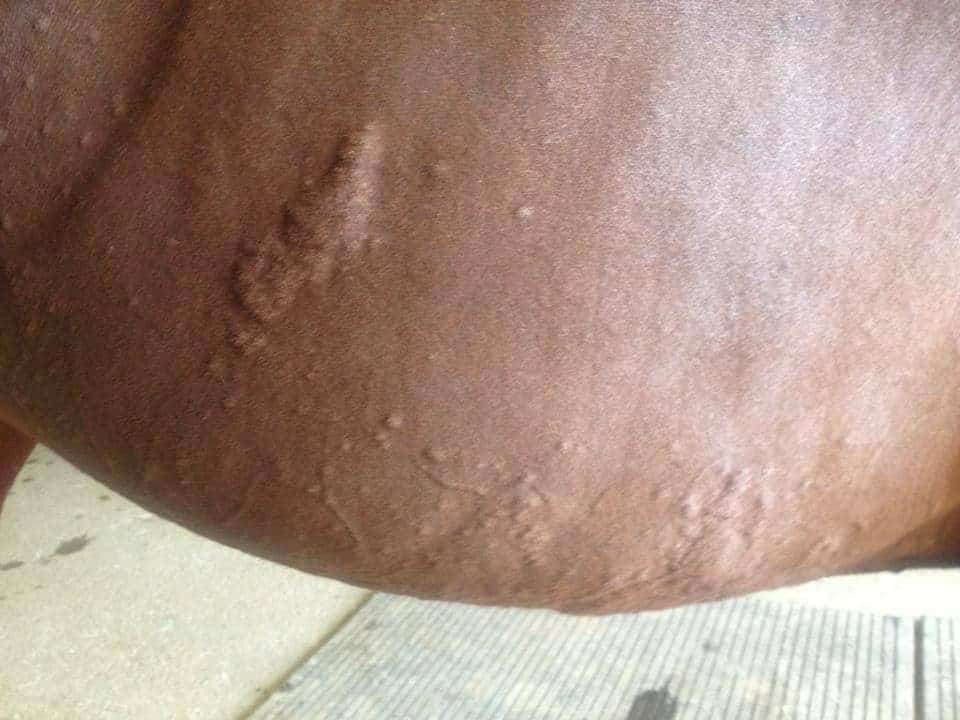
Allergic dermatitis in horses–simply, inflammation of the skin caused by an irritating stimulus–is a common yet often treatable and manageable problem with multiple causes.