Reproduction and Sports Medicine Update: AAEP 2007
Veterinarians who attended presentations at the event came away with 18 hours of continuing education credit and new knowledge of current topics in equine reproduction and lameness.

Veterinarians who attended presentations at the event came away with 18 hours of continuing education credit and new knowledge of current topics in equine reproduction and lameness.
During the past six years (Jan. 2, 2002 – Jan. 31, 2008), 1,429 cases of equine placentitis have been diagnosed at the University of Kentucky Livestock Disease Diagnostic Center (LDDC). Of these, 1,189 cases had an infectious agent identified.
When creating a feeding
As of April 14, a horse that had shown clinical signs consistent with equine herpesvirus myeloencephalitis while stabled at Murray State University in Murray, Ky., remains in guarded condition at a referral hospital in Lexington. Samples
Caretakers of the horses seized in a recent South Carolina abuse case got some good news last month, when one of the mares delivered a full-term foal.
“She’s just beautiful,” said Kelly Graham, director of public relations for the Richland
Based on the results of diagnostic tests, the Western College of Veterinary Medicine (WCVM) at the University of Saskatchewan has resumed all regular clinical services for equine patients at its Veterinary Teaching Hospital.
The decision,
Experts have reported that Eastern tent caterpillars are developing normally this spring and have just completed the egg hatch stage. Controlling the caterpillars is vital to area horse farms, as University of Kentucky research has strongly linked
One horse at the Murray State University Equine Unit in Murray, Ky., has tested positive for equine herpesvirus myeloencephalopathy caused by equine herpesvirus-1 (EHV-1), according to Rusty Ford, equine programs manager with the Kentucky
The Farm Animal Council of Saskatchewan and the Western College of Veterinary Medicine (WCVM) at the University of Saskatchewan are teaming up to present an informational seminar on equine herpesvirus Thursday, April 10, in Saskatoon, Sask.

Learn how your horse’s anatomy works with our complete anatomy and physiology guide, including basic terminology, skin, forelimbs, hindlimbs, feet/hooves, head and neck, tendons/ligaments, muscles, digestive, cardiovascular and reproductive systems.
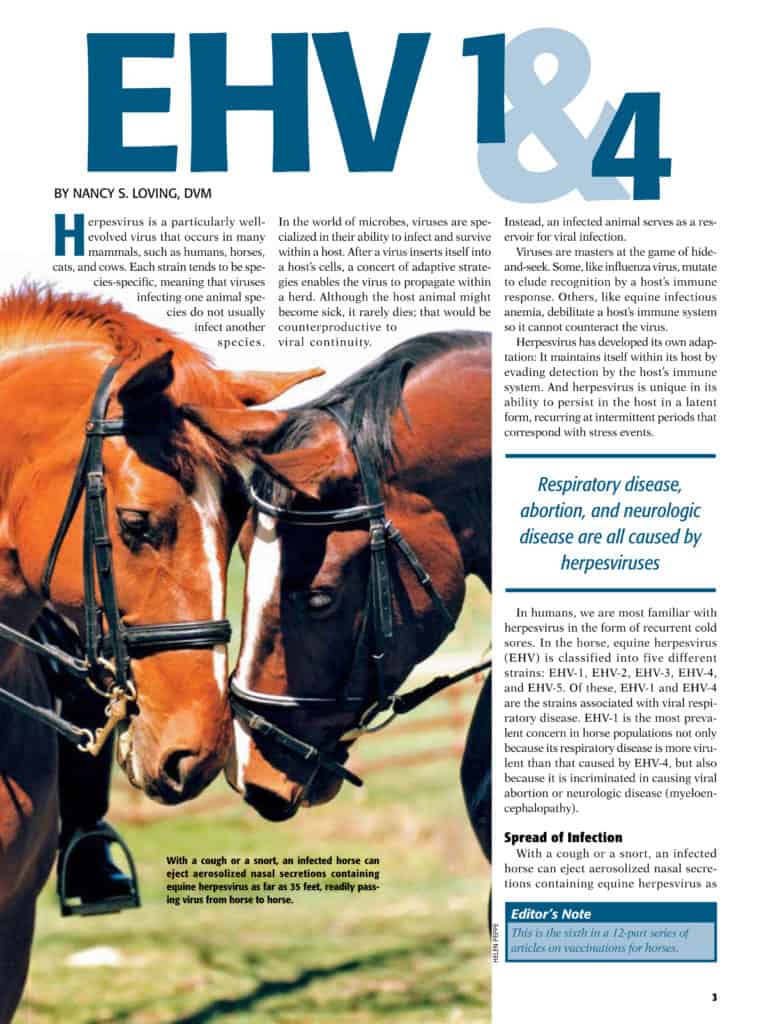
Respiratory disease, abortion, and neurologic disease in horses can all be caused by equine herpesviruses. EHV-1 and EHV-4 are the strains associated with viral respiratory disease, and EHV-1 can also cause neurologic disease…
More than 1,000 readers of TheHorse.com responded to a poll asking, “Have you ever had a veterinarian perform a Caslick’s procedure on a mare?”