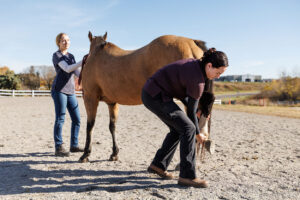
Arabian Registry To Require DNA Testing
DNA testing replaces blood typing as the Arabian Horse Registry of America’s required tool for verification.
Horse breeding from planning through foal care
DNA testing replaces blood typing as the Arabian Horse Registry of America’s required tool for verification.
Since the devastating disease process known as mare reproductive loss syndrome (MRLS) appeared on the scene in 2001 (and reappeared in 2002), concerted efforts have been focused on understanding and controlling the problem. Economic losses to th
Newborn foals are especially susceptible to gastrointestinal diseases such as clostridial enterocolitis, which is characterized by abdominal pain, diarrhea, toxemia, shock, or death without prior signs. While this disease occurs only
You’re preparing your mare for the upcoming breeding season. The stud owner insists on a bacterial culture of your mare’s uterus prior to live breeding to reduce the chances of her passing any sexually transmitted diseases (STDs) she might have
I’m considering using shipped cooled semen for my mare. How do I find a qualified facility?
Keeneland will catalog 3,597 lots for the November breeding stock sale in Lexington, Ky. The number is down by 12.6% from last year’s figure of 4,119. Tom Thornbury, Keeneland’s associate director of sales, identified the effects of mare
It was previously thought that modern horses were descended from a limited number of wild herds and were selectively bred, leading to the diversity in breeds that we have now. However, new DNA evidence suggests that horses have a more diverse
A mare (or mares) imported from North America to Victoria, Australia, is believed to be at the center of the latest outbreak of equine herpes virus (EHV-1), or equine rhinopneumonitis virus, in Australia.
As the Australian
Four interesting facts were brought to light because of the late-term abortion and Eastern tent caterpillar (ETC) study that was recently completed at the University of Kentucky, according to Thomas Tobin, MVB, MSc, PhD, MRCVS, Dipl. ABT, of the
The scientific community wrapped up a two-day workshop at the University of Kentucky’s Gluck Equine Research Center Aug. 28 with a thorough review of research into mare reproductive loss syndrome (MRLS). They put forth some ideas on how to
In the wake of a positive West Nile Virus (WNV) test on a Canadian Standardbred horse, almost 50 Thoroughbred shuttle stallions were released from Australia’s major quarantine station outside Sydney on the morning of Aug. 30.
The decisio
Through a unique collaboration with the USDA’s Agricultural Research Service (ARS), the University of Kentucky is launching an innovative new forage-animal research initiative. The program will discover new technologies to enhance the health and
A young breeder asked me if she could take a mare from her foal for one hour every day.
I have a Paso Fino mare whose due date is three months away and her milk bag is full, hot, and dripping very white milk. She has been waxed over for about a week now, but thankfully she seems to be in no distress. I can find no one with this
While most people don’t consider equine podiatry an artistic profession, Ric Redden, DVM, owner of the International Equine Podiatry Center and organizer/chief instructor of the first In-Depth Equine Podiatry Course going on this week, heartily
The Kentucky Thoroughbred Association (KTA) will offer a seminar July 25 to assist breeders in filling out loan applications for funding tied to mare reproductive loss syndrome. The money is available through a federal law enacted in
Stay on top of the most recent Horse Health news with
"*" indicates required fields