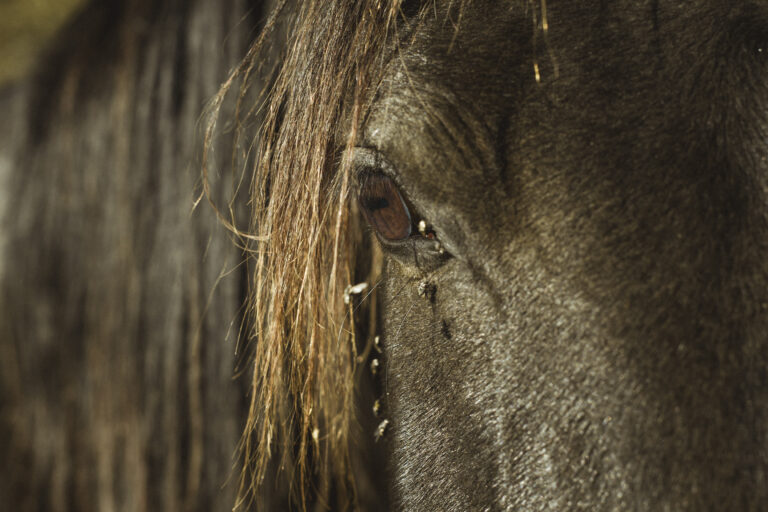
Readers Wage War on Muddy Pastures
More than 460 readers of TheHorse.com responded to a poll asking, “How do you manage mud around your barn?”
Horses and carriages play a role in nearly every important British royal ceremony–so much so that the royal stables and carriage houses, called the Royal Mews, are situated beside Buckingham Palace, the official London residence of the monarch.
The West Virginia Senate passed an overhaul of the state’s horse racing regulations Feb. 25, which include mandatory pre-race veterinary exams for horses. The revisions have met with some opposition from horsemen and breeders who claim their
The equine genetics research group at the University of Minnesota College of Veterinary Medicine is collaborating with Dr. Ray Geor, professor and chair of the department of large animal clinical sciences at Michigan State University, and Dr. Nicholas Frank, associate professor of large animal clinical sciences at the University of Tennessee, to investigate the occurrence and genetics of equine metabolic syndrome (EMS).
The University of Kentucky Maxwell H. Gluck Equine Research Center and Veterinary Diagnostic Laboratory is reporting an increase in the number of cases of fetuses and placentas submitted to the laboratory and diagnosed with nocardioform placentitis.
The Morris Animal Foundation (MAF) announced Feb. 2 that it would fund $10,800 for researchers at the University of Kentucky’s Gluck Equine Research Center to conduct a genome-wide association study of horses for susceptibility to equine arteritis virus (EAV). EAV is the causative agent of equine viral arteritis (EVA), which is characterized by upper respiratory tract disease in adult horses,
The UK Veterinary Diagnostic Laboratory, formerly the Livestock Disease Diagnostic Center, is offering a new test for the disease-causing bacteria of equine strangles, Streptococcus equi subspecies equi, that differentiates between vaccine-related and wild-type infections.
Kentucky Equine Research (KER) has established a graduate student fellowship at the University of Kentucky College of Agriculture to honor the memory of Larry Lawrence, PhD, who was a valued KER employee for many years.
The March 1 lecture will be presented by Elizabeth Davidson, DVM, assistant professor and sports medicine clinician at New Bolton Center.
The Louisiana State University (LSU) School of Veterinary Medicine has received a grant from the American Veterinary Medical Foundation (AVMF) for $20,000 in support of a State/Regional Disaster Management Training Program. The $20,000 from the AVMF is matched with in-kind gifts for a total value of $63,200. This program will provide emergency response training to aid animals before, during, and
On a warm spring night everyone in the barn is eagerly awaiting a new foal’s arrival. The wait is rewarded with the birth of a big, strong, and beautiful colt. During the next 12 months the foal thrives. The owners dream of having a future champion until one morning the farm manager notices the colt’s gait is abnormal, and he looks somewhat incoordinated (ataxic) in his hindquarters.
After being hit with a commodity market crash in 2008 and a global recession in 2009, Kentucky’s farm economy showed marked improvement in 2010. Agricultural economists with the University of Kentucky College of Agriculture estimate Kentucky farm cash receipts to be $4.4 to $4.7 billion this year, up at least $100-300 million over 2009 and well above the 10-year average of $4 billion.
A survey September 2010 conducted by Saddle Up Safely, a rider safety awareness coalition of 40 community organizations led by the University of Kentucky College of Agriculture’s Equine Initiative and UK HealthCare, reveals that equestrians are experiencing too many riding accidents that could be prevented or minimized.
As the gavel fell and “sold” was uttered Dec. 3 in the Keeneland sales ring, Hip No. 20 began his journey home. The equestrian- and agricultural-themed member of the class of 2010 Horse Mania horses had now been twice purchased by a syndicate of people on behalf of the UK Equine Initiative.
Sandra Collins, a senior laboratory technician in the laboratory of Gene Lyons, PhD, will retire from the University of Kentucky’s Department of Veterinary Science on Jan. 3 after more than 40 years with the lab.
Registration is now open for the second annual Kentucky Breeders’ Short Course, hosted by the University of Kentucky College of Agriculture in partnership with the University of Minnesota. The Short Course will be held Jan. 21 and 22 at The Red Mile race track in Lexington
Stay on top of the most recent Horse Health news with
"*" indicates required fields