Common Hock Abnormalities Found on MRI
Frequent findings included osteoarthritic changes, sclerosis, and mild bone spurs, among others.

Frequent findings included osteoarthritic changes, sclerosis, and mild bone spurs, among others.

Nuclear scintigraphy is especially useful for honing in on the locations of active bone conditions in horses.

Even small deviations in sensor placement can result in an inaccurate hind-limb lameness diagnosis, researchers found.
Dr. John Pigott will provide service in sports medicine, regenerative therapy, and elective and emergency surgery.
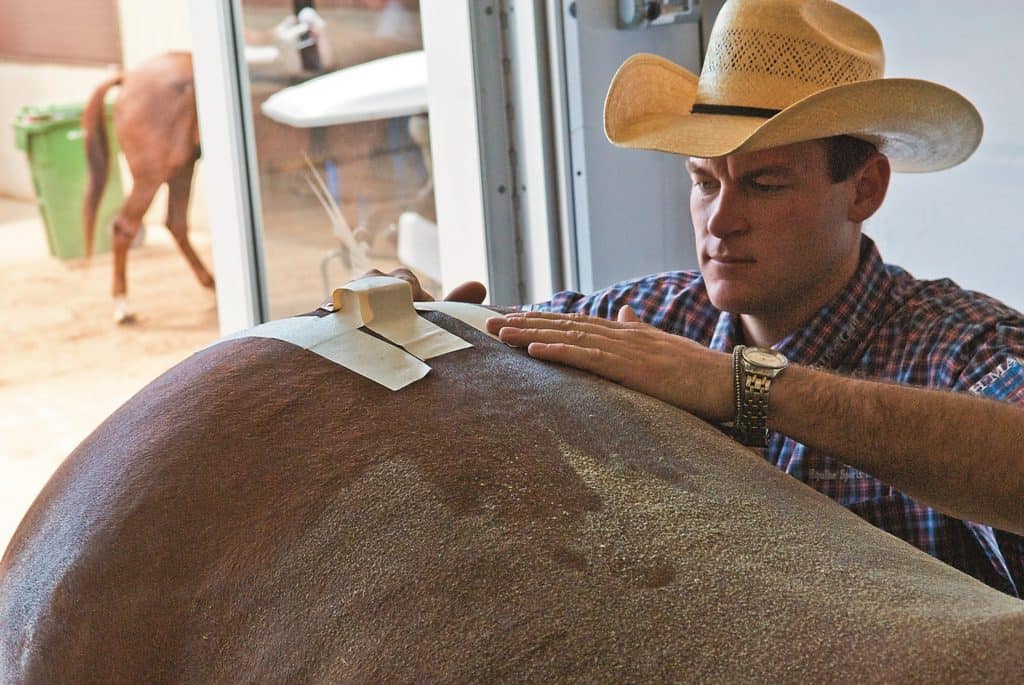
There was a strong correlation between vet and inertial sensor system when evaluating lameness change post-nerve-block.

Researchers say a screw fixation procedure can help sport horses return to function after a central tarsus fracture.

These wounds are bad news! Pursue immediate and aggressive therapy for the best chance at a successful outcome.
Whether you’ve had horses all your life or are new to the industry, you’re bound to deal with lameness at some point.

Learn what your horse needs in his diet and exercise program to help develop a well-muscled topline.

Diet, exercise, biomechanics, and genetics all play a role in disease development, researchers say.

Medication and diagnostic analgesia are only effective if veterinarians put them in the right place, so accuracy is key.
Neil Mittelman, DVM, and Holly Stewart, VMD, will present a joint lecture on March 1 at the New Bolton Center.

Recent study results suggest that shock wave can help horses return to function faster than surgery or rest alone.

For years veterinarians’ options were limited, but new products are helping them control horses’ pain better than ever.

Though the overall prognosis isn’t great, some foals with incomplete ossification can race if managed properly.

Horses treated with regenerative therapy healed eight-and-a-half months faster than those undergoing surgery alone.