Stephanie L. Church, Editorial Director

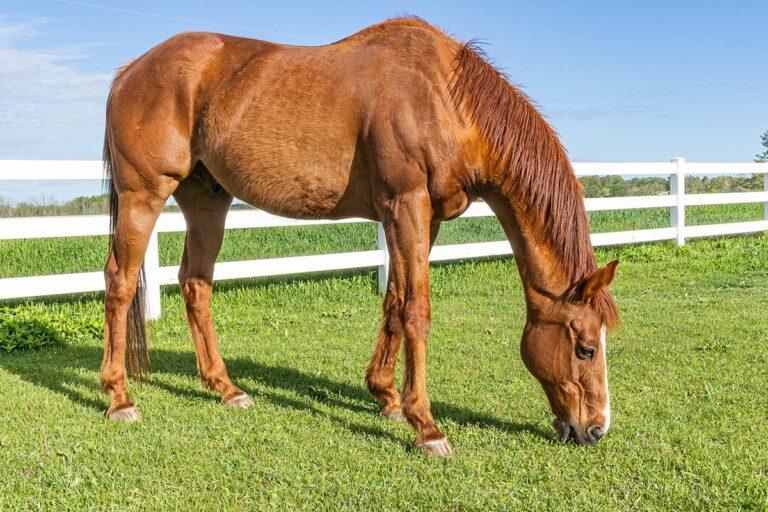
Stephanie L. Church, editorial director for The Horse and Stable Management, grew up riding and caring for her family’s horses in Central Virginia and received a B.A. in journalism and equestrian studies from Averett University. She joined The Horse in 1999 and has led the editorial team since 2010. A 4-H and Pony Club graduate, she enjoys dressage, eventing, and trail riding. Her heart horse, It Happened Again (“Happy,” pictured), a former graded-stakes-winning Thoroughbred gelding, was her longtime mount and remains a lasting inspiration. She now has an 8-year-old off-track Thoroughbred, Dune of Pilat (“Dune”), and is enjoying building a partnership with him. Stephanie is based in Lexington, Kentucky.

Articles by: Stephanie L. Church, Editorial Director

More on the Recent Grass Sickness Link to

Researchers in the United Kingdom recently advanced scientific knowledge of equine grass sickness with a three-year study that found the disease to be strongly associated with low antibody levels to the bacterium Clostridium botulinum.

Read More

Senate Passes Bill Prompted by Saddlebred Attacks

Legislation prompted by the attack on five Saddlebreds in Central Kentucky last summer was passed by the Kentucky Senate on Thursday, March 25, according to an Associated Press story.

The article said, The bill was sent back to the”P>Legislation prompted by the

Read More

Illinois Slaughter Legislation Update

Rep. Robert S. Molaro yesterday postponed consideration of Illinois Senate Bill 1921, which would ban equine slaughter for human consumption in the state of Illinois. Dekalb, Ill., is the home of Cavel International, one of the remaining equine

Read More

Help Needed for Stallion Infertility Research

Bhanu P. Chowdhary, BVSc, AH, MVSc, PhD, associate professor in Texas A&M’s College of Veterinary Medicine, is trying to find molecular causes of stallion infertility and reduced fertility.

Chowdhary said, “Our research focuses specifically on genes located on the Y chromosome of the horse. In humans it has been clearly shown that of the around 7% infertile males, at least a

Read More

Belgian Hit, Killed by Car in Massachusetts

A driver sustained serious injuries when his car struck a 2,000-pound Belgian horse in Westport, Mass., on March 6, according to an article in the online edition of The Herald News, which is based in Fall River, Mass.

“The (32-year-old) operator was identified by police as David Costa,” said the article. “Police said the horse had escaped from its corral. After Costa’s gray Ford Escor

Read More

Neurologic Conditions, In-Depth

Assessing neurologic conditions might seem difficult, but with practice and attention to the subtle differences between different conditions’ deficits, the process can become easier. Additionally, practitioners discussed vaccination and treatment options for the different diseases.

Read More

Lyme Disease Treatment and Vaccine

Nearly 50% of adult horses in areas of the northeastern United States are or have been infected with Borrelia burgdorferi, the causative agent of Lyme disease. Thomas Divers, DVM, Dipl. ACVIM, Dipl. ACVECC, and others at Cornell Universit

Read More

Legislation Introduced for Expediting Horse ID Plan Use

Four bills that would accelerate implementation of a national animal identification system have been introduced in Congress–two in the Senate and two in the House of Representatives. Horses are not specifically mentioned in any of these bills, but will be included in a national animal ID program at some point in the future. According to an official in one bill sponsor’s office, specifics of

Read More

Residual Effects of WNV

Horse owners should have equine survivors of West Nile virus (WNV) re-examined by their veterinarians before putting the animals back into work. In a study of Minnesota horses which survived clinical WNV infection, 40% showed WNV residual effects at six months after diagnosis; these neurologic effects can make the horse more dangerous to ride or drive. Julia Wilson, DVM, Dipl. ACVIM, is an

Read More

Vaccines–Comparative Efficacy

Several researchers have been working the past few years to determine if any U.S.-registered equine vaccine had advantages over others. It turns out that the serologic responses to–and protection given by–these vaccines varies significantly.

Read More

Animal Identification Plan Largely Misunderstood

Comments collected on the draft U.S. Animal Identification Plan (USAIP) have been largely characterized by misunderstanding and frustration, according to one government official. The plan, which at this time is not an official program of the USDA, was designed to establish a timely traceback system to minimize the  the spread of foreign animal diseases, such as foot and mouth disease, an

Read More

Conformation And Racing Problems (AAEP 2003)

Genetics, racing surface, number of starts, age of the horse, pre-existing disease, conformation, and trauma have all been implicated as potential factors in the cause of racing and training injuries.

Read More

Possible Equine Anthrax Outbreak in India

According to a Feb. 23 ProMED-mail post, Kashmir, India, could be experiencing an equine anthrax outbreak.

In late December 2003, an India Times article reported that, “Veterinarians here have raised alarm over the spread of anthrax amongst livestock. Over 135 horses from a state-run stable have died due to the deadly disease. The numbers are rising.” According to the

Read More

Lyme Disease Research

Infection with Borrelia burgdorferi, the causative agent of Lyme disease, is widespread in the northeastern United States, with nearly 50% of adult horses in some areas infected or with a history of infection. Thomas Divers, DVM, Dipl. ACVIM, Dipl. ACVECC, and others at Cornell University recently completed research that confirmed the consistency and predictability of how

Read More

Safety Issues of Shock Wave Therapy

There’s been a lot of speculation about the analgesic effects of extracorporeal shock wave therapy (ESWT) and radial shock wave therapy (RSWT)–no one has identified the duration or mechanism of analgesia.

Read More

More From The Horse

electrolytes for horses; Why Do Electrolytes Encourage Horses to Drink?
spring pasture, turnout tips, horse turn out, horse in pasture, grazing, spring, spring turnout
Horses in their stable
What's New With Weaning?

Stay on top of the most recent Horse Health news with

FREE weekly newsletters from TheHorse.com

Sponsored Content

Weekly Poll

sponsored by:

How often do you apply fly spray to your horse during peak fly season?
176 votes · 176 answers

Readers’ Most Popular

The Horse
Privacy Overview

This website uses cookies so that we can provide you with the best user experience possible. Cookie information is stored in your browser and performs functions such as recognising you when you return to our website and helping our team to understand which sections of the website you find most interesting and useful.