The debate over training methods and their impact on horses remains heated, highlighting the ongoing need for education

Passionate social media users often voice concerns about protecting horses from training methods portrayed in photos and videos. But despite those good intentions, the information shared—and sometimes aggressively promoted—online isn’t always backed by scientific evidence, experts warn.
We’re tackling the tricky task of addressing some of the most criticized and misunderstood training methods in hopes of shedding some important light on what’s really going on from a scientific perspective.
While there are endless horse training tactics up for debate in our modern equestrian era, here we’ll cover what our sources consider the top four that deserve clarification.
Negative vs. Positive Reinforcement Horse Training Methods
Negative reinforcement and positive reinforcement don’t get their names from being bad or good. Rather, these are mathematical ways of describing a reward, says Angelo Telatin, PhD, professor at Delaware Valley University’s Equine Science and Management Department, in Doylestown, Pennsylvania. If the reward is getting rid of something you don’t want, that’s subtraction—hence, negative. If the reward comes from getting something you do want, that’s addition—hence, positive.
Proper negative reinforcement works by releasing the pressure of a light touch or tug, he says. Horses are sensitive to this painless contact—somewhat like an insistent tap on our shoulders—so they’re motivated to find a way to make it stop. Through operant conditioning they then learn to respond to hand or voice signals first, avoiding pressure.

In positive reinforcement, trainers give a treat (or wither scratch or other reward) when the horse volunteers the desired response. Horses become highly motivated to find associations between hand/voice cues and their own behaviors that lead to rewards, says Marco Pagliai, a science-focused horse trainer based in Tuscany, Italy.
Timing Is Everything
While each method has its scientific and welfare merits, critics argue negative reinforcement is blackmail and positive reinforcement turns trainers into vending machines, Pagliai says. But the biggest issue by far with both approaches is the trainer’s lack of knowledge and skill, he adds.
Telatin agrees. Regardless of the method, people must master shaping—rewarding the smallest steps of progress—and highly precise timing, he says. Mistakes can tip training into punishment, whether it’s ongoing added pressure (positive punishment, PP), or ongoing withholding of a treat or other reward (negative punishment, NP).
“Negative reinforcement/positive punishment and positive reinforcement/negative punishment are two sides of the same coin,” Telatin explains. “If the timing is wrong, one becomes the other. If shaping doesn’t follow multiple, very small steps, the horse is lost and mostly perceives punishment instead of reward.”
Common Mistakes
Mistakes in negative reinforcement can make horses resistant to light cues, leading to stronger and more aversive pressure from the trainer, conflict behavior from the horse such as bucking and rearing, or even learned helplessness, says Pagliai. “People often don’t know when to release pressure,” he explains. “So many horses experience a lot of pressure and confusion, which is abusive.”
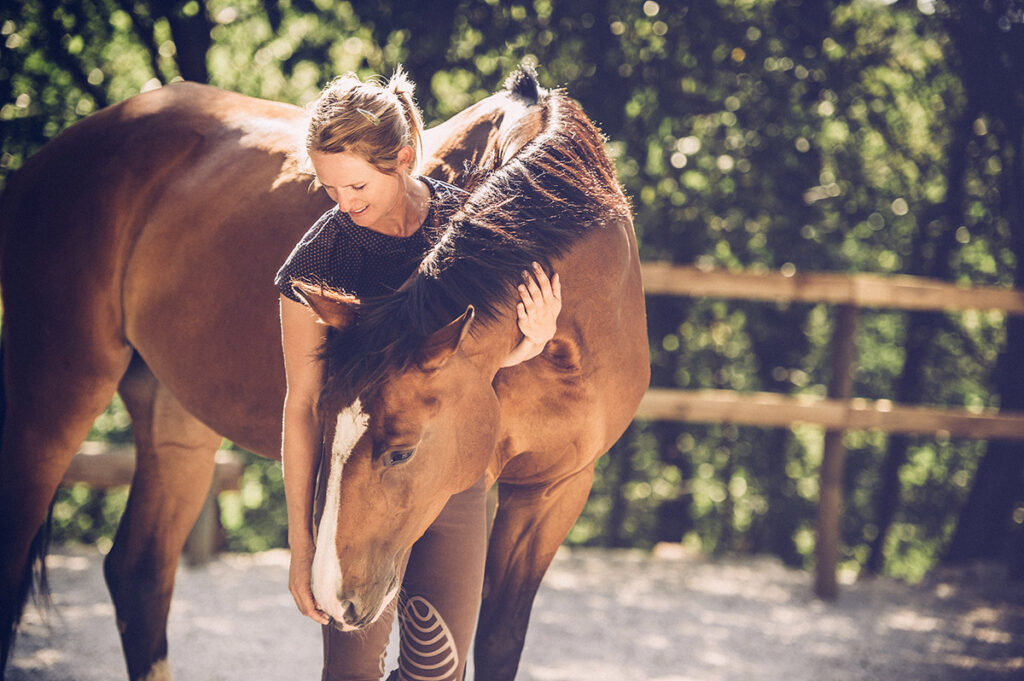
Mistakes in positive reinforcement, meanwhile, can make horses frustrated and anxious and even condition them to bite or charge. “It’s very easy to make mistakes with food,” Pagliai says. “And people blame the food instead of taking responsibility for their own bad timing and training mistakes.”
Positive reinforcement might even require more human skill than negative reinforcement does, due to horses’ strong food motivation, says Pagliai. “With positive reinforcement, horses ask lots of questions—which can put humans in a difficult position if they don’t have all the answers.”
Individual differences between trainers and horses play an important role as well, Telatin says. Some people simply master one technique better than the other. And some horses just learn better with positive reinforcement, whereas others can “literally turn into a rage machine to get cookies.”
Challenges of These Training Methods
The challenges of getting positive reinforcement right might be related to the method’s newness, says Robin Foster, PhD, CAAB, CEBC, a research professor at the University of Puget Sound, in Tacoma, Washington. “We have a thousand years of protocols built up with negative reinforcement, and perhaps a decade of people developing protocols for positive reinforcement,” she says. “Even good trainers are often still pretty clunky with positive reinforcement. So it’s just not a fair comparison.”
For both Telatin and Pagliai, the ideal is a customized blend of negative and positive reinforcement for each horse, carried out by people with skilled training in each method.
“The best thing is to combine these two things and to know where and when you use them both,” Pagliai says.
Hyperflexion in Equine Athletes
Most equestrian federations prohibit hyperflexion—riding horses with the nose dipped toward the chest. Yet many riders, especially high-level competitors, continue to train their horses in hyperflexion, believing it leads to better scores, says Sue Dyson, MA, Vet MB, PhD, DEO, an independent consultant in Newmarket, U.K.
Certainly dressage judges often reward horses with nasal planes angled behind the vertical, despite official rules, she says. And stewards frequently overlook the practice in the warm-up ring.
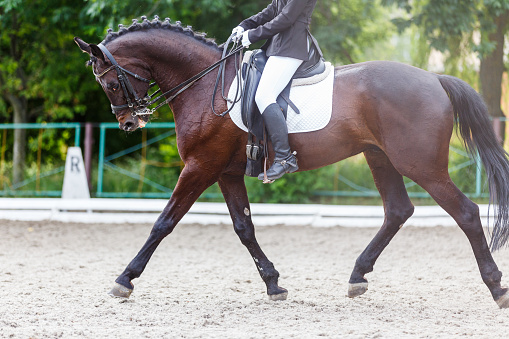
Yet, researchers on multiple studies have shown hyperflexion places strain on neck muscles and can create a kink in the trachea (TheHorse.com/117618), reducing airflow and, hence, oxygen intake. Hyperflexed horses can strain to rotate their eyes for a better view of the ground but still struggle with a reduced field of vision. “Hyperflexion’s got a cascade of effects,” Foster says.
Is Hyperflexion Always Bad?
Despite these findings, though, horses often hyperflex the neck on their own, as they gallop, play, and scratch themselves, says Jean-Marie Denoix, DVM, PhD, Dipl. ACVSMR, ECVSMR, professor of equine movement pathologies at the French National Veterinary School at Alfort. “Physiologically, it’s a movement that’s natural for horses, so I’m not shocked when I see it happen for brief periods.”
It can also—under a skilled and educated rider—improve horses’ gymnastic ability, helping strengthen different muscle groups and allowing a wider range of healthy movements, he says. “But like any gymnastic exercise, this kind of training has to occur in good hands,” Denoix says.
Consider the Details
While this could seem contradictory, it’s important to consider the details, Dyson says. What is the angle? How long has the horse been hyperflexed? Is he being forced and constrained in this position? What is the horse’s natural neck shape?
Individual differences matter too, says Foster. A few degrees might be easy for one horse and difficult for another—depending on genetics, conditioning, and musculoskeletal health, among other factors. “Every horse is going to be limited in how much flexion they can display,” she explains.
Kathrin Kienapfel, PhD, of the Swiss National Stud Farm’s Equine Research Group, in Avenches, says she’s eager for a clearer hyperflexion definition. She’s measured precise head and neck angles in hundreds of competitive dressage horses, finding many of them dip into hyperflexion at less than 10 degrees behind the vertical. That’s fairly consistent with Dyson’s work, in which she found 67% of FEI World Cup dressage horses held the head at least 10 degrees behind the vertical for at least 10 seconds in the show ring (TheHorse.com/1100095).
How harmful or helpful are these angles for short moments? For now, we don’t really know, our sources say, because most studies lump angles into three broad categories: at, behind, and in front of the vertical.
Dyson says it’s essential to consider how far behind the vertical horses are. Her ridden behavior analyses revealed horses up to 15 degrees behind the vertical—which she calls overbent—were comfortable during competition. But some tucked the head further during difficult moves such as the piaffe, which might reflect temporary discomfort, she says.
True hyperflexion, she adds, occurs between 15 and 35 degrees behind the vertical. Dyson says under skilled riders, this can offer good gymnastic exercise for short bouts.
Rolkur
By contrast, rollkur—in which the horse’s nose is “stuck to the chest,” at angles of 35 degrees or greater, is where we see the significant negative consequences on health and welfare described in research, she says. It also restricts stride length and the horse’s ability to lift his front end, upending the whole biomechanics of the horse.
But regardless of angle, a horse’s head position should never be forced, says Dyson.
“That’s constraint, and it’s just not acceptable,” says Denoix, adding that the psychological consequences might be even worse than the physical ones—and especially dangerous for horses with spinal conditions such as intervertebral laxity (looseness).
While many people fiercely criticize hyperflexion, though, the widespread issue of high-headed riding gets curiously overlooked, Dyson says. “Excessive raising of the head and neck can also have major deleterious effects on back function—worse than behind the vertical in my opinion,” she says.
Desensitization as a Horse Training Method
Pagliai says desensitization training often involves outdated and/or unethical methods to teach horses to not react to scary stimuli.
A common mistake is assuming that when the horse stands still, the desensitization process is done. “But it isn’t,” he says. “You can’t just assume he’s not scared anymore and move on with training. You have to learn to look at the horse and really understand what he’s feeling.”
Others desensitize horses using flooding—preventing a horse from getting away while inundating him with sights, sounds, or smells that scare him until he gives up.
“We’re literally breaking the horse,” he says. “So he’ll do anything we ask him to do—but without any real focus and certainly without any positive emotion, like a robot. With the knowledge we have today, it’s totally terrifying that people still resort to flooding their horses.”
Foster, meanwhile, worries about more modern desensitization techniques, such as using positive reinforcement to teach horses to touch anything unfamiliar.
“It might seem like a smart move, but it’s actually a very dangerous thing to teach a young horse to touch any unknown thing,” she says. “What if it’s a sharp object, or a flame, or some other potentially harmful object? There’s a reason they should still exercise caution in many situations. What you want is a horse who’s comfortable ignoring things and walking calmly past them.”
Whip Touches
Telatin says the verb “to whip” has a negative connotation that implies abuse. But the noun “the whip” can be a useful tool when employed with proper skill.
“I know welfare-focused trainers who’d rather give up the saddle, bridle, and even halter than lose the whip,” he says. They use the tool to gently touch horses from a greater distance than the arm alone can reach or to make noncontact visual cues.
“In the right hands, the whip should be called something like an indicator, because it indicates to the horse what you’re asking him to do—without inflicting any kind of pain—and then you remove it (which is negative reinforcement) once the horse gives the right response,” he explains. “There’s nothing improper about that, and it has absolutely nothing to do with whipping a horse.”
In fact, mustangs and other horses lacking human handling often accept whip touches—including wither scratching—as an important first step toward accepting the touch of a human hand, he adds.
Timing Is Everything – Again
Like the other methods described, though, ethical whip use requires advanced skills based on equine learning theory, says Telatin. People often flub the timing; touches should be either constant or made up of light taps less than a second apart, and they must stop immediately when the horse gives the response we’ve asked of him.
Telatin says that in practice, tap intervals are frequently too long—usually because the trainer moves the whip back to tap the horse again. If the horse experiences at least a full second without whip contact, he perceives this pause as a reward for some random behavior he performed and then can’t understand why the whip contact keeps coming back. In essence, he learns to give the wrong response.
“Then people tend to get agitated, and they want to win, so their adrenaline picks up and suddenly they’re tapping faster without realizing it,” Telatin says. “And that’s when the horse finally gets the shorter intervals he needs in order to learn. But the trainer thinks the horse was being testy or difficult and needed for us be tougher and more dominant. And that’s just wrong.”
Whipping in horse racing is a more complex problem—in part due to well-meaning no-consecutive-strike rules that interfere with timing, Telatin explains. “Combined with the force of each stroke, the whip transforms from a communication tool into a punisher that randomly inflicts pain, which is the worst scenario for a horse, physically and emotionally.”
Regardless of the sport, whip use causing injury or fear is never acceptable, he insists.
Take-Home Message
Many training methods get hotly debated in today’s equestrian world, but the arguments aren’t always grounded in sound science. A closer look reveals problems often lie in poor execution due to a lack of sufficient knowledge and training, our sources say. With better education, guided skill-building, and advancements in research, equestrians can adopt welfare-friendly training practices while steering clear of unscientific methods for the benefit of their horses.