Understanding how joint inflammation affects a horse’s movement and joint fluid chemistry might help veterinarians detect disease before lameness becomes obvious. At the 2025 Equine Science Society Symposium, held June 3-6, in Fort Collins, Colorado, Lindsay Korac, a PhD student at the University of Guelph, in Ontario, Canada, presented research findings linking specific biomarkers with subtle gait asymmetries.
Biomarkers are objective measures that can help veterinarians and researchers recognize changes in the horse’s body. By pairing motion analysis tools with blood and synovial (joint) fluid biomarker data, Korac and her fellow researchers investigated how inflammation influences both movement and joint health in horses.
Studying the Biomechanics of Horse’s Movement
The research team at the University of Guelph examined the biomarkers CS846 (aggrecan synthesis in joint cartilage) and PGE2 (the inflammatory pathway linked to pain signaling) and used objective measurements of gait biomechanics including:
- Force plates: tools that measure ground reaction forces;
- Motion capture: infrared cameras that reflect movement;
- AI: an app that detects vertical displacement to reveal asymmetries; and
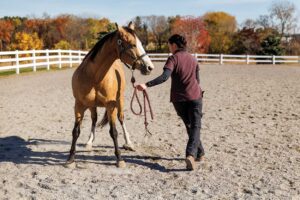
- Inertial sensors. Korac and her team used these small sensors attached to specific areas on the horse to collect data at the trot, enabling them to assess quantifiable date in horses moving in-hand.
They studied 11 horses of varying ages, breeds, and weights to determine the effects of joint inflammation (via injection) on biomarkers and biomechanics and any association between the two. They injected the horse’s joints with 75 nanograms of reIL-1B, chosen to create inflammation at the joint but not outward lameness, and collected joint fluid samples at 0, 6, and 12 hours post injection. “We collected data on gait biomechanics of each horse’s movement at Hours 0 pre-injection and Hours 6 and 12 post-injection using IMU sensors, said Korac. “We calculated the vertical displacement data from the sensors placed at the poll and pelvis. These sensors could identify the difference in vertical displacement between the forelimbs (poll sensor) and hindlimbs (pelvis sensor) to determine if the horse has an impact or push-off asymmetry.”
Lameness and Inflammatory Marker Association in Horses
Following the injection of the inflammatory stimuli into the intercarpal (knee) joint of the horses, Korac and the research team found that none of the horses showed clinical (observable) lameness or deviated from their baseline movement. This was important, as previous models of equine joint research have significant changes in lameness AAEP scoring throughout the duration of the inflammatory stimuli. This emphasized the value of a model that could utilize a dose of 75ng to assess joint health without making the horses lame.
Korac saw a positive association between increases in PGE2 and CS846 and forelimb asymmetry showing that as the biomarker concentrations increased during inflammation, asymmetry also increased in the forelimbs. She also noted a negative association between PGE2 levels and hindlimb asymmetries, and positive association with CS846 with hindlimb asymmetries.
Take-Home Message
Korac saw an increase in synovial fluid biomarkers of PGE2 and CS846 and no increase in clinical lameness in any of the horses following the inflammatory injection showing the model was able to create an inflammatory response at the joint level without causing outwardly lame horses. She and her research team saw positive associations for PGE2 and CS846 with poll asymmetry measures suggesting that this research was able to integrate biochemical and functional data as a comprehensive joint health evaluation tool. “Future studies might examine new biomarkers, extend the duration of the study, or examine the effects of therapeutic intervention on these biomarkers,” she said.