Horse hair offers insights into health, genetics, stress, and even history
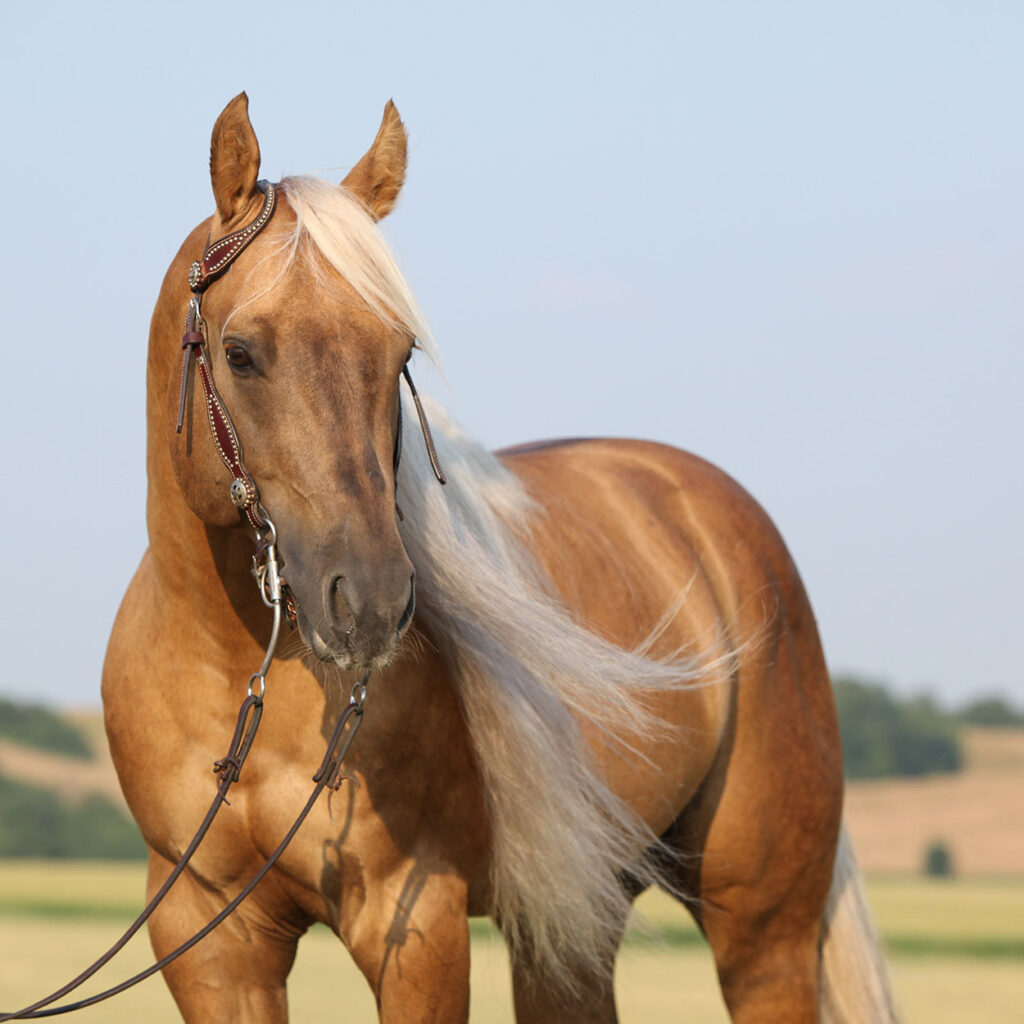
That sleek, shiny coat. That thick, flowing mane. The full, elegant tail.
We love horses’ hair—so much so that throughout the past 5,000 years we’ve bred horses based on their coat/hair color and quality. And long before that, humanity began portraying the beauty of equine hair in drawings, paintings, sculptures, animations, and other artwork.
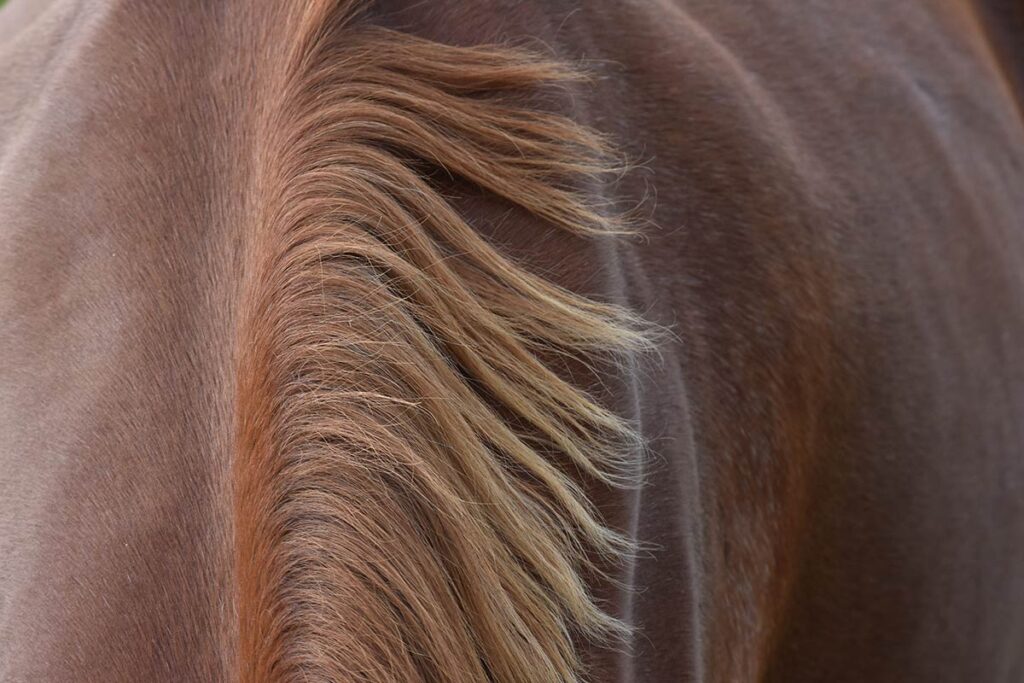
Beyond that aesthetic appeal, horses’ hair contains abundant information about their health, welfare, breeding, drug intake, and even ancient history.
In this article we’ll provide an overview of the latest knowledge about what horses’ hair can tell us.
What’s in a Strand of Hair?
Hair forms at the bulb, nestled in the follicle under the skin, and grows into a multilayered root that—unless it’s white—is colored by melanin. The shaft extends beyond the skin and progressively moves outward as the bulb produces new growth. There, polypeptide chains of amino acids such as glutamic acid, cysteine, and serine create strong keratin fibers that align to create a thick central cortex (sometimes surrounding a thin core called the medulla) and an outer cuticle level where fibers overlap like scales.1
Hair consists mainly of keratin, water, melanin pigments, lipids—such as triglycerides, phospholipids, and cholesterol—and minerals, including iron, magnesium, zinc, and copper. Its chemical makeup is 45% carbon, 28% oxygen, 15% nitrogen, 7% hydrogen, and 5% sulfur.
Researchers have suggested equine coat hair usually matches human hair in thickness, while tail hair measures about 50% thicker and mane hair falls somewhere between. Horse hair offers strength, resilience, and natural water resistance.2
Appearance: A Simple Health Measure in Horses
A good look at a horse’s coat, mane, and tail can give basic insights into health status, says Carissa Wickens, PhD, associate professor and extension equine specialist at the University of Florida (UF), in Gainesville.
Healthy horses usually have glossy coats that follow clear seasonal patterns of winter fullness and summer sleekness. “The coat will have some sheen to it when the animal is receiving adequate nutrition, preventative health care, and regular grooming,” she says.
Horses with compromised immune systems due to internal disease or malnutrition, however, might grow dull or brittle hair. The coat can sometimes get patchy due to skin infections, including rain rot or ringworm, or to parasites such as lice. Hair that doesn’t shed, sheds unevenly, or changes color in an unusual way could reflect metabolic disease, such as pituitary pars intermedia dysfunction (PPID, formerly equine Cushing’s disease).
Coat quality can also diminish with prolonged exposure to flies, mosquitoes, and other biting insects, such as Culicoides, especially in hot, humid climates with long insect seasons, Wickens says. “It doesn’t necessarily indicate a serious health condition or immediate welfare concern, but maintaining skin and coat health requires attention and management, like applying repellents, fly sheets, and masks, using fans, and adjusting turnout schedules to minimize exposure.” In addition to discomfort and unsightliness, bites can put horses at risk for bacterial infections, other pathogens (among them West Nile virus), and sarcoids.
Beyond the body coat, the mane and tail can also provide health clues when horses rub them off, she adds. Balding manes suggest itchy dermatitis conditions such as insect bite hypersensitivity (IBH), whereas broken hairs around the tailbone can point to scratching due to intestinal parasites. Hair loss along the mane and tail can also signal selenium overdose.
But even healthy hair can alert owners to potential problems. For example, splashed white and overo Paint Horses are more likely to carry the EDNBR gene mutation that causes hearing loss and overo lethal white syndrome, Wickens says. Silver coats are often associated with multiple congenital ocular anomalies (MCOA). And some horses with Appaloosa spotting could have night blindness or recurrent uveitis.
Chestnut horses have the MC1R “redhead” gene that researchers have linked to lower pain thresholds, which could—if these horses are not managed correctly—lead to behavior problems. Importantly, though, that doesn’t mean red coats signal a difficult horse, says Andy Booth, a science-based trainer who works out of southwestern France. “I find the chestnut mare reputation to be unfounded,” he says. “But it can have a strong placebo effect. Once someone decides a horse is difficult, that’s how (the horse) tends to be.”
Finally, a coat that feels warm to the touch doesn’t always keep the horse warm, says Grete H.M. Jørgensen, PhD, of the Norwegian Institute of Bioeconomy Research, in Tjøtta. In fact, Warmbloods usually have higher coat temperatures in winter than draft horses with thick hair because the coat is not organized in layers with underwool and long cover hairs commonly found in the cold-blood breeds. Such structures in a horse’s coat are important to protect against the elements and reduce heat loss from the body to the surroundings.
What’s in a Whorl?
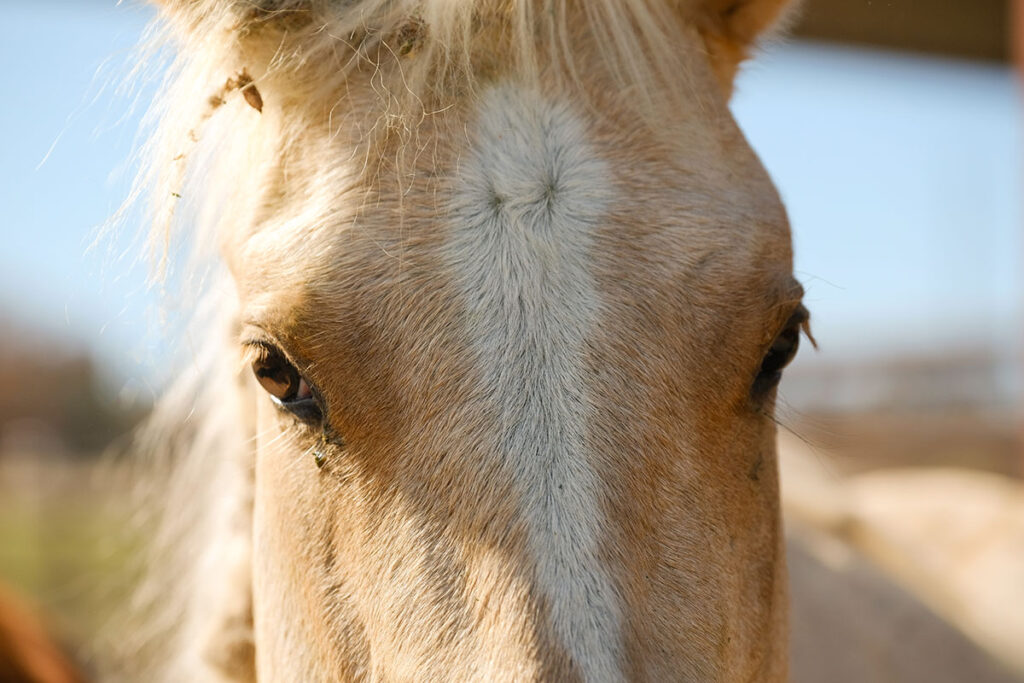
Swirling hair patterns on a horse’s head and neck—known as whorls—appear to share the same genomic regions that code for neurologic and behavioral functions, suggesting a genetic-biological link between whorls and temperament says Gregório Miguel Ferreira de Camargo, PhD, of the Federal University of Bahia, in Brazil.3 In fact, genes linked to whorl position (above, at, or below eye level) have parallels in humans associated with schizophrenia, depression, and Parkinson’s disease.
Such findings might explain why many people consider horses with above-the-eye whorls to be difficult, those with below-the-eye whorls to be calm and steady, and those with whorls at the eye-line to be somewhere between. In addition, donkeys generally have whorls far down the nose, which aligns with their reputation for being less reactive than most horses, says Katrina Merkies, PhD, a professor at the University of Guelph, in Ontario, Canada.
Meanwhile, researchers on multiple studies over the past 15 years have suggested horses with clockwise-swirling whorls tend to favor their right side while those with counterclockwise whorls more often favor their left. Even so, not all research supports such links between whorls and laterality, says Uta König von Borstel, PhD, a professor at the University of Giessen, in Germany.
Additional work might also help equine researchers link whorls to horses’ performance traits and the propensity for certain disciplines, such as jumping versus dressage, Ferreira de Camargo says.
Monitoring Stress and Welfare
When horses produce increased levels of the stress hormone known as cortisol, it suggests they might be experiencing welfare issues, says Kristýna Machová, PhD, professor in the Department of Husbandry and Ethology of Animals at Czech University of Life Sciences Prague, in the Czech Republic.
Salivary cortisol concentrations can give immediate feedback about short-term acute stress, including healthy physical activity, whereas blood and fecal cortisol levels provide insight over the past several hours or days. Cortisol levels in hair, meanwhile, offer a noninvasive way to assess stress and welfare over weeks and months, Machová says.
In her team’s recent study on hair cortisol concentrations in equine-assisted therapy horses, for instance, they revealed animals didn’t benefit from one-month holidays each year, she says. Rather, they showed much healthier cortisol readings when they had three days off each week instead of two.
That said, cortisol concentrations can depend on the type of hair (coat, mane, tail), its location on the body, color, and the season in which it was collected. Also, if stress continues for too long, horses stop producing cortisol altogether.
“It’s a very useful parameter that can give the owner an indication of how his horse is doing and, if the level is high, give him an incentive to look for the cause, whether it is related to training or health, for example,” Machová says. “But it’s also always a good idea to combine the assessment of physiological parameters with behavioral observation and thorough questioning.”
Mineral Analysis? Science Says No
Some companies offer hair screening for minerals using advanced techniques such as inductively coupled plasma mass spectrometry (ICP-MS), particle-induced X ray emission (PIXE), and inductively coupled plasma optical emission spectroscopy (ICP-OES). But researchers haven’t shown their merit.
In 2022 scientists at Leipzig University, in Germany, found dramatically different results between laboratories on selenium, iron, copper, zinc, and other mineral concentrations in the same four horses’ mane hairs.4 That same year Dutch researchers discovered that hair analyses of minerals in cadaver horses did not match their liver biopsies—a highly invasive gold standard for assessing trace minerals. The mineral list included arsenic, cadmium, chromium, cobalt, copper, iron, lead, manganese, molybdenum, nickel, selenium, vanadium, and zinc. “Our results do not support the use of hair to determine mineral status in the horse,” they reported.5
Still, scientists in Poland found that mane analyses gave an accurate reflection of the amount of copper and zinc added to horses’ oats, suggesting hair could be useful for at least monitoring these two heavy metals. In their 2022 study they also revealed that mane analyses could flag toxic concentrations6 of two dangerous heavy metals—lead and cadmium—which horses could pick up from their surroundings.
As with cortisol concentrations, elements found in hair can vary according to hair type, color, and location on the body—meaning if you’re tracking changes over time, make sure you’re comparing like samples.
Long-Window Drug Detection
Officials at competitive events generally test equine athletes for doping by analyzing blood and/or urine samples. These biological matrices allow for the detection of drugs administered within the previous hours or days—revealing whether a horse’s performance has been illegally enhanced for a race or competition, says Ludovic Bailly-Chouriberry, PhD, director of LCH Laboratory, in Verrières le Buisson, France.
By contrast, hair offers a critical long-term window for drug detection, says Bob Gray, MSc, chief scientist at LGC Group, in Fordham, England. Because hair accumulates traces of most types of doping agents, it can provide a valuable and reliable record of drug intake over the previous weeks, months, and even years. Considering an approximate mane hair growth rate of 2 cm per month, labs can use high-sensitivity instrumentation such as triple-quadrupole mass spectrometers (MS/MS) or high-resolution mass spectrometry (HRMS) to trace past drug use and even estimate when and for how long the horse was treated, he says.
Another important benefit of drug testing in hair is it allows for knowledge and technology to catch up with innovative illegal drug use. Sometimes a gap exists between when people start using a new doping agent and when authorities detect it and scientists develop tests. Long manes and tails keep records of that agent’s use well after it isn’t new anymore—meaning laboratories can analyze the relevant hair sections to detect doping retroactively, says Bailly-Chouriberry.
Regardless, pinpointing exact doses and dates through hair analyses remains difficult, so scientists have not yet established cutoff values for drugs allowed within a few days prior to competition, he adds. Plus, drugs get processed on different timescales in the body depending on administration route—orally, topically, or via various methods of injection. Therefore, laboratories focus hair analyses on banned substances such as anabolic steroids, whereas blood and urine analyses remain vital for controlled medications such as the non-steroidal anti-inflammatory drug phenylbutazone.
Hair-based anti-doping testing in horse racing started relatively recently, with analytical methods advancing rapidly over the past decade. But regulators now widely accept the technique, and officials have relied on it as the sole testing method in a number of high-profile regulatory cases, Gray says.
In 2017 racing chemists from the Association of Official Racing Chemists (AORC), working in equine anti-doping laboratories certified by the International Federation of Horseracing Authorities (IFHA) collaborated to form a hair analysis committee to both guide and unify horse hair analyses worldwide. The Fédération Equestre Internationale (FEI) has not yet adopted hair analyses for equestrian events—but its leaders expressed an openness toward the idea at their 2025 Sports Forum held in Lausanne, Switzerland.
Breeding, Screening, and Equine Genomic Research
The horse’s hair root is a great place for harvesting DNA, says Samantha Brooks, PhD, associate professor in equine physiology at UF. Testing that DNA can allow scientists to identify specific types of desired genes, such as the chromosome inversion that leads to tobiano Paint Horse patterns, variants in the SLC24A5 gene that give some Paso Finos “tiger eyes,” or the base change in DMRT3—which contributes to gait patterns such as lateral gaits and for trotting that resists transitioning into a canter.
Hair analysis also reveals critical genetic health information. Genetic tests that use 20-30 strands of mane hair with roots can detect genes linked to congenital diseases, including distichiasis (abnormal eyelash growth) in Friesians, cerebellar abiotrophy in Arabians, and hyperkalemic periodic paralysis (HYPP) in Quarter Horses. Such testing gives owners a heads-up about not only diseases their horses might develop but also asymptomatic carriers that when bred with other asymptomatic carriers could produce symptomatic foals.
Finally, full genome mapping based on DNA extracted from hair roots allows researchers to trace an individual horse’s pedigree and breed background, while also helping reconstruct the broader history of domestic horses. By comparing modern horses’ DNA with ancient DNA from equid fossils across the planet, scientists including Ludovic Orlando, PhD, director at the Centre for Anthropobiology and Genomics of Toulouse, in France, are discovering when and where horses were first domesticated. They’re even starting to decipher how people domesticated these horses more than 4,000 years ago—thanks in large part to hundreds of genomes mapped from the manes of our own horses living today. Through such studies Orlando and his team have noticed bottlenecking of certain genes around the time of domestication, such as those coding for good temperament, robust size, and a strong back.
Take-Home Message
Horses’ hair contains interesting and often valuable information about their current and future health, the genetic traits they carry, and various drugs or toxins to which they might have been exposed. Ongoing research can help owners, veterinarians, and regulatory authorities take advantage of everything horses’ hair can tell us.
References
1. Yang W, Yang Y, Ritchie RO, Meyers MA. On the strength of hair across species. Matter. 2020;2(1):136–149.
2. Üstüntağ S, Paşayev N. Physical, thermal, and mechanical of horse tail and mane hairs. Res J Text Appar. 2025;29(2):341–355.
3. Lima DFPA, da Cruz VAR, Pereira GL, Curi RA, Costa RB, de Camargo GMF. Genomic regions associated with the position and number of hair whorls in horses. Animals (Basel). 2021;11(10):2925.
4. Wahl L, Vervuert I. Commercial hair analysis in horses: a tool to assess mineral intake. J Equine Vet Sci. 2022;119:104145.
5. van der Merwe D, van den Wollenberg L, van Hees-Valkenborg J, de Haan T, van der Drift S, Vandendriessche V. Evaluation of hair analysis for determination of trace mineral status and exposure to toxic heavy metals in horses in the Netherlands. J Vet Diagn Invest. 2022;34(6):1000–1005.
6. Cygan-Szczegielniak D, Stasiak K. Concentration of selected essential and toxic trace elements in horse hair as an important tool for the monitoring of animal exposure and health. Animals. 2022;12(19):2665.