These paraprofessionals help veterinarians provide top-level care to their clients and patients
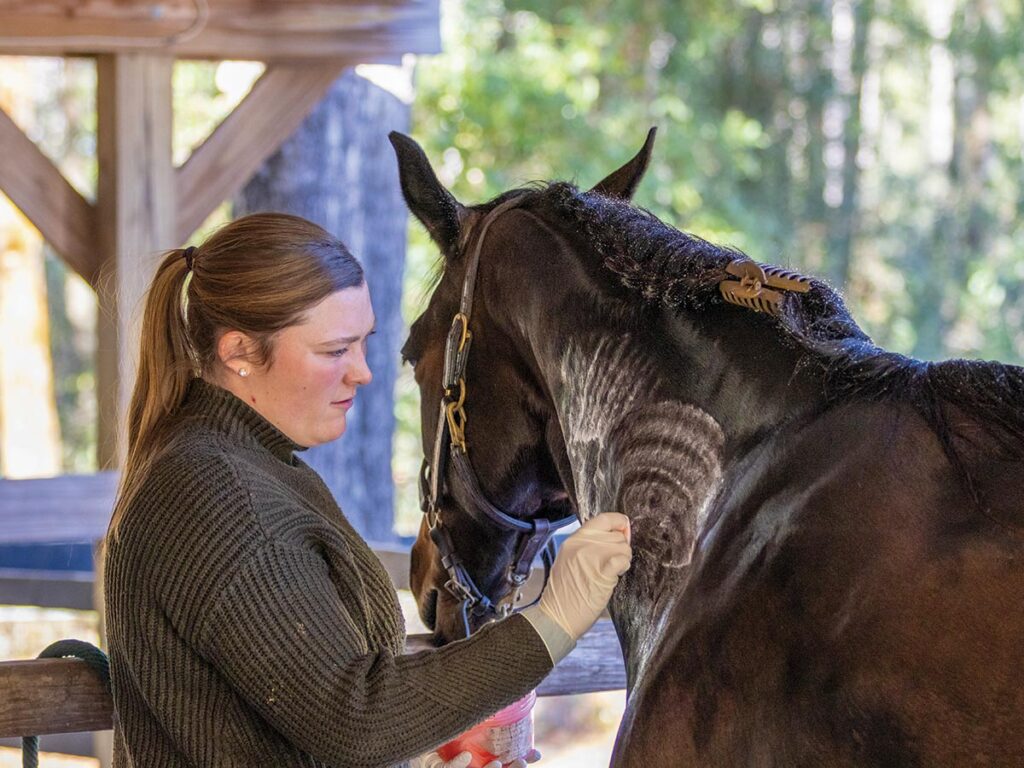
Last winter a burnt-out groom in my friend circle in Wellington, Florida, announced she was leaving her position at a show barn. When I asked about her next move, she replied, “I’m gonna take it easy and just go be a vet tech for Dr. ‘X’ for a few months before looking for another grooming job.”
The assumption genuinely stunned me—that a veterinary technician position, which on paper requires a two-year college degree, state licensing, and medical competencies, could be seen as a step-down or easy alternative to professional equine grooming.
Job postings at equine ambulatory practices do sometimes imply that anyone with good basic horse handling abilities can easily learn the necessary skills. Equine veterinary practices often advertise career opportunities using the title of “vet tech,” and individuals use it as well, even without formal training, a degree, or certification, while still performing the job competently. Despite ambiguity in job titles and descriptions, typically veterinarians are the first to sing the praises of their passionate, valuable technicians and assistants—certified or not.
Let’s take a behind-the-scenes look at these individuals who work tirelessly to help vets provide top-level care to their patients.
Veterinary Assistant vs. Vet Tech
Let’s start by tackling the nomenclature debate between the titles “veterinary assistant” and “veterinary technician.” Deborah Reeder, LVT, RVT, VTS-EVN, emeritus consultant and online academy program coordinator for the American Association of Equine Veterinary Technicians and Assistants (AAEVT), made the parallel and distinction between the two professions in a 2024 article for the American Association of Equine Practitioners (AAEP) titled “Ethical and Professional Utilization of the Credentialed Veterinary Technician and Assistant.”
“Veterinary technicians and assistants play crucial roles in modern veterinary practice, providing essential support to veterinarians while adhering to state-specific regulations,” Reeder wrote. “Credentialed veterinary technicians, distinguished by their completion of American Veterinary Medical Association (AVMA)-accredited programs and passage of credentialing exams, are qualified to perform various (health care) tasks under veterinary supervision. However, they are not permitted to diagnose, prescribe, or perform surgery,” actions she specified remain reserved exclusively to licensed veterinarians.1
In contrast, “veterinary assistants, often on-the-job trained, contribute by handling clerical duties, animal care, and restraint but lack the formal credentials of technicians,” Reeder wrote. She noted that confusion persists regarding titles and licensure, complicating standardization and public understanding. Unlike nurses in human medicine, who hold the title of registered nurse (RN), credentialed veterinary technicians don’t share a single, federally recognized title. Instead, states use different acronyms: licensed veterinary technician (LVT), registered veterinary technician (RVT), or certified veterinary technician (CVT). And not all states require credentialing.
The Vet Tech’s Education
Becoming a credentialed veterinary technician in most states involves completing a two-year AVMA-approved associate’s degree in veterinary technology, successfully passing the Veterinary Technician National Exam (VTNE), administered by the AAVSB (American Association of Veterinary State Boards), and then applying for credentialing with the state veterinary board or licensing authority. Usually, once they’re certified, licensed, or registered, vet techs must attend continuing education (CE) events annually each year, depending on the state
This story requires a subscription to The Horse magazine.
Current magazine subscribers can click here to and continue reading.
Subscribe now and gain unlimited access to premium content.
Subscribe NowWe at The Horse work to provide you with the latest and most reliable news and information on equine health, care, management, and welfare through our magazine and TheHorse.com. Our explanatory journalism provides an understandable resource on important and sometimes complex health issues. Your subscription will help The Horse continue to offer this vital resource to horse owners of all breeds, disciplines, and experience levels.