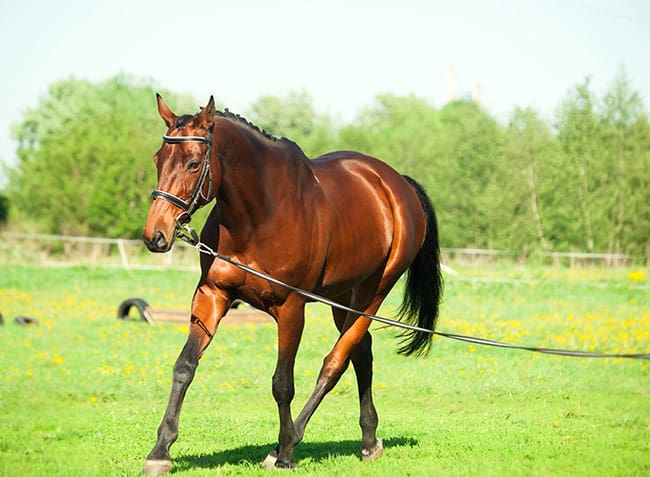
Ground reaction forces (GRFs) shape every stride a horse takes, influencing balance, posture, and performance. During the 2025 American Association of Equine Practitioners Convention, held Dec. 6-10, in Denver, Colorado, Hilary M. Clayton, BVMS, PhD, Dipl. ACVSMR, FRCVS, professor and McPhail Dressage Chair emerita at Michigan State University, in East Lansing, delivered the featured Milne lecture. In her presentation she outlined how these forces and the horse’s center of mass govern locomotion and inform decisions in both lameness workups and rehabilitation.
Clayton began by defining the three-dimensional GRFs and the summative vector they create. “When the hoof presses downward against the ground, the ground pushes back against the limbs with an equal and opposite GRF that can be measured using a force plate,” she said.
When illustrated, the GRF appears as an arrow indicating the force’s size and direction. In each gait the GRF vector follows a consistent pattern. “We look at the effects of the GRF in vertical, longitudinal, and transverse directions,” said Clayton. “The vertical GRF always acts upwards, combating gravity. The longitudinal GRF acts to accelerate, decelerate, or maintain speed, and the transverse GRF works from side to side across the horse’s body to produce turning.”
Ground reaction forces generated by the horse’s limbs produce movements and rotations of the body. All forms of locomotion, from galloping to jumping to dressage, result from GRFs. The GRF-induced vertical motion of the body also causes oscillations (variations in magnitude) in pressure on the horse’s back and tension in the reins.
The Role of GRFs and Center of Mass in a Horse’s Balance
The center of mass (CoM), which represents the entire substance of the horse’s body, follows a characteristic trajectory during each gait, rising and falling in rhythm with the limb movements. During each complete stride of walk, vertical body motion is small. The withers and croup are highest when the forelimbs and hind limbs, respectively, are vertical in the middle of their stance phases (when the foot contacts the ground and supports weight).
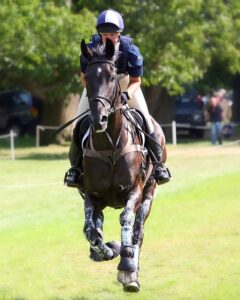
“The CoM movements in the trot, however, follow the opposite pattern in that they are highest in the suspension phases and lowest in the middle of the diagonal stance phases,” said Clayton. “There are two oscillations per stride in walk and trot but only one in canter, in which the CoM is high during the suspension and low in mid-stance.”

The lowest CoM position coincides with peak vertical GRF. “The relationship between GRF and body position is important in relation to understanding asymmetrical movements of the poll, withers, and croup in lame horses,” Clayton added.
How Do Horses Balance?
Clayton said when a horse’s CoM is above his base of support (BoS), he is in a stable position. But if the CoM moves outside the base of support, the horse will take a step to change the shape or position of the BoS so it includes the CoM.
Conformational characteristics that confer good balance and stability include large body mass, a low CoM, which is typically due to having relatively short limbs, and a large base of support with the CoM centrally located.
Agility in Equine Movement
Agility describes a horse’s ability to change direction quickly and efficiently. When a horse anticipates a new direction, he might shift his weight that way in advance. This moves the CoM toward the edge of the base of support, making it easier for the horse to move quickly in the intended direction. For example, a Thoroughbred in the starting stalls leans forward to prepare for acceleration when the gate opens.
Turning, however, involves generating a transverse GRF that pushes the horse’s body sideways.
“The easiest way to do this is for the horse to lean into the turn while the limbs push outwards to generate a turning GRF,” Clayton said.
For example, in her research she’s shown that high-earning cutting horses turn by leaning into the turn, then pushing sideways. In contrast, low-earning horses begin the turn by moving their limbs to the side.
Clinical Applications for Equine Biomechanics
Clayton highlighted the clinical relevance of this work. “Knowledge of GRFs and their effects on the CoM is beneficial for understanding how horses move and the ways in which we can teach them to move with better posture and self-carriage,” Clayton said. “Veterinarians need to understand normal locomotion as a prerequisite to recognizing changes in the movement patterns that can indicate the horse is lame or has a neurological disease. During recuperation from injury, rehabilitation specialists use targeted exercises to restore the normal movement patterns so that the horse makes a full recovery after injury.”
Take-Home Message
Understanding how GRFs and the CoM work together gives veterinarians a clearer picture of how and why horses move the way they do. By recognizing normal motion patterns across gaits and disciplines, practitioners can better identify abnormalities and guide rehabilitation to help horses develop strength, self-carriage, and agility.