Most horses aren’t underfed, they’re underbalanced.
Even when hay quality looks good and grain is on the menu, key vitamins and minerals often fall short. That gap quietly affects hoof strength, muscle tone, recovery, and overall resilience long before anything obvious shows up.
Here’s how to fix it.
Why ‘Good’ Diets Still Miss the Mark
Forage should always be the foundation of your feeding program. But it’s not nutritionally consistent.
What’s in your hay depends on soil, harvest timing, plant species, and storage conditions. Two bales that look identical can deliver very different nutrient profiles. One of the biggest losses? Vitamin E. It’s plentiful in fresh pasture but drops sharply once forage is stored.
Grain doesn’t reliably solve the problem either. Most commercial feeds are only fully fortified if you feed them at the recommended rate, often several kilograms per day. In reality, many horses get less, which means they also get fewer vitamins and minerals than intended.
This is where a concentrated vitamin and mineral supplement earns its place. It lets you correct deficiencies without adding extra calories or unnecessary starch.
The Gaps That Show Up Most Often
After reviewing thousands of equine diets, a consistent pattern emerges. Horses commonly fall short in:
- Sodium: essential for hydration, nerve signaling, and muscle contraction
- Vitamin E: critical antioxidant for muscle and immune health
- Selenium: works alongside vitamin E to protect cells
- Copper and Zinc: key for hooves, skin, and connective tissue
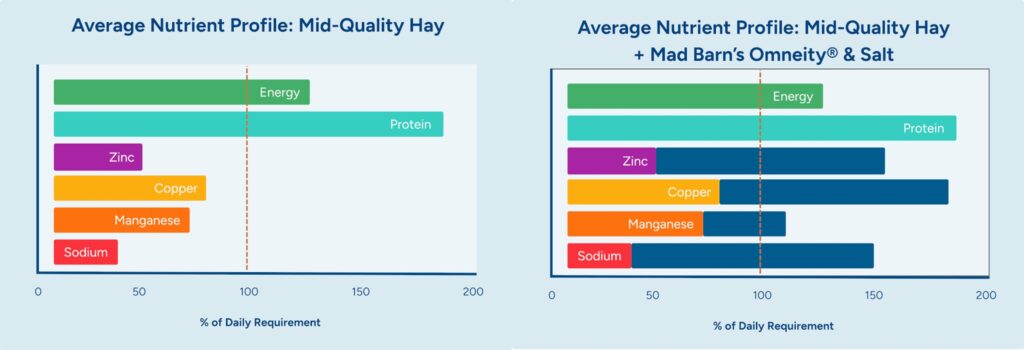
These aren’t minor details. Subtle deficiencies here can translate into poor hoof growth, dull coats, slower recovery, and reduced topline development.
At the same time, most horses are already getting more than enough calories and protein. Adding more feed isn’t the solution, balancing what’s already there is.
What Actually Makes a Supplement Worth Feeding
Not all supplements are created equal. A well, formulated product should do more than tick boxes on a label, it should meaningfully balance your horse’s diet.
Here’s what to look for:
1. Meaningful Nutrient Levels
Check that the product delivers enough vitamins and minerals to meet requirements at the recommended feeding rate. If the inclusion levels are too low, it won’t move the needle.
2. Bioavailable Trace Minerals
Copper, zinc, selenium, and manganese should ideally come from organic or chelated sources. These forms are easier for the horse to absorb and use.
3. Strong Vitamin Support
Hay-based diets are often short on vitamins E and A. A quality supplement fills those gaps and includes a full spectrum of B vitamins, especially important for performance horses or those under stress.
4. Amino Acids That Matter
Lysine, methionine, and threonine are the building blocks for muscle, topline, and hoof tissue. Without them, protein in the diet isn’t used efficiently.
5. Hoof-Focused Nutrients
If hoof quality is a concern, look for an effective dose of biotin paired with the amino acids above.
6. No Unnecessary Additions
Extra iron is rarely needed and often counterproductive. Many horses already consume excess iron through forage and water, which can interfere with copper and zinc absorption.
7. Low Sugar and Starch
Especially important for easy keepers and horses with metabolic issues. A good supplement shouldn’t add unnecessary energy to the diet.
Two Practical Approaches to Balancing the Diet
Omneity®: A Complete Daily Balancer
For most horses, simplicity works best.
Omneity® is designed to cover common deficiencies in forage-based and low-grain diets with one product. It combines:
- Fully organic trace minerals
- Comprehensive vitamin fortification
- Biotin and key amino acids
- Digestive support from yeast and enzymes
- No added iron and low sugar/starch
The result is broad support for hooves, coat condition, topline, and overall health, without the need to stack multiple supplements.
It’s available as a powder (cost-effective and flexible) or pellets (easier for picky eaters).
AminoTrace+: Targeted Support for Higher Needs
Some horses need more than a standard balancer.
AminoTrace+ is formulated for situations where nutrient demands are elevated or imbalances are more pronounced, including:
- Insulin resistance, EMS, or PPID
- Horses prone to laminitis
- Diets high in iron
- Poor hoof quality or slow growth
- Increased workload or recovery demands
Compared to a standard balancer, it delivers:
- Higher levels of copper and zinc to counteract excess iron
- Added magnesium and natural vitamin E
- Enhanced amino acid support
- 20 mg of biotin per serving
- Digestive support from yeast and prebiotics
- A low-NSC pelleted format suitable for metabolic horses
This is a more targeted tool when you need to correct specific issues, not just maintain baseline nutrition.
Choosing the Right Fit for Your Horse
The goal isn’t to add more products, it’s to build a balanced, efficient diet.
Start by looking at:
- What your horse is currently eating (hay, grain, supplements)
- Their workload and body condition
- Any health concerns (metabolic issues, hoof quality, recovery)
- What they will actually consume consistently
For most horses, a complete balancer like Omneity® is the simplest and most effective starting point.
If your horse has more complex needs, metabolic challenges, poor hoof quality, or a mineral imbalance, AminoTrace+ offers a more concentrated solution.
Take the Guesswork Out of Feeding
You don’t have to figure this out on your own.
If you’re unsure where your horse’s diet stands, start with Mad Barn’s Horse Nutrition Calculator. It breaks down your current feeding program and shows you exactly where vitamins and minerals are falling short, and where they’re already adequate.
From there, you can make targeted adjustments instead of guessing or over supplementing.
If you want a deeper level of support, you can submit your horse’s diet for a free evaluation by a Mad Barn equine nutritionist. You’ll get personalized guidance based on your horse’s workload and health status and your performance goals, so you can move forward with a plan that actually fits your situation.
Because when the diet is properly balanced, everything else, from hoof quality to recovery, gets easier to manage.