A strong topline helps a horse carry his rider and perform in balance and comfort. It includes muscles extending from the neck and withers through the back and loins, and its condition can provide clues about a horse’s nutrition, fitness, and overall health.
Kara Brown, VMD, Dipl. ACVSMR, assistant professor of equine sports medicine and rehabilitation at the University of Pennsylvania’s New Bolton Center, in Kennett Square, says the topline provides a visible indicator of a horse’s core strength. “A horse’s core includes not only the topline, which in veterinary terms are the epaxial muscles (those that sit on top of the vertebrae in the back) but also the hypaxial muscles (those that sit on the bottom side of those vertebrae) and the abdominal muscles.”
As in human athletes, core strength helps improve balance and performance in horses. This becomes important when they perform athletic tasks with a rider on board. “The topline is just the tip of the iceberg but is the thing that we focus on the most when it comes to core strength in horses,” says Brown.
Why Horses Lose Topline
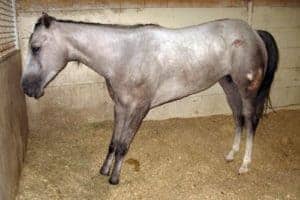
When viewed from behind, most horses should have a convex contour to their back, almost like a rainbow, Brown says. “It should be nice and round,” she explains. “When horses have topline atrophy, the top of their back looks more like a triangle, so you will start to see a really prominent profile to the very center of their back, where the spinous processes lie.”
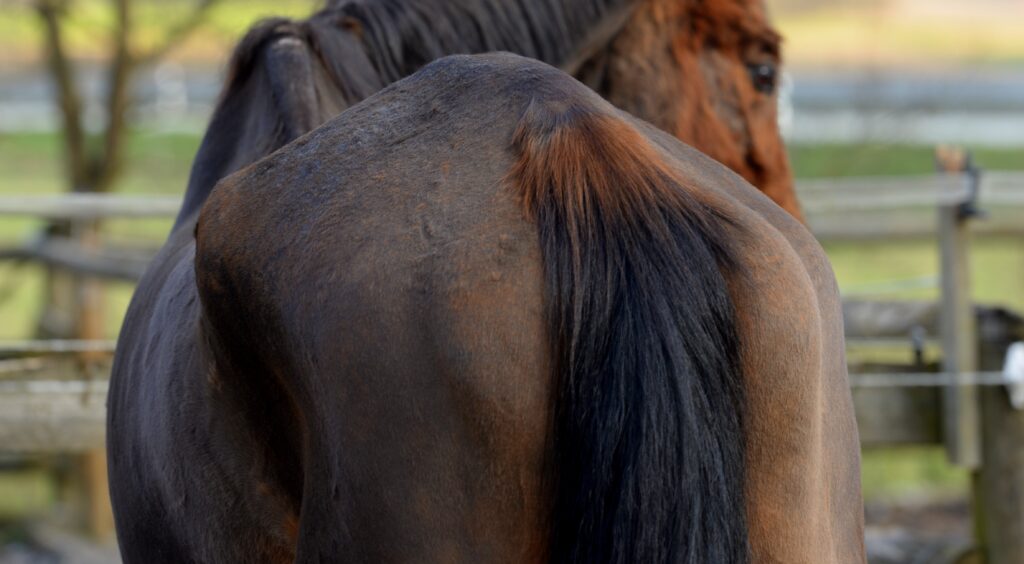
When veterinarians see muscle atrophy along a horse’s topline, back pain often comes to mind first, Brown says. Although disease affecting the back can be a cause, topline loss can also signal an underlying lameness, she adds, which makes determining the cause important.
Atrophy as a result of disuse can take months to become noticeable along the topline. Hind-end lameness can alter the kinetics and biomechanics of the back, Brown says. “Just like people who limp for long periods of time, their back starts hurting or their hip starts hurting—it’s all connected.”
Gluteal muscle loss can also accompany many of the conditions that cause topline atrophy.
“From the side, we really want a nice soft curve to the gluteal muscles between the top of the rump to the top of the tail, and when that starts to look like a straight line, then I start to get nervous that the horse is experiencing some gluteal atrophy,” says Brown.
Other conditions can contribute to topline loss as well. Gastric ulcers and parasite infection can potentially lead to loss of muscle mass along the back, says Jacquelyn Dietrich, BVSc, CVA, CVMMP, CERPV, of Legacy Equine Sports Medicine Inc., in the Bay Area of California. She added that other health conditions, such as pituitary pars intermedia dysfunction (PPID, formerly called equine Cushing’s disease), can affect the topline muscles and result in lordosis, or increased curvature of the back.
Consider Saddle Fit
Saddle fit can also play a role in a horse’s back health. A poorly fitting saddle can cause back pain, so Brown recommends having a saddle fitter evaluate and adjust the saddle at least once a year. However, she sometimes sees the reverse situation in her patients.
“Horses can have a disease process that results in loss of topline, which makes the saddle fit abnormally,” says Brown. “In these cases, it’s important to ensure that the horse doesn’t have an underlying source of topline atrophy that is actually resulting in a previously well-fitting saddle now fitting poorly.”
In addition to musculoskeletal disease, neurologic diseases such as equine protozoal myeloencephalitis (EPM) and equine degenerative myeloencephalopathy (EDM) and muscular disorders such as vitamin E responsive myopathy (VEM), myofibrillar myopathy (MFM), and polysaccharide storage myopathy (PSSM) can cause muscle atrophy, weakness, and irregular movement, leading to topline loss.
If a horse has a neurologic condition, muscle atrophy can develop more quickly than when it occurs secondary to skeletal problems, Brown says. This can happen even when the horse follows a normal, well-designed exercise routine. Because these diseases involve different treatments, veterinarians should identify and treat the underlying condition before addressing rebuilding the topline.
Equine Nutrition and Topline Health
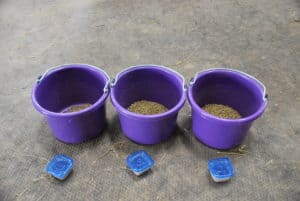
Good nutrition supports muscle development and maintenance, so consult your veterinarian or an equine nutritionist to determine whether your horse’s diet meets his individual needs.
Providing high-quality forage and feed (and supplements when appropriate) can help maintain topline muscle even as horses age and their backs begin to weaken. Brown emphasizes the importance of creating a diet that supports your horse’s workload and provides the calories and nutrients he needs to maintain an appropriate body condition.
Veterinarians might consider a horse’s vitamin E levels when evaluating a horse with poor topline development or muscle loss. The nutrient plays important roles in muscle, nerve, and immune health.
Horses that don’t have access to pasture or have spent an extended period eating only hay might need vitamin E supplementation.
Your veterinarian will test your horse’s blood vitamin E concentration to help determine whether supplementation is necessary and, if so, how much to provide. Too much vitamin E can interfere with the absorption and balance of other nutrients.
Dietrich says she has found added vitamin E works well to support muscle recovery and strength building if the horse tests low for it. She also uses other supplements to encourage a strong topline. “I’m a big fan of protein supplements,” she says. “Horses that are building or maintaining muscle and strength can benefit from a quality protein source, as well as vitamin E when necessary.”
Exercises to Build Your Horse’s Topline Muscle
Once your veterinarian has identified and addressed the underlying cause of topline loss, appropriate exercise can help a horse rebuild muscle. Dietrich uses several exercises to rehabilitate horses that need to develop strength.
Daily dynamic mobilization exercises, including carrot stretches, sternal lifts, and pelvic tucks, can benefit horses whether they are ridden or not. Resistance bands can help horses with proprioception (awareness of their body position and movement), while pole work engages the core and topline. Always work with your veterinarian to develop an exercise routine that’s appropriate for your horse.
“Even when you’re rehabilitating a horse that requires restricted movement due to an injury, being diligent about therapeutic stretches and mobility exercises can keep their core muscles activated during times of decreased exercise,” Dietrich says. “If you have a horse that is limited due to a specific injury, there are always things that you can do in their stall or cross ties. Even having them walk over different types of surfaces can help proprioception, which aids in preventing atrophy of muscles that support the axial skeleton.”
Rebuilding lost topline muscle takes time, Brown adds. “It takes a lot longer to build lost muscle than it does to take it away,” she says. “I would encourage people who find the source of the disease and then treat it not to be too discouraged if it takes some time to build that muscle back. That is just the nature of muscle.”
Take-Home Message
If your horse is losing topline, work with your veterinarian to identify the underlying cause and develop an appropriate treatment plan. Appropriate nutrition and exercise can then help support his recovery.