Article

Subcategories:
None

Two Horses Die at Newbury Racecourse; Electrocution Suspected

Two horses collapsed and died in the paddock on Feb. 12 at the Newbury Racecourse in Berkshire, England, according to a report from BloodHorse.com. An investigation into the cause of the horses’ deaths is under way, but initial reports indicate that the horses might have been electrocuted.

Read More

Providing Nutritional Support for the Equine Skeletal System

Throughout a horse’s life, bone adapts and changes continually in relationship to its environment. Osteochondrosis (OCD) is the failure of the bone to develop strong cross-linkage of collagen fibers (which affects the cartilage) and is most commonly caused by poor nutrition, mechanical trauma, and rapid growth, with nutrition being the most important. Lesions caused by OCD can result in serious

Read More

West Virginia Man Faces Cruelty Charges

A West Virginia man is facing multiple animal cruelty charges in connection with the alleged maltreatment of horses on his Greenbrier County farm. Greenbrier County Sheriff’s Department Chief Deputy Kirby Hanson said that last week after responding to a tip about a downed horse, law enforcement officers discovered more than 30 horse carcasses on a 300-acre farm belonging to Grady Whitlock.

Read More

Alltech’s Annual Symposium Changes the Game in 2011

Whether in sports competition or the game of life, there are turning points that elevate the underdog to victory, redefining the anonymous as the unforgettable. In the face of mounting challenges, how does one identify and seize these pivotal moments to create a catalyst for success? In Lexington, Ky., from May 22-25, Alltech’s 27th Annual International Animal Health and Nutrition Symposium will

Read More

New Surgical Tool for Treating Epiglottic Entrapments in Standing Horses

An epiglottic entrapment is an upper airway abnormality that can cause poor performance in athletic horses. A team of researchers from the University of Montreal recently developed a safer instrument for surgically correcting an entrapped epiglottis. When a horse swallows food or water, the epiglottis (a movable, leaf-shaped piece of cartilage located at the base of the tongue and above the

Read More

Sheryl King to Head Horsemen’s Council of Illinois

Sheryl S. King, PhD, PAS, director of Southern Illinois University’s (SIU) Equine Science Program, has been elected president of the Horsemen’s Council of Illinois (HCI), the voice of the equine industry in Illinois. King began her position as the equine specialist in the department of animal science at SIU in 1983 and presently serves a director of its equine science program, the only such

Read More

Hoof Cracks, Wounds, and More Discussed at Farrier Session (AAEP 2010)

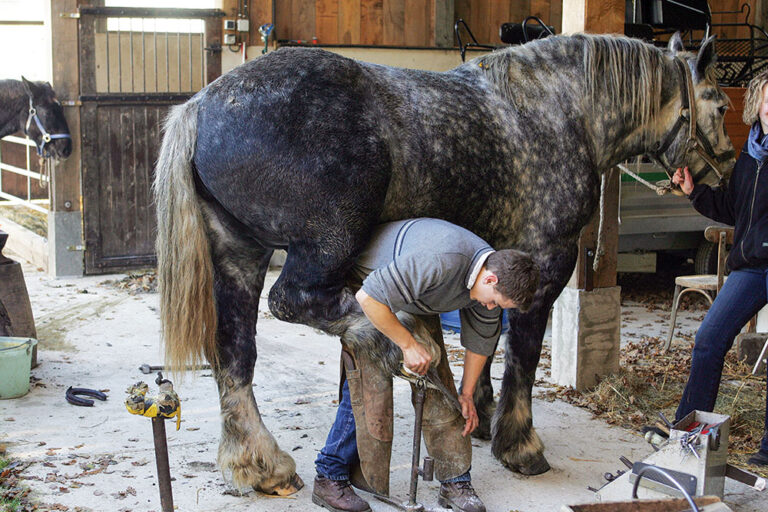
“No foot, no horse” is perhaps the most used and still the most true statement there is in horse care. A horse is generally worthless without functional feet, which is why the American Association of Equine Practitioners devoted a complete day during the 2010 convention (held Dec. 4-8 in Baltimore, Md.) to farriery topics and the working relationship between veterinarians and farriers.

Read More

Compounded Pergolide Comparisons (AAEP 2010)

Systemic effects of equine Cushing’s disease, a common malady in older horses, have been controlled well in many horses with daily administration of pergolide. Until 2007 this medication was available for off-label use–the human product was available for purchase. Then, the FDA-approved product was removed from the human pharmaceutical market. The product had to be compounded in order to be

Read More

Equine Guelph Seeks Respondents for 2011 Equine Industry Survey

Equine Guelph is seeking respondents for its 2011 Equine Industry Survey now through March 31. The survey is available online and in a printable PDF. Founded in 2003, Equine Guelph is operated in conjunction with the University of Guelph. According to their website, “Equine Guelph focuses on five interrelated areas: research, education and training, performance, healthcare and

Read More

Infectious Respiratory Disease: PCR Testing Suggested (AAEP 2010)

Polymerase chain reaction (PCR) is a fast, accurate, quick, and easy testing method to diagnose pathogens associated with equine upper respiratory tract infections, and researchers on a recent study recommended that veterinarians pursue PCR in cases of infectious upper respiratory disease. Not only does it allow the veterinarian to pinpoint the causative pathogen, it also can help control the

Read More

Catnip Oil Tested as Stable Fly Repellent

Anyone who’s ever set foot on a farm has most likely encountered the plaguelike presence of Stomoxys calcitrans–otherwise known as stable flies. These pests are both an annoyance and a health risk for horses, but the results of a recent study indicate that a common treat for cats might be the answer barn managers are looking for.

Read More

Styrofoam’s Effects on Forefoot Pressure and Load Distribution (AAEP 2010)

Laminitis is a critical cause of lameness in horses: Not only is the exact cause not known in all cases, but considerable controversy persists about how to treat and manage this disease. At the 2010 American Association of Equine Practitioners Convention, held Dec. 4-8 in Baltimore, Md., Jennifer Schleining, DVM, MS, Dipl. ACVS-LA, a clinician in the department of veterinary clinical science at

Read More

Assessing Sperm Morphology in Stallions Table Topic (AAEP 2010)

A Table Topic on stallion sperm morphology at the 2010 American Association of Equine Practitioners Convention, held Dec. 4-8 in Baltimore, Md., revolved around the analysis of different sperm defects on the stallion and what their effects were on the fertility of individual stallions.

Read More

Breeders’ Cup: Drug Tests Done in Life At Ten Probe

On Feb. 9, the Kentucky Horse Racing Commission (KHRC) offered no details about or a timeline for the ongoing investigation into Life At Ten’s performance in the 2010 Breeders’ Cup Ladies’ Classic at Churchill Downs in Louisville, Ky., though there was public acknowledgment of drug testing related to the case.

Read More

More From The Horse

Nose brown horse closeup on a green background
horse nose snout nostril detail close animal equine pont
training issue or lameness; Think With Your Head About Your Riding Helmet
Farrier-Foal-AE

Stay on top of the most recent Horse Health news with

FREE weekly newsletters from TheHorse.com

Weekly Poll

sponsored by:

What’s your biggest challenge when trying to improve barn air quality?
84 votes · 84 answers

Create a free account with TheHorse.com!

The Horse
Privacy Overview

This website uses cookies so that we can provide you with the best user experience possible. Cookie information is stored in your browser and performs functions such as recognising you when you return to our website and helping our team to understand which sections of the website you find most interesting and useful.