Readers Stay in Shape to Ride
More than 680 readers of TheHorse.com responded to a poll asking, “Do you take extra steps to keep in shape for riding your horse?”

More than 680 readers of TheHorse.com responded to a poll asking, “Do you take extra steps to keep in shape for riding your horse?”
After being on the national back burner for the last three years, the illegal immigration issue has resurfaced again in Kentucky in the form of a bill that breezed through the state Senate in early January.Horse industry officials discussed how the bill, which could subject employers to felony prosecution for assisting undocumented immigrants, would affect the local horse industry if approved by
The University of Kentucky’s Veterinary Diagnostic Laboratory (VDL) has noted an increase in the number of abortions reported in Kentucky’s 2011 foal crop, especially those caused by nocardioform placentitis. The VDL, which reported 19 cases from July to Dec. 2010, saw 34 cases of abortion caused by nocardioform placentitis from Jan. 1 to Jan. 24.
These days, as a veterinarian, it is not unusual to walk into a barn and set up more than $100,000 in equipment to do a routine exam. We have digital radiography, computerized radiography, ultrasound, and even lameness locators.
Do you have any advice on the emotional rehabilitation of horses coming to rescues from abusive situations?

No building is completely fireproof, but farm owners and managers can take certain steps to minimize the chances of a fire occurring.
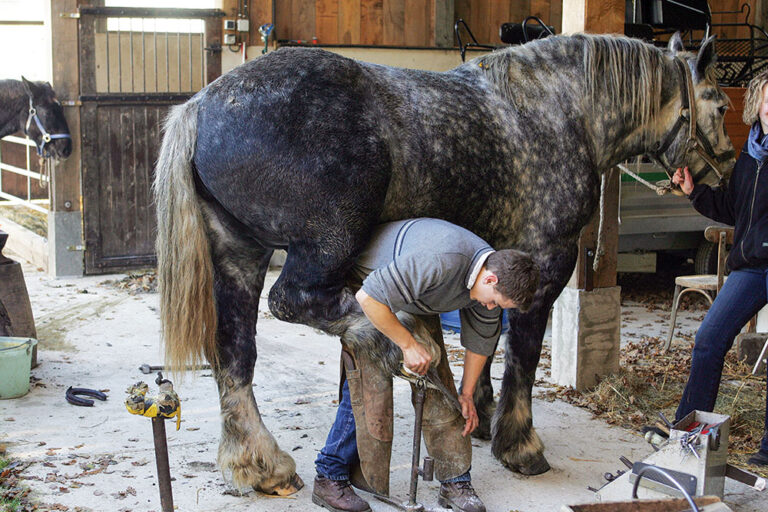
The old adage “No Hoof, No Horse” has never been truer than in this day and age. Balancing your horse’s feet has become more of a factor in promoting good performance and long-term soundness. The optimum balance comes as the horse’s weight is distributed equally over his foot.

Some horses are more predisposed to getting gastric ulcers, due to management, performance, or temperament. With proper medical treatment and removal of predisposing factors, ulcers can be healed, and horses can remain ulcer-free.
Rusty Ford, Equine Programs Manager for the Kentucky Office of the State Veterinarian, was named the 2010 Equine Health Steward by the Kentucky Horse Council (KHC) at an awards banquet on Jan. 14. Ford has been safeguarding the health of Kentucky’s horses for more than 20 years. His contributions to the planning and implementation of the import of foreign horses for the 2010 Alltech FEI World
I own a 28-year-old thin mare that I have been treating for folliculitis (inflammation of the hair follicles) with Betadine surgical scrub baths, and she has many bald spots on her rump. What can I use to help grow the hair back quickly?
A Table Topic at the 2010 American Association of Equine Practitioners Annual Meeting, held Dec. 4-8 in Baltimore, Md., addressed medical pain management. Attendees agreed that the mainstay of pain management in the horse remains the use of non-steroidal anti-inflammatory drugs such as phenylbutazone, flunixen meglumine, and a newer entry, firocoxib. Participants reported relatively few instances
Horse feed manufacturer Manna Pro Products LLC has voluntarily recalled one of its horse feed products distributed in California, Nevada, and Oregon because it might contain potentially harmful levels of monensin sodium (trade name Rumensin). According to the U.S. Food and Drug Administration, monensin sodium is a medication approved for use in some livestock and poultry species, but can be
A Montana man accused to maltreating a herd of horses has pleaded not guilty to the charges against him. The herd of 450 horses, owned by James H. Leachman, was residing on 9,400 acres of deeded land and 30,000 acres of leased Crow Tribal land southeast of Billings, Mont., with scant forage and no water source.
Jill Johnson, DVM, MS, Dipl. ACVIM, ABVP, a long-time professor of veterinary medicine, retired from Louisiana State University (LSU) on Jan, 2. She joined the faculty on April 1, 1977, and played a role in training every LSU School of Veterinary Medicine (SVM) graduate since the first class graduated in May 1977.
While a mare with twins by her side is rare and sometimes celebrated, twinning in horses is actually dangerous for the mare, especially during delivery. More often than not, one of the twins, generally the smaller and weaker of the two, will die before birth. In fact, the chances of a mare carrying twins to term and delivering them successfully are about one in 10,000. The manual reduction of one
The Equitarian Initiative Table Topic session at the 2010 American Association of Equine Practitioners (AAEP) Annual Meeting, held Dec. 4-8 in Baltimore, Md., was characterized by great enthusiasm and a spirit of collaboration among the participants and like-minded organizations. Jay Merriam, DVM, of the Massachusetts Equine Clinic in Uxbridge, started off the session with a summary of the Vera