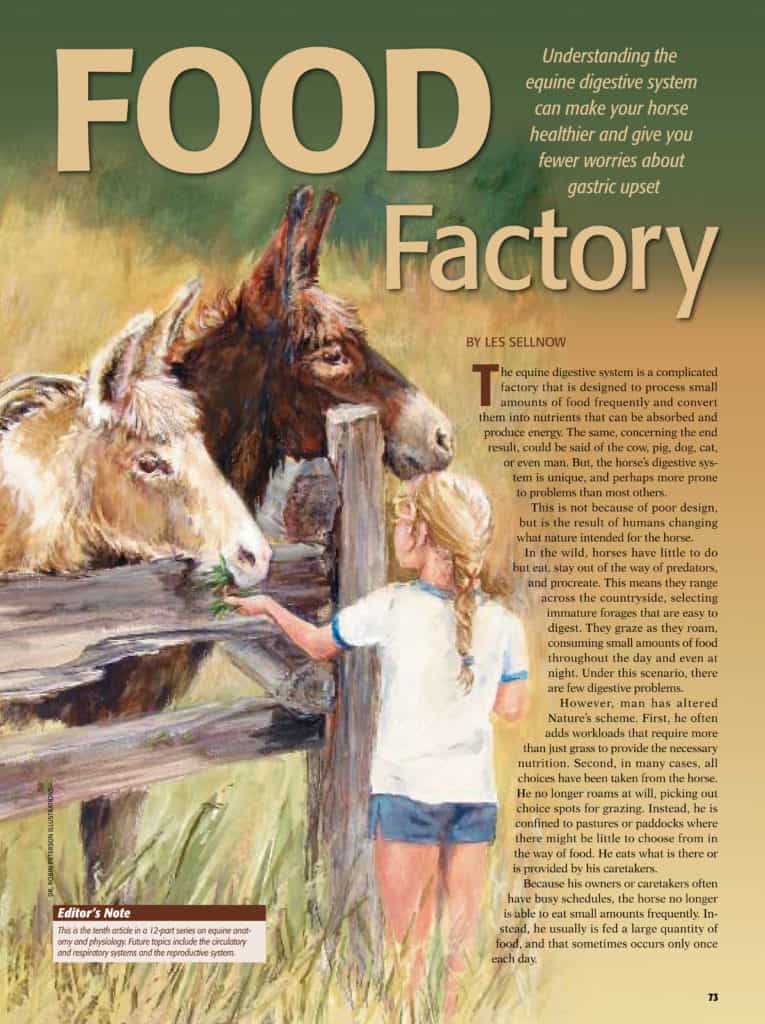
The Equine Digestive System: Food Factory

Understanding the equine digestive system can make your horse healthier and give you fewer worries about gastric upset. In this article, we’ll take a look at just how this “factory” is designed and how it functions.

Read More

Clearing Sand From the Gut

Sand colic due to an accumulation of sand in the intestines accounts for up to 30% of all colics, often causing weight loss and chronic diarrhea. Psyllium has often been recommended as a laxative for clearing sand out of the intestines, although

Read More

Alfalfa Hay Reduces Ulcer Severity

If your horse has ulcers, giving him omeprazole isn’t the only thing you can do to help reduce the severity of the problem. Noah Cohen, VMD, PhD, MPH, Dipl. ACVIM, discussed a study that found alfalfa hay reduced the severity of ulcers in young,

Read More

Giving Omeprazole for Ulcers Intravenously

In the past few years, we’ve been hearing how many more horses have gastric ulcers than we used to think. We also know that oral omeprazole paste (GastroGard, manufactured by Merial Limited, Decatur, Ga.) effectively treats and prevents ulcers.

Read More

Stapling the Gut

These days, in many species incisions are often closed with staples rather than stitches–and they’re not just for external use any more. At the 2007 American Association of Equine Practitioners Convention, held Dec. 1-5 in Orlando, Fla.,

Read More

Reducing Hindgut Acidosis

Acidosis (abnormally high acidity) in the hindgut (the large intestine and colon) can cause a number of problems in horses, including anorexia, colic, laminitis, and stereotypic (continuous, repetitive, and serving no purpose) behaviors such as

Read More

Scoping Events Show Prevalence of Equine Gastric Ulcers

Equine gastric ulcer syndrome (EGUS) can occur in horses anywhere. In 2007, Merial (the maker of Ulcergard and Gastrogard) illustrated the prevalence of EGUS by hosting gastroscopy events at two universities on opposite sides of the country.

Read More

Correcting Large Colon Displacement

Left dorsal displacement of the large colon isn’t the most common cause of colic–only about 6-8% of colics are caused by this. However, up to 21% of affected horses tend to displace again, even after surgical correction. These horses often have

Read More

Derby Champ Winning Colors Euthanized

Champion Winning Colors, winner of the 1988 Kentucky Derby, was euthanized Feb. 17 following complications from colic at Hagyard Davidson McGee vet clinic near Lexington. The 23-year-old Caro mare was buried at Greentree Farm, a division of

Read More

Hitting the Road for Education

Take more than 1,000 veterinarians and veterinary students from around the globe, some armed with presentations representing thousands of hours worth of equine research, and add to it some tartan, bagpipes, and Scottish fare. Drop it all into a

Read More

Alfalfa Might Buffer Gastric Acid Production, Prevent Ulcers

Feeding grain, confinement, exercise, and overall environmental stress factors are thought to cause ulcers, he said. It’s commonly thought that horses turned out on pastures are better off than those that are confined. However, if grass hay is the on

Read More

2007 Morris Animal Foundation Equine Research Wrap-Up

The results of equine research funded by the Morris Animal Foundation (MAF) in 2007 added to scientists’ understanding of foal pneumonia, hereditary muscle disorders, laminitis, and pharmacology.

Read More

More From The Horse

spring pasture, turnout tips, horse turn out, horse in pasture, grazing, spring, spring turnout
Horses in their stable
What's New With Weaning?
hives

Stay on top of the most recent Horse Health news with

FREE weekly newsletters from TheHorse.com

Weekly Poll

sponsored by:

How often do you apply fly spray to your horse during peak fly season?
168 votes · 168 answers

Create a free account with TheHorse.com!

The Horse
Privacy Overview

This website uses cookies so that we can provide you with the best user experience possible. Cookie information is stored in your browser and performs functions such as recognising you when you return to our website and helping our team to understand which sections of the website you find most interesting and useful.