Laminitis and Equine Metabolic Syndrome
Learn about equine metabolic syndrome and its relationship to laminitis, recognizing and managing at-risk horses to prevent laminitis, and more with Dr. Raymond Geor of Michigan State University.

Learn about equine metabolic syndrome and its relationship to laminitis, recognizing and managing at-risk horses to prevent laminitis, and more with Dr. Raymond Geor of Michigan State University.
In certain cases of navicular disease, drilling a hole into the navicular bone–a procedure called core decompression that’s commonly used to treat human osteonecrosis (bone death caused by poor blood supply to the area)–might provide a new
Recent surveys of equine veterinarians reveal that laminitis is the No. 1 lameness concern of equine practitioners, due how difficult it is to treat and manage this debilitating condition. On the topic of laminitis control, Heidi Reesink, VMD, a
Lameness caused by quarter cracks is a nemesis of horses and owners, and treatment is often complex.
The National Thoroughbred Racing Association’s (NTRA) subsidiary, NTRA Charities, has announced that the Barbaro Fund for Equine Health and Safety Research has disbursed $49,000 to support the second year of a research project on laminitis. The funds
When it comes to penetrating hoof injuries, early, aggressive treatment is key to a favorable outcome.
The equine genetics research group at the University of Minnesota College of Veterinary Medicine is collaborating with Dr. Ray Geor, professor and chair of the department of large animal clinical sciences at Michigan State University, and Dr. Nicholas Frank, associate professor of large animal clinical sciences at the University of Tennessee, to investigate the occurrence and genetics of equine metabolic syndrome (EMS).

Teams of veterinarians and farriers from around the country gathered at the fifth International Conference on Laminitis and Diseases of the Foot in Monterey, Calif., Sept. 17-18, 2010, to discuss the most cutting-edge information available for the fight to conquer laminitis.

Practical explanation of laminitis, diagnostic imaging, interpretation, and treatment principles.
Autumn is just around the corner and, for many areas of the country, that means the onset of wet weather, a reduction in riding, and more stall time for horses. All of which could mean an uptick in the risk of your horse developing thrush–that gunky, smelly, black discharge oozing from the bottom of his hoof.
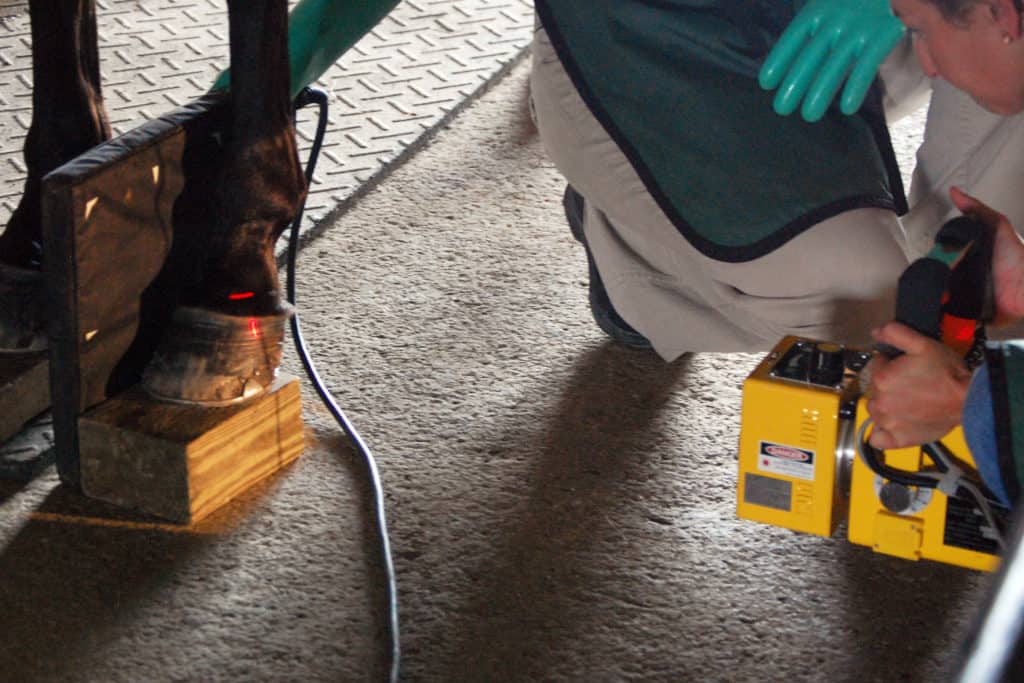
Dr. Vernon Dryden of Rood & Riddle Equine Hospital demonstrates navicular syndrome diagnosis in a 16-year-old Quarter Horse.

Dr. Vernon Dryden of Rood and Riddle Equine Hospital discusses what navicular syndrome is, diagnosis, and treatment options.

Due to their inquisitive nature, a well-developed flight response, and that they are commonly confined in areas with potential obstacles such as metal or wire, horses tend to be accident prone, making wounds a fairly common occurrence.
Nearly 50 researchers and laminitis experts from around the world met to prioritize future laminitis research needs during the the 2nd AAEP Foundation Equine Laminitis Research Workshop. The group also explored specific questions about the dire
Fifteen new research projects to benefit the horse will be launched this year through funding from the Grayson-Jockey Club Research Foundation.
Adjusting a laminitic horse’s weight bearing plays a crucial role in the animal’s recovery, explained Debra Ruffin Taylor, DVM, MS, Dipl. ACVIM, of Auburn University, at the 2010 Western Veterinary Conference, held Feb. 14-18 in Las Veg