MRI in Equine Practice: Great Information and Growing Pains
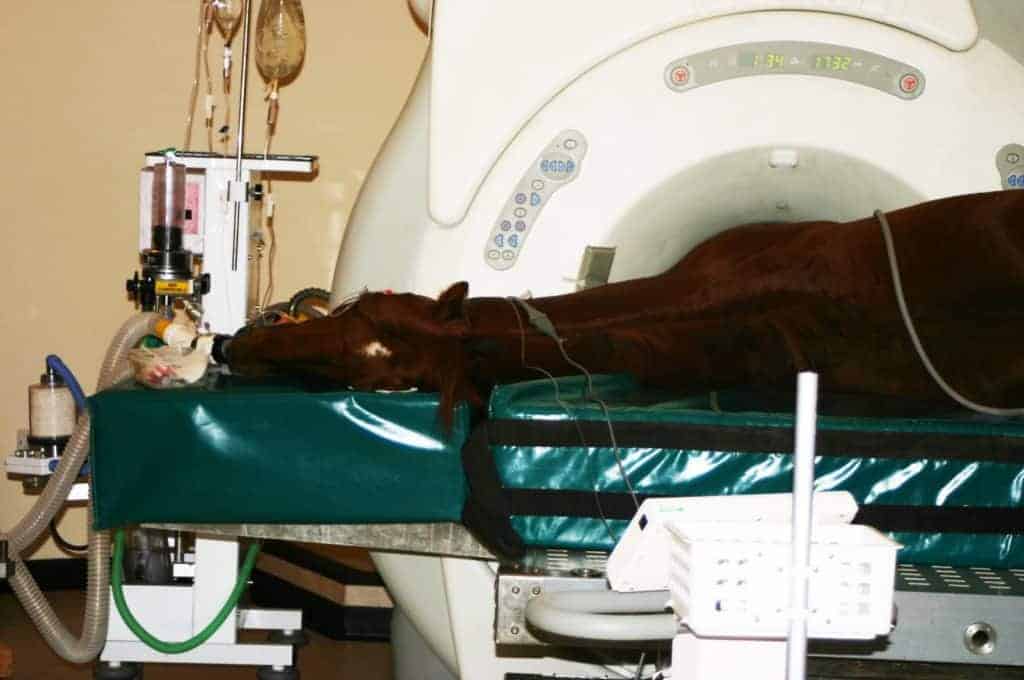
MRI has become one of the most popular go-to tools for diagnosing the causes of lameness in horses.

MRI has become one of the most popular go-to tools for diagnosing the causes of lameness in horses.
In the early days of the large animal veterinarian, all medical supplies had to either fit into the back of a small car or a satchel. A bucket of cold water, a rough piece of burlap, and a hard bar of soap were the only things available for washing
Before you invest in a therapeutic modality, look not just for testimonials and anecdotal reports, but for hard scientific proof and comparable applications in human medicine. Before using any type of modality on your horse, be sure to discuss
If you have been at the All American Quarter Horse Congress in Columbus, Ohio, this week, you’ve seen them there. If not, you’ll have about 30 more chances to meet the Equine Sports Medicine veterinary team members within the next year.
Vet-Stem, Inc., has announced that a license agreement with the University of California has been completed which secures Vet-Stem’s exclusive rights to stem cells derived from fat for veterinary use.
The veterinary rights for stem cells
The Food and Drug Administration (FDA) has issued a final guidance on quality systems, a set of formalized practices and procedures to ensure quality of human and veterinary drugs and human biological drug products during manufacturing. This
The Animal Health Trust in Newmarket, England, has announced that it will be acquiring a standing magnetic resonance imaging (MRI) unit to expand its equine diagnostic capabilities.
“In 2000, a high-field MRI scanner was installed at th
Veterinarians could use a non-invasive procedure to detect fluid shifts in dehydrated horses and respond with treatment more readily than with usual methods such as blood work.
Endotoxemia occurs when toxins from the wall of Gram-negative bacteria crosses the intestinal wall and gains access to the bloodstream. Endotoxin becomes concentrated on the surface of white blood cells, causing them to secrete inflammatory agents.
There are many reasons why wounds fail to heal. Some wounds, especially chronic ones, are hypoxic, meaning they lack oxygen. Therefore, hyperbaric oxygen therapy (HBOT) can be used to re-oxygenate wounds and help them heal.
Morris Animal Foundation (MAF) and the University of Minnesota’s College of Veterinary Medicine (UM) jointly announced on Aug. 9 that the foundation has committed to raise $2.5 million over five years to fund the top-ranked consortium project
Cerebrospinal fluid (CSF) testing for equine protozoal myeloencephalitis (EPM) has been widely regarded as the only definitive way to diagnose the disease. This test can be difficult, expensive, and potentially dangerous, and according to new
Researchers at Purdue University have developed a new low-cost system that analyzes scattered laser light to quickly identify bacteria for applications in medicine, food processing and homeland security at one-tenth the cost of conventional
Scientists at the University of Georgia’s College of Veterinary Medicine are studying a new diagnostic test that will detect a common disease of the musculoskeletal system of the horse before he exhibits lameness or other performance problems.
How to increase funding for equine research was the primary focus of a collaborative equine research summit held in
The unique properties of field strength, size and configuration of the magnet, allow the ability to image the limbs, head, and neck of full size horses and whole body of animals less than 500 pounds.