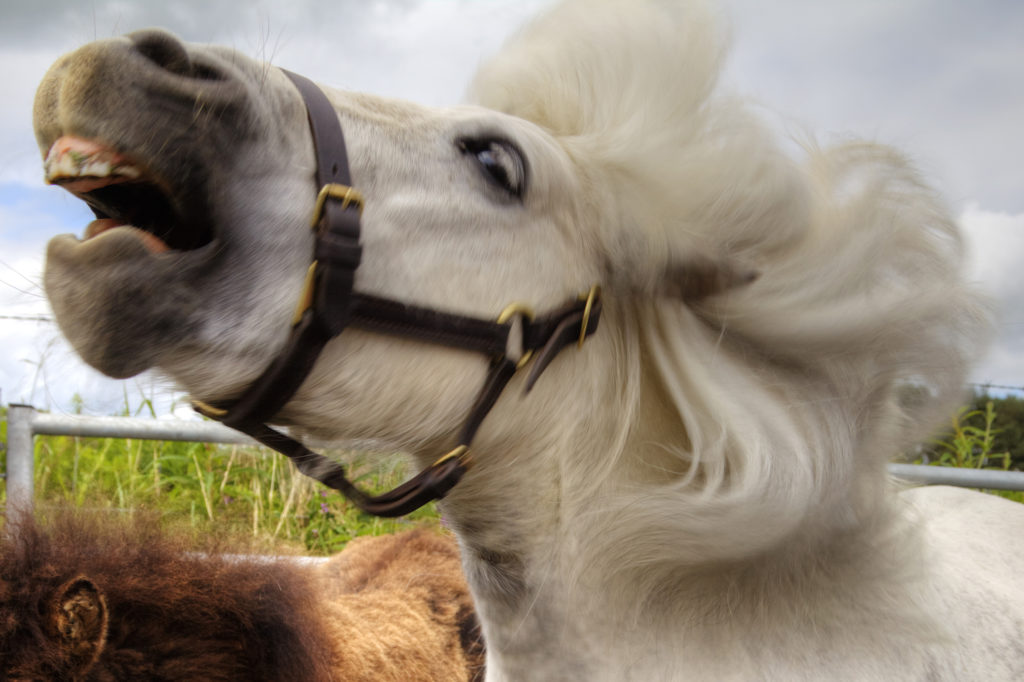
Headshaking in Horses: A Sensitive Matter
There’s a nerve-tingling explanation behind many equine headshaking cases. Here’s what you need to know.

There’s a nerve-tingling explanation behind many equine headshaking cases. Here’s what you need to know.

Researchers found that high-field MRI provided highly detailed and anatomically accurate images of equine stifle soft tissues.

MRI revolutionized the way veterinarians diagnose problems with the equine podotrochlear apparatus. Dr. Kyla Ortved explains its importance and when it’s worth the expense.

MRI is allowing vets to identify lameness conditions that were harder to evaluate in the past. One such ailment, most frequently found in sport horses, is osseous trauma of the long pastern bone’s sagittal groove. Here’s what they’ve learned so far about this condition.

Neck pain in horses remains challenging for veterinarians to diagnose and treat, but new options are on the horizon, one practitioner says.

In the first of this two-part series, we’ll explore full-body rehabilitation options, from the horse’s head to tail.

Are breathing issues slowing your horse down? Here are some surgical and management options that might help.

Tendons and ligaments are meant stretch and flex. So it must be bad news when hard material forms within them, right? Not necessarily, researchers say.

Regenerative therapies can help horses recover following injury. Download this free fact sheet to learn more about stem cell, IRAP, and PRP therapy use in horses.

Read some of the top tweets and take-homes on topics such as lameness, equine obesity, laminitis, and more from the 2018 British Equine Veterinary Association Congress.

Find out how equine researchers are using the latest gadgets and gizmos to diagnose lameness, collect data, and more.

Recent research suggests that bone scans in horses aren’t always accurate in diagnosing causes of lameness and poor performance in sport horses when used alone.

Results from a study on a small population of horses suggest that freezing samples for short periods before testing won’t impact the results.

Scintigraphy gives provides the practitioner with information about some injuries related to bone or soft-tissue connections to bone, but it might not reveal many other sources of foot pain, researchers found.

Horse are especially sensitive to endotoxemia. To address the issue, Dr. Stacy Anderson of Lincoln Memorial University, in Harrogate, Tennessee, presents her research on neutrophil apoptosis (the death of cells that occurs as a normal and controlled part of an organism’s growth or development) in horses.

If a horse tests positive for Lyme disease antibodies, does that mean the horse has the disease? Dr. Eric Swinebroad responds.






