Climate, soil, and smart grazing choices all help with greener pastures and healthier horses
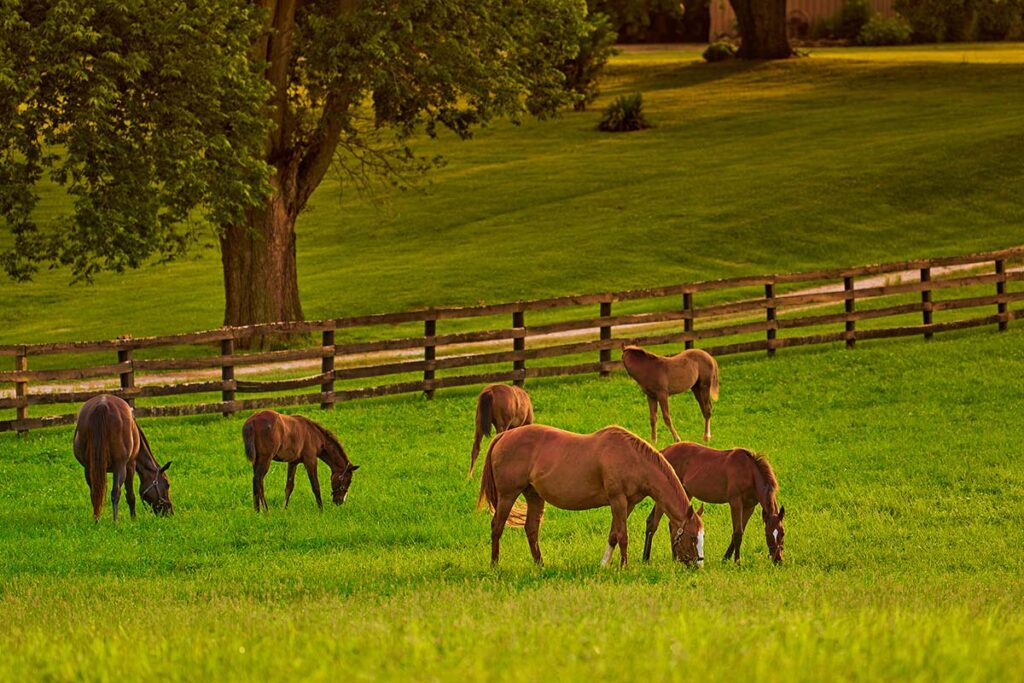
The quality of pasture forage significantly impacts the health of your horse. Bob Coleman, PhD, PAS, an associate professor and horse extension specialist in the University of Kentucky’s Department of Animal & Food Sciences, in Lexington, says, “Everyone would like that nice, lush green pasture, but we ultimately want our pasture to have a good stand of forage, minimum areas of bare ground, and few weeds or plants that we don’t want our horses to consume.” The nutrient concentration and digestibility of pasture forage relates to horses’ voluntary forage intake, and it needs to be palatable. “If they won’t eat it, then the nutrient level within the plant becomes a moot point,” says Coleman.
With that in mind, consider the following factors when thinking about your horse’s pasture forage quality.
Plant Species Adaptation to Climate Conditions
Pasture forage quality depends mainly on the plant species and variety you choose, with selection based on what grows best in your region. Forage-Livestock Systems Program assistant professor and extension specialist Liliane Silva, PhD, of Clemson University’s Department of Animal and Veterinary Sciences, in South Carolina, says forage species and varieties adapt to different climates. Grazing and forage land in the United States can be roughly grouped into three segments based on climate conditions: temperate region (cool-season), transitional zone, and southeastern (tropical) region.
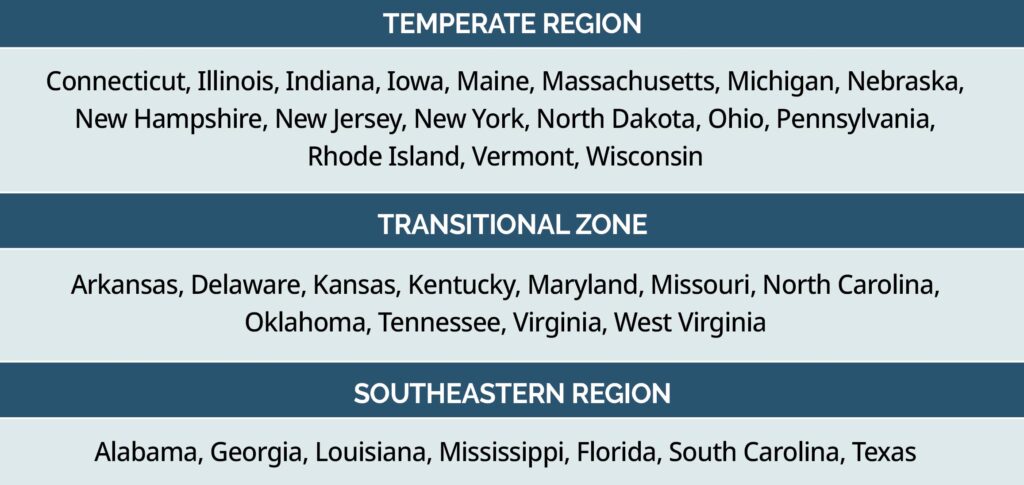
Coleman stresses that too many times we read or hear about a great pasture mix but forget to take note if it suits our area. Silva offers some examples of pasture grasses and legumes (think alfalfa or clover, which are members of the same family as soybeans, chickpeas, lentils, and peanuts) best suited for each region or zone. The cool-season temperate forage region occupies much of the northeastern U.S., the Midwest, Great Lakes states, and parts of the northern Great Plains. Cool-season perennial forages such as orchardgrass, smooth bromegrass, endophyte-free ryegrass, Kentucky bluegrass, tall fescue, common white clover, Ladino white clover, red clover, and alfalfa are best adapted to this region. Planting warm-season grasses here would not make sense, Silva says, as the climate is not warm enough for those plants to flourish.
As you move south, the vegetation changes to include more warm-season species; agronomists refer to this area as the transitional zone, which includes what Silva terms the tall fescue belt. Other forages such as Kentucky bluegrass, orchardgrass, annual and perennial endophyte-free ryegrass, and red and white clover all are well suited for this zone.
The southeastern region (including Hawaii and Puerto Rico) relies heavily on warm-season grasses such as Bahia grass and Bermuda grass, the warm-season annual legume lespedeza, and the cool-season annual grasses and legumes. In the southeastern region “we can grow warm- and cool-season forages, which allow us to almost have a year-round forage system,” says Silva.
Pasture Plant Growth, Time of Year
In addition to understanding the relationship between the pasture plant and climate, you also need to note the length of the growing season for that plant species. “The forage in the pasture is a crop,” says Coleman. You want to provide grazing for your horses as much of the year as possible.
Cool-season grasses produce most of their growth when you’d expect—during the cooler periods of the year (March to June and September to November). In the summer cool-season grasses either become dormant or die. Likewise, warm-season grasses mostly grow during warmer periods of the year (June to October). These plants become dormant or die when the fall frost begins.
Forage legumes have the longest growing season, growing throughout the cool and warm seasons. “Take note of what is happening in your area with temperatures and rainfall,” says Coleman. “When you get into that hotter, drier season, you may encounter some summer slump where cool-season grass does not grow.”
In a transitional zone or the southeastern region, pasture plant forage often dips in late fall and early winter, when warm-season forages have gone dormant or died and cool-season ones haven’t yet fully established. Planting annual forage species (i.e., annual ryegrass) in your pasture can fill that gap and extend your grazing season for the year, he says.
Horse Pasture Plant Mixtures and Soil Drainage
“Our understanding of the varieties of pasture forage and how they adapt to different soil conditions can assist us in determining which pasture plants combine well with others,” says Silva. Knowing whether your soil type is predominately sand, clay, silt, or loam helps you ensure you have the correct forage species for your pastures. Sandy soil is basically inert and drains freely (it is highly prone to drying up) with little nutrient-holding capability. Clay soils have the potential to retain high levels of nutrients but can become waterlogged in the winter or dry up and turn to dust in the summer. Maintaining an air/water balance in this type of soil often proves difficult. Silt soil particles tend to run together and, thus, choke out the air and soil bacteria needed for forage productivity. Loams—a mixture of sand, clay, and silt—avoid the extremes of each, making them much easier to manage and maintain.
Landscape position and soil texture primarily determine how well soil drains. Determining the soil type and soil drainage characteristics will help you select the appropriate pasture forage plant mixtures. For example, Bahia grass, ryegrass, and white clover adapt to a wide range of soil drainage types and tolerate wetter areas. These plants would grow well together. However, Bermuda grass does not tolerate poorly drained soils and involves more management and fertilization than Bahia grass.
Alfalfa combines well with Bermuda grass because both species have similar soil drainage and fertilization requirements. Other examples of pasture plants that grow well together include orchardgrass and lespedeza; bluegrass and white clover; bromegrass mixes and all pasture legumes; and tall fescue and clover. “We cannot change what is given in our soils, but we need to know what the proportions are in order to manage our horse pasture forages effectively,” says Silva. The information on local soil type and drainage should be available from your county soil survey, or you can have the soil in your pastures tested.
Pasture Plant Tolerance to Close and Heavy Grazing
“There are grasses and some legumes that make great pasture species and are adapted to a particular area,” says Coleman. “But remember horses can graze close to the ground and can be hard on plants; therefore, owners must select those pasture plants that can handle grazing.” In the chart below are some pasture plants and how well they tolerate—or don’t tolerate—heavy grazing.
| PASTURE PLANT | HEAVY-GRAZING TOLERANT | NOT HEAVY-GRAZING TOLERANT |
|---|---|---|
| Alfalfa | X | |
| White clover | X | |
| Orchardgrass | X | |
| Kentucky bluegrass | X | |
| Smooth bromegrass | X | |
| Tall fescue | X | |
| Ryegrass | X | |
| Bahia grass | X | |
| Bermuda grass | X |
Tips on Improving Horse Pasture Forage Quality
Coleman and Silva recommend working with your county extension agent to get information on what grasses grow best locally.
Coleman provides a few tips on keeping your pasture forage at its best:
- Look for pasture forage plants that can handle grazing pressure.
- Soil testing helps identify the fertilizer and lime required to produce high-quality pasture forage. Soil testing every couple of years should be adequate to determine how much phosphorus (P) and potassium (K) the soil needs. Nitrogen (N) needs are not generally part of the soil test but applying 40-60 pounds of N per acre every year can be reasonable, he says. Farm owners often apply nitrogen in the fall for cool-season grasses to give them a good start in the spring. With warm-season grasses experts recommend N in the spring. (Nitrogen is applied as urea, and 100 pounds of urea is equivalent to about 45 pounds of N.) Lime recommendations based on your soil test results show how much limestone to apply to adjust soil pH for optimal forage growth. Again, check with your local extension office for advice.
- Irrigating is a great way to deliver water but, in many cases, is not available. In areas with lower annual rainfall, drought-tolerant species tend to perform better.
- Consider some form of rotational grazing. This can help you manage the lawns and roughs that form based on your horses’ preferred grazing patterns. “They will be selective—after all, they are spot grazers selecting the plants they prefer and the parts of the plants,” says Coleman. If possible, keep horses off pasture during winter, instead using confinement areas and dried forage. Otherwise, they continue to nibble the grass, which isn’t growing, down to the ground. This damages perennial grass plants, which take longer to recover in the spring. In addition, your horses’ hooves slice through the soil in wet conditions, damaging root systems and further slowing spring recovery.
- Mow pastures to even out the grazing area. Do not mow grass shorter than 4 inches. Drag the pasture to scatter the manure piles after mowing, unless you are picking them up. Do this only when it is hot and dry to avoid spreading parasites, and rest pasture for about three weeks to give it time to regrow. That time depends on Mother Nature, adequate rain, and the species of plants. Cool-season grasses and legumes need 3-4 inches of residual leaf area (the amount of green plant left after grazing) for recovery; warm-season grasses need 4-8 inches of residual leaf area for recovery.
- Move your horses off pasture once they graze it down to 4 inches. “You will need to walk the pasture frequently and move the horses based on the forage and not the calendar,” Coleman says. The pasture rest period matters just as much as the time horses graze it.
Silva concurs with Coleman and provides some additional tips:
- Avoid overstocking pastures. Strive for a stocking rate of at least 1.5 to 2 acres per horse. Consider the pasture-carrying capacity (the ability of the pasture to provide nutritional value based on the number of horses grazing). “It is important to maintain a balance between the pasture forage available and horse numbers,” Silva says.
- Make sure no toxic weeds grow there. Assess the stand often for this. The best weed control is a strong, actively growing stand of grasses and legumes that helps keep weed pressure to a minimum.
- Be aware of any pasture plant that could present potential issues for horses grazing it. Select pasture plants adapted not only to the climate, soil, and season but also the class of horses grazing it—think about laminitic horses, for instance, and how pasture sugars affect them.
Take-Home Message
Pasture forage quality plays a big part in horse health and nutrition, so choose plant species that match your region’s climate and soil and the grazing pressure on your farm. Cool- and warm-season grasses, legumes, and annuals each have specific growth patterns and tolerances, impacting forage availability throughout the year. Soil testing, proper grazing management, and selecting the right forage mix can enhance pasture productivity and sustainability. Consult your local extension agent for pasture plans tailored to your area and your horses’ specific needs.